
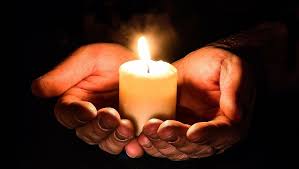
Today
is All Souls Day, the day when the Christian churches remember those who have gone
to their eternal reward. It forms a triumvirate with All Hallows Eve on October
31st and All Saints Day on November 01st and is
celebrated across the world in various ways. It began in 998 AD when a French monk, Odilo, who as
Abbot of Cluny monastery designated a specific day to remember those who had
died and whose souls were still considered to be in purgatory. Having
established itself as a local feast it had gradually spread throughout the western
church by the end of the 10th century and later expanded into those
lands conquered by Europeans who brought the Christian faith with them. You can
find out more about the history and how individual countries celebrate by
reading David Nielsen’s excellent blog here.
What I
found interesting was how in some countries like Mexico it is disrespectful to
mourn the dead hence the colourful celebrations. Many other cultures commemorate
rather than mourn the passing of a loved on as part of their process of life.
Many of the Halloween practices began as Rosemary mentioned in her post on
Monday last with the pagan celts before they became Christianised, and many of
their traditions were incorporated into the Celtic Christian liturgy and
practice. The Celts were people of the land, they lived their lives in rhythm with
nature and with their surroundings, so death was treated as part of the natural
cycle of life. This is something we can still see today whereby some Irish and
Scottish families in particular still indulge in the practice of “waking the
corpse”, not to mourn but to celebrate a life – hopefully – well lived.
What
has this got to do with being a writer you may ask? For me personally I have
written before how my re-discovery of writing poetry and expressing my inner
most thoughts through this genre, came about following the sudden death of my
Father in March 2012. Some three and a half years later I also wrote a poem
called “First Christmas” coinciding as it did with our first yuletide without
my mother who passed away in the September but also celebrating the first
Christmas of my youngest Grandson, born in April 2015 and who Mum was photographed
holding before her final stay in hospital where she died.
We know
too that the literary world is full of people, including already established
writers, who used the death of someone close as the inspiration for putting pen
to paper figuratively speaking. Memoirs and biographies of those in the public
eye seem mostly to focus on the living but it is only after their passing that
we often get the true measure of someone’s life and sometimes more than once,
witness how many books have been written about Churchill for instance. I wonder
how many books and articles will be written about our late Queen in the years
ahead compared to how many were written during her lifetime.
Death
has a funny habit of bringing out the maudlin in us, we write eulogies for loved
ones but some of us find it hard to mention the funnier moments in someone’s
life without breaking down. When I wrote my parents eulogies, my biggest
problem was what to leave out such was the wealth of anecdotes in my possession,
and whether they were fit and proper for a Roman Catholic funeral mass. When we
write about someone’s life we naturally gravitate to the past tense because
that is where we are, in the present reflecting on the past, even though we may
feel that they are present with us even years later. In recent months I have
read two books by former rugby players (Doddy Weir and Rob Burrow) both now living
with Motor Neurone Disease, an illness which is nearly always fatal. As you
would expect, they both had their fair share of scrapes and japes especially when
touring, but in amongst the humour there is a tremendous warmth about the
friendships made on and off the field and the importance of family both rugby
and non-rugby. Both men know they are on borrowed time yet have used the time they
have left to ensure that they not only raise money for research into an effective
treatment or cure, but to raise awareness. This will be their legacy long after
their on-field exploits have been relegated to occasional VT re-runs on sports programmes.
I’m
sure many of you can provide your own examples, some of them very personal. It
matters not; for today we remember those who have died and gone to their
eternal rest. Some of us may attend church services, some may visit the graves
of relatives to lay flowers or maybe like the Mexicans, throw a party.
The
poet Helen Steiner Rice wrote the following and is a fitting epitaph for those
who have gone before us; –
The
life of one we love is never lost. Its influence goes on through all the lives
it ever touched.

