
 |
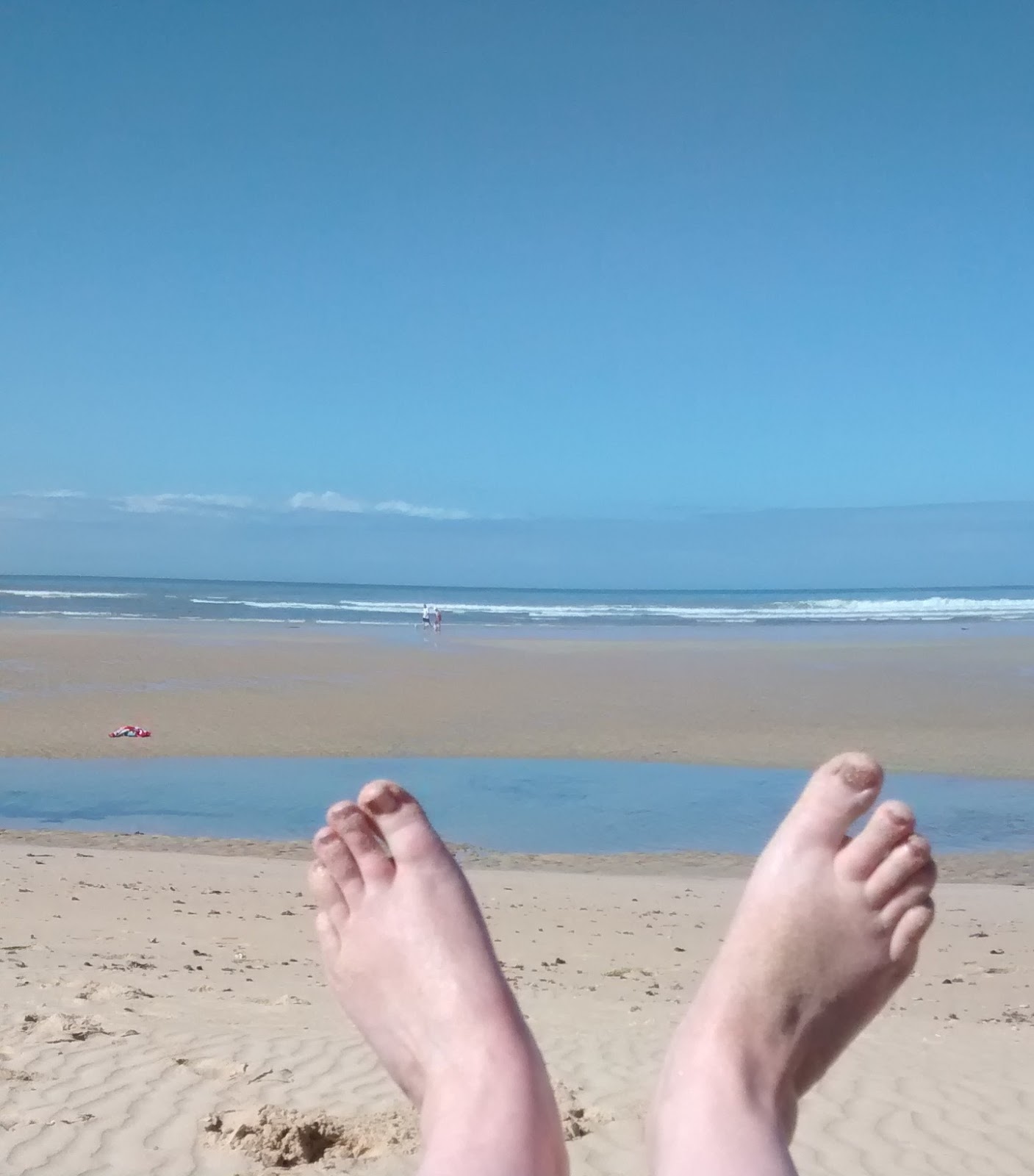
| Fiona’s feet on Cannon Rocks beach, South Africa. |
As you are reading this I am on a beach near my in-laws house
inSouth Africa
During this Easter break, apart from visiting my husband’s family, I will
hopefully be getting some rest and perhaps writing a chapter or two of my new
novel. On a two-week holiday a chapter or two is all I think I can and should
manage. I do not want to spend all my time writing, but when I do it will be a
restful kind of writing; the kind of writing that restores rather than depletes
my energy levels.
in
During this Easter break, apart from visiting my husband’s family, I will
hopefully be getting some rest and perhaps writing a chapter or two of my new
novel. On a two-week holiday a chapter or two is all I think I can and should
manage. I do not want to spend all my time writing, but when I do it will be a
restful kind of writing; the kind of writing that restores rather than depletes
my energy levels.
When you write for a living the very act of writing can
exhaust you. When writing is work, I suppose, it’s almost inevitable. For
people who write for a hobby it usually has the opposite effect – to relax and
invigorate you. So as a professional writer I try to consciously strike a
balance between the two: writing as work and writing as leisure.
exhaust you. When writing is work, I suppose, it’s almost inevitable. For
people who write for a hobby it usually has the opposite effect – to relax and
invigorate you. So as a professional writer I try to consciously strike a
balance between the two: writing as work and writing as leisure.
I do this by structuring ‘down-time’ into my writing day. I
try to get all my admin, social media and marketing work done in the morning,
as well as lecture or workshop prep when I’m running courses. But just before
lunch I stop and take my dogs for a walk. And unless their nemesis – the
neighbour’s cat – is spotted, it is usually a restful time for my body and
mind. When I get back I have lunch while watching the news then settle down to do some creative writing in the afternoon. After the down-time between my morning and afternoon
work, I find my mind is more rested and I’m able to be more creative. I
generally do about two hours writing then have a 20 minute lie-down. If my
daughter has an after-school club and will be home late I then try to put in
another hour’s work before the family get home. That is my ideal daily rhythm.
However, when I’m approaching a deadline I frequently abandon
that rhythm and write and write and write, putting in six – seven hours in a
day, with only a short break to grab a sandwich which I eat as I continue
writing. Six hours does not seem a lot, but when it is hour after hour of
focused thinking, it is exhausting. After a week or two of this, I am near
breakdown – but have a finished manuscript! I then need to take a couple of
weeks off from all writing before I come back to the project and give it a
second read through.
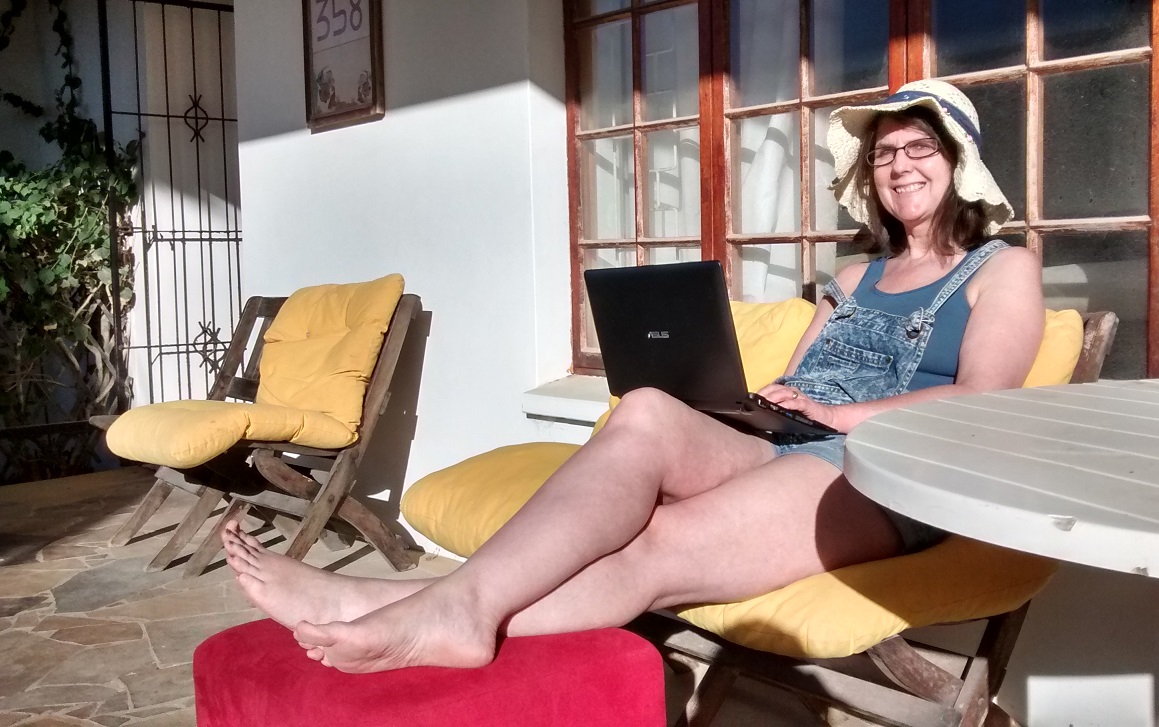 |
| Fiona writing a chapter of Poppy Denby in South Africa. |
Understanding your creative rhythm and how to build down-time
into your schedule is essential for a writer. But we are all different. Some of
you may hold down nine-to-five jobs and write in the evening or on weekends.
Some of you may have physical or mental health limitations. Others have
time-draining family situations. But each of us can and should be able to find
something that rests our mind apart from writing. One of my creative writing
students ensures he does a 10-mile run every day. Ten miles??????? Another
likes to lie down while listening to music. Still another does the dishes (!)
and another, yoga. What all of these have in common is that they are ‘mindless’
activities that allow the part of your brain that is involved in writing to
switch off and rest. If you don’t have this down-time it will eventually work
its way out into your body and your writing. The quality of my writing produced
after down-time is far superior I believe to what I produce during my marathon
sessions.
And of course, as a person of faith, prayer and time set
aside to read the Bible is also essential to my daily rhythm. One might not use
the term ‘mindless’ to describe it, but it is certainly soul enriching.
aside to read the Bible is also essential to my daily rhythm. One might not use
the term ‘mindless’ to describe it, but it is certainly soul enriching.
Do you understand your creative rhythm? What is your down-time?
Fiona Veitch
Smith is a writer and writing tutor, based inNewcastle upon Tyne . She writes across all media, for
children and adults. Her mystery novel The
Jazz Files, the first
in the Poppy Denby Investigates Series (Lion Fiction) was shortlisted for the
CWA Historical Dagger award in 2016. The second book, The Kill Fee is currently a finalist for the Foreword Review mystery novel of the year, and the third,
The Death Beat, will
be published in October. Her novel Pilate’s
Daughter a historical love story set in Roman
Palestine, is published by Endeavour Press and her literary thriller about
apartheidSouth Africa
Publishing imprint. Her children’s books The Young David Series and the Young Joseph Series
are published by SPCK.
Smith is a writer and writing tutor, based in
children and adults. Her mystery novel The
Jazz Files, the first
in the Poppy Denby Investigates Series (Lion Fiction) was shortlisted for the
CWA Historical Dagger award in 2016. The second book, The Kill Fee is currently a finalist for the Foreword Review mystery novel of the year, and the third,
The Death Beat, will
be published in October. Her novel Pilate’s
Daughter a historical love story set in Roman
Palestine, is published by Endeavour Press and her literary thriller about
apartheid
Publishing imprint. Her children’s books The Young David Series and the Young Joseph Series
are published by SPCK.
Originally written by Fiona Veitch Smith

