
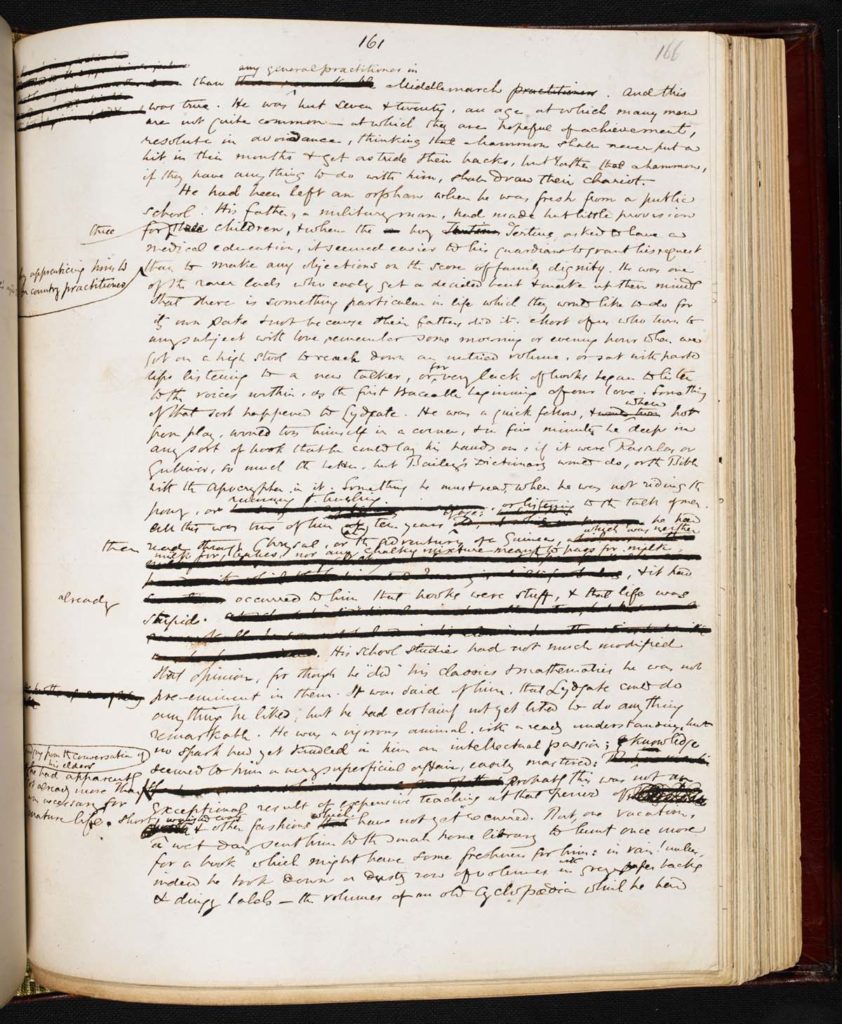
(Photo credit: museumcrush.org)
Earlier this month, I saw Middlemarch at the RST in Stratford.
Centred around the book by George Eliot, the play had the author herself as narrator.
She propels and guides the story, interacting with the characters, listening to them, interrupting them, questioning them.
The author interacted with her writing.
She engaged with her story.
What is our relationship with our writing?
Perhaps sometimes it is a ‘pick up the computer and throw it out of the window’ one, but let’s not think about that.
Actually, let’s think about that…
In the play, George Eliot challenged her writing.
She asked questions of it.
She listened to it.
Rather than throw the computer out of the window*, she sat with her writing.
She got to know it.
She interacted with the difficulties her characters faced, with the curve balls, with the disappointments, with the questions….and with the joys.
This approach is reflected in the original manuscript, which I believe is in the British Library, complete with notes and crossings out.
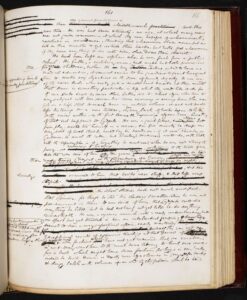
(A page of the original manuscript)
Middlemarch has been mooted as one of the best Victorian novels.
How much we’d have missed if George Eliot thrown it out of the window.
How might we as writers get to know, question, and engage with our own writing?
Writing is the best way to talk without being interrupted.
Jules Renard
Might I suggest that, instead, we encourage interruption.
Not the interruption from our writing that comes from the doorbell, or a call, or whatever it might be.
The interruption from our writing that comes from our words on the page/screen.
What are they saying?
*I am aware that computers were not invented back then. I should probably question my inclusion of them in relation to Middlemarch….

