
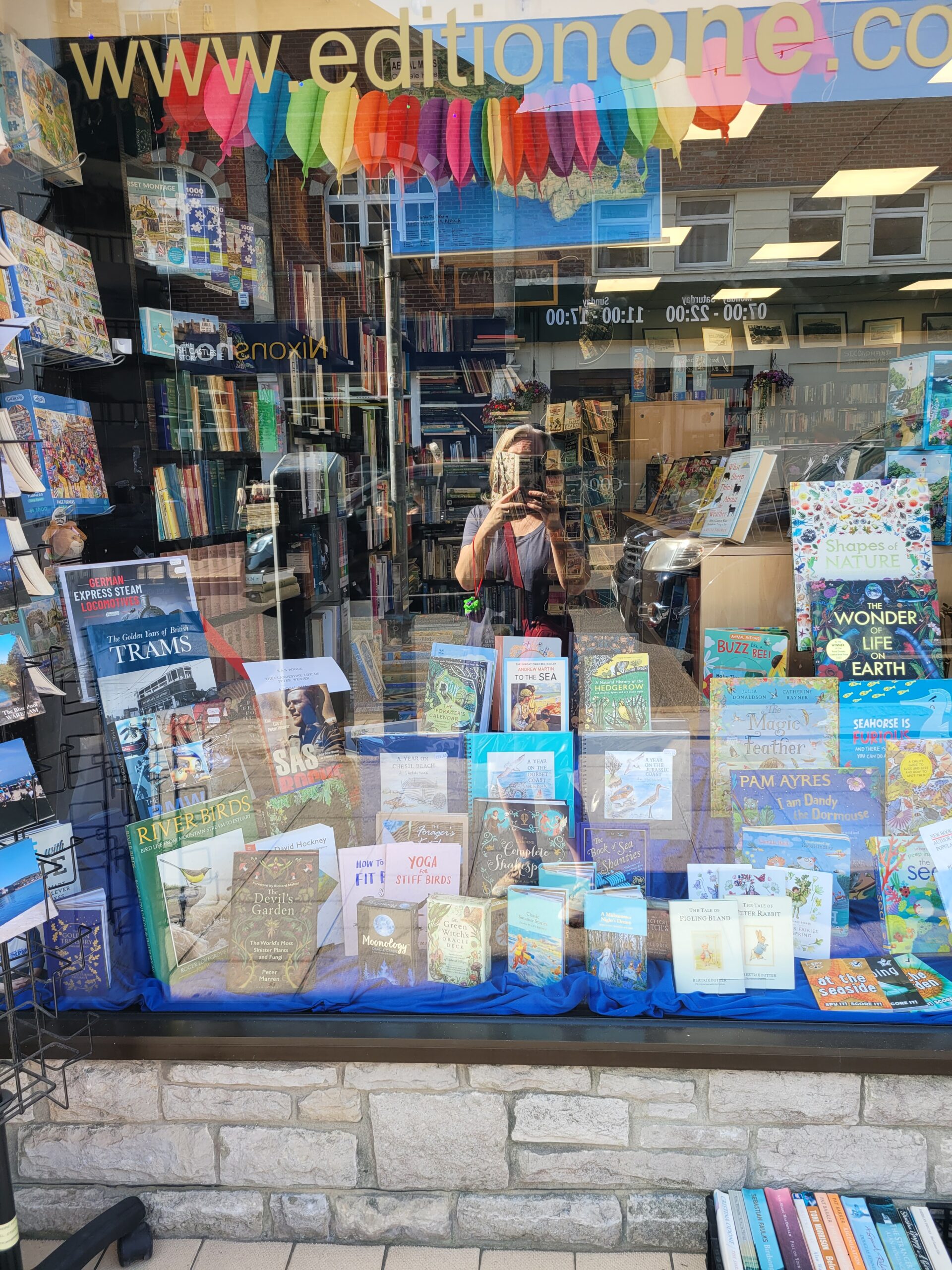
I recently returned from a trip to Dorset to visit my parents (and of course enjoy the beautiful beaches). Part of our time there coincided with Swanage Carnival Week, and one of the carnival activities my son and I like to participate in is ‘What’s Not My Line’, where businesses hide an item in their window display that shouldn’t be there, and you have to find as many as possible. The game is made harder by businesses that also decorate their window with the carnival theme (this year it was the Wild West). When we’ve not much else to do or happen to be downtown, we enjoy playing shop-window detective and joining the others pressing their noses against the glass, official lists in hand. We’ve not yet managed to get anywhere near completing the list – upwards of seventy shops take part each year.
The level of difficulty varies greatly. Some items are easy to spot, others are very obscure, and some downright sneaky. Some shops we have to return to several times before the ‘aha’ moment hits and we find the item. But since we’ve done this a couple of times, we’ve learned what to look for. For example, checking the top of the window for a rogue item hanging down, or the edge for something tiny like a plaster stuck on the glass. Some are cleverly misleading – for example, a proprietor might place something in the display that fits with their business but isn’t a brand they sell. Spotting the tricks one shop uses also gives us ideas for where to look in another window. You also get to vote on the best-dressed window. It’s a lot of fun for the three pounds it costs to buy the form.
As I was deciding what to write for this blog and thinking about what I’ve been doing recently, it struck me that What’s Not My Line is a pretty apt illustration of the process of editing our work, particularly the hard act of deleting material – taking out ‘what’s not my line’. When we begin the task, with perhaps several hundred manuscript pages on our laps or laptops, it seems overwhelming. (Or exciting, if you love this stage.) But the more we work on it, the easier it gets to spot phrases or even whole paragraphs that really shouldn’t be there. Perhaps they fit the story, but they’re not necessary; maybe it’s a single word whose removal makes the whole paragraph read better. Sometimes it’s something we looked at several times before we suddenly realise it shouldn’t be there. When we spot something we need to change in one place, it becomes easier to spot something similar in another. And yes, perhaps we feel we’ll never finish the list.
But here’s where my final point comes in. On the form, it says that even if you don’t spot every single item, you should hand it in anyway, as you still might win a prize. We can be pretty sure that we (or whoever helps us) won’t catch 100% of the edits or possible edits, but there’s a point when we’ve done our best and have to send it into the world for others to read. And remember, it’s the overall impression that counts – ‘best-dressed window’ is not quantitative. If we can get noses in books (as opposed to up against the glass), we’ve done our job.
What helps you spot what’s not your line?

Susan grew up in the Greater London area but has been an unintentional expat for most of her adult life. She currently lives on the coast of Slovenia and has a UK base in Dorset, which is the inspiration for her historical and mystery novels. Her website is www.susandcook.com.

