
Over the years, I have acquired various items that are pleasing and comforting to hold. These range from carved heart-shaped pieces of rose quartz, polished and smooth to lie in the palm, to small ‘holding crosses’ made of olive wood; grounding tools for prayerful contemplation.
When my children were young, we used to pick up stones from the beach. These had to fulfil certain criteria to become our ‘thinking stones’ — pebbles that sat comfortably in the hand and were not too heavy to carry in a pocket. If they glittered like granite or quartz, that was an added bonus.
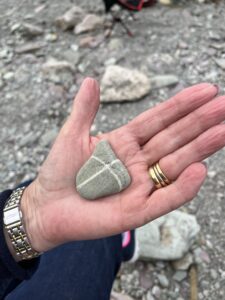
The image of my hand at the top of this post shows a perfect beach find.
I was on the first weekend of a course, walking with a group on the pebbly beach at Talland in Cornwall, enjoying a little beachcombing as we went.
There is simple pleasure in finding small treasures on the shore — a sea-worn piece of driftwood, a pretty shell, some green sea glass — and this stone, with its white cross, jumped out at me as I looked down.
It fits perfectly in my palm and its shape, with the slight quirk to the left, gives it extra character.
Cradling the stone made me think about how precious our hands are.
They stroke a baby’s downy cheek.
They grasp to hold on and punch to defend.
They carve, shape and mend.
They stretch out, palms open, to receive prayer and blessing.
Hands twist and wring in anguish or rest quietly in a lap. They are sensitive to the lightest touch yet carry us faithfully through a lifetime. Our fingerprints make them uniquely ours.
Thumbs lead and fingers follow — squeezing tight when words are scarce, brushing tears from tired eyes, clenching when courage demands.
Fists rise in anger. Slaps sting with regret. Claps ring out in joy.
These hands close in clasp and open to hope. They type to connect and write to remember.
They wave in welcome and sign farewell.
When walking with a small child, you and they are always exactly the right height for a soft little hand to creep into yours. What a privilege it is to feel the trust being placed into your guardian hand.
Hands feature throughout Scripture. In Psalm 31, David writes, “My times are in your hands; deliver me from the hands of my enemies, from those who pursue me.” Here, in a single verse, hands become both a place of safety and a source of danger.
The act of handwriting is just one example of the multi-tasking uses of our hands. Researchers have shown that writing by hand engages widespread areas of the brain in ways that typing does not. Whether or not we think about it, it is an astonishing partnership between mind and body.
Before you have written a single word, your hands are already making choices. You choose a pencil, a favourite pen or perhaps a fountain pen. You choose a notebook, a journal, a sheet of headed paper or the back of an envelope. Then, almost without conscious thought, your fingers wrap themselves around the pen while your brain recalls the shape of every letter you have ever learned.
Think of the opening words, Once upon a time… or Dear John… Your hands know just how much pressure to apply, how to form each curve and straight line, when to lift the pen and where to place a full stop. Meanwhile, your mind is choosing vocabulary, ordering thoughts and shaping ideas into sentences.
What a remarkable partnership. Your hands are not simply carrying out instructions; they are giving visible expression to thoughts, memories and imagination. Every handwritten page is evidence of the conversation between brain, heart and hand.
The same hands that knead bread, wipe away tears and plant flowers can also write a letter of encouragement that changes someone’s day. And perhaps the final act of loving hands is to close the eyes of another, one last time.
The little stone with its white cross sits comfortably in my palm. It reminds me that hands are made not only for doing, but for holding. And sometimes, simply holding something beautiful is enough.

