
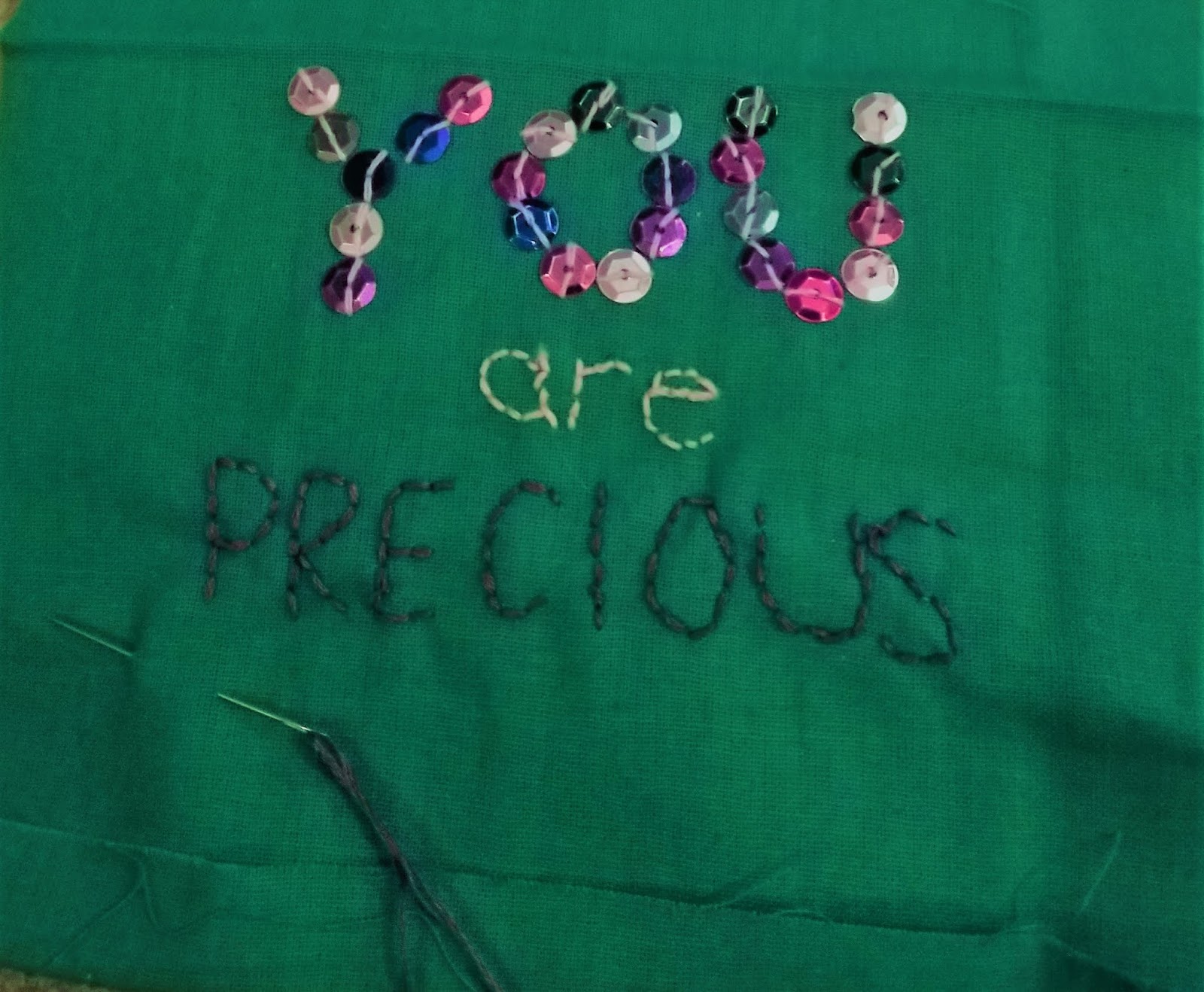
Saturday was #WorldMentalHealthDay. It’s a cause close to my
heart which I’ve been thinking and writing about a lot this year. I’ve responded
angrily on Twitter to apparent platitudes from politicians, calling for properly
funded and easily accessible mental health service*. And I’ve blogged practical
tips for how to support those of us who experience mental illness on a personal
level.**
One of those tips, originating from conversations with my
son, was this:
DO consider the everyday language you use and be
accurate. DON’T diminish mental illnesses by using diagnoses casually. For
example, you’re not ‘a bit OCD’: you just like things to be neat and tidy. It’s
very different to the daily-life-disabling anxiety of obsessive compulsive
disorder. And you demean the experience of any of us who have a specific
condition by referring to it this way.
Mental illness diagnoses, like OCD, can be used quite
thoughtlessly in general conversation. And in some ways, that may illustrate the
flexibility of language. But for someone who has a diagnosis (which has often taken
painful months or years to arrive at), to hear someone else use the word ‘bipolar’
as a mere description of variable moods, it diminishes their experience and
illness. And it hurts.
So accuracy in language is important and, perhaps even more
so, kindness in language is imperative.
Language evolves over the years, that’s a given. Did you
know, for example, that ‘nice’ used to mean ‘silly’ or ‘ignorant’? Or that ‘meticulous’
meant ‘fearful or timid’? I didn’t until recently.
But however much words change their meaning, as Christian
writers, I think we need to apply St Paul’s words to how we write. Will our end
result be ‘true…honourable…just…pure…lovely…commendable…any excellence…worthy
of praise’? Will it reveal ‘love, joy, peace, patience, kindness,
goodness, faithfulness, gentleness, self-control’? What are our intentions behind
using these words? What effect will these have on our readers and hearers?
These qualities may be revealed in the specific words used or
rejected. They may be in how our characters behave (I was struck by Wendy Jones’s
DI Shona McKenzie’s insistence on no bad language among her team). They may be
in the identification of a common experience in a poem. Or how a plot works
out. Or in using our writing to fight against injustice. Or how we respond to
trolls on social media.
God has given us such a gift in words and the desire to create
with them. So in our writing, let’s imitate Him. Let’s exercise truth and accuracy.
And let’s always try to #BeKind.
(If you’d like to read the blog posts, these are the links: *World Mental Health Day: How to Help Part 1 and **World Mental Health Day: How to Help Part 2 )
Liz Manning fits writing around being an Occupational
Therapist, BB captain, wife, and mum to two adult sons. Or perhaps it’s the
other way round. She blogs regularly at https://thestufflifeismadeofblog.wordpress.com/

