
On the whole, Christians are agreed that they don’t use, and don’t much like hearing, ‘strong’ language. By ‘strong’ language I mean, broadly speaking, religious, sexual, and lavatorial terms used as expressions of annoyance, exasperation, amazement, and (especially) aggression towards other people.
So, if we dislike it and don’t do it, we won’t put it in our books, right? It’s a no-brainer.
But hang on, we don’t like murder, lying, theft, and adultery, and we don’t practise any of them. But we put them in our books. Lots of Christian writers pen the most lurid possible crime stories, some of which contain distressing scenes of mutilation and bodily harm, with blood all over the place. Speaking entirely for myself, I find such descriptions upsetting and repulsive, but most Christian readers seem quite comfortable with them.
So why is it OK to describe horrible physical aggression, violent altercations, shocking deceit, and heartbreaking crimes of every kind — as long as nobody swears (not even the dastardly villains, who usually spring from the cursing classes)?
The only reason I can think of is that when you read a crime, it remains imaginary — it doesn’t actually take place in front of you. But when you read a rude word, it carries out the actual function of a word — it makes its own special phonetic sound (even if only in your head) and delivers its own special payload of meaning. So the name of the Deity, a word for excrement, or a verb relating to copulation is actually, as it were, uttered in the reader’s presence, as much as if some foul-mouthed person had marched into the room and sworn. (By the way, I hope it’s acceptable to use those terms excrement and copulation, which carry the same literal meaning as certain four-letter words, but are not usually used for swearing — presumably because they’ve got too many syllables.)
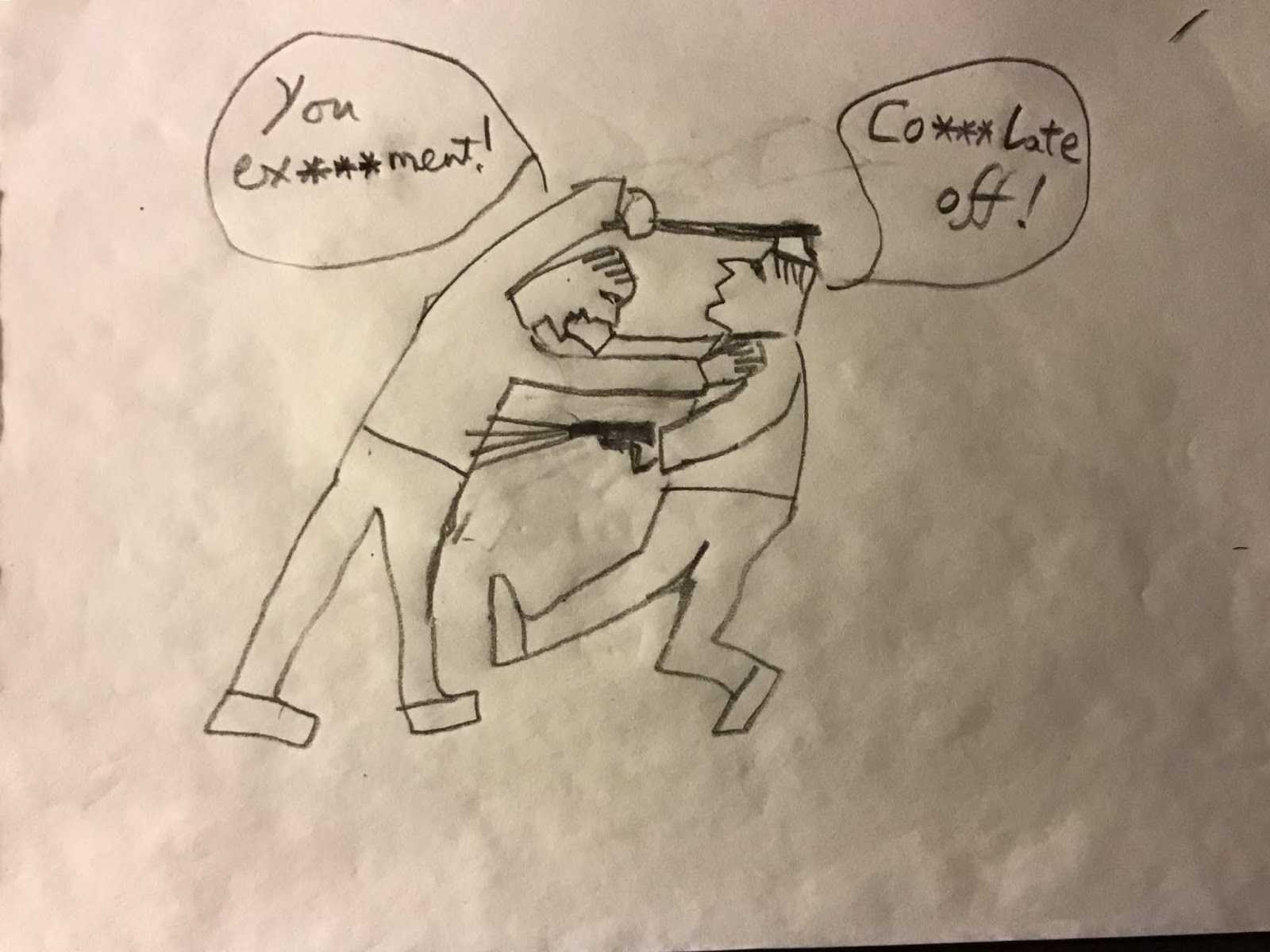
Unfortunately, I don’t think this objection stands up. For one thing, when we write, we aim to put realistic language into our characters’ mouths. We have no problem with characters saying ‘I’m gonna smash your face in!’, or ‘you’re a pain in the backside’, or ‘bloody hell!’ (or do we have a problem with this last one?). So it seems inconsistent to censor one corner of the vocabulary that is, for most of our fellow citizens and potential readers, completely normal, and even, in many situations, inoffensive.
And for another thing, how come we are at one and the same time so thick-skinned as to be able to treat a series of bloody murders as mere stepping-stones towards the solution of a fascinating puzzle, and yet such shrinking violets that we can’t cope with some naughty words which we must hear (if not in our homes and churches) just about everywhere we go? After all, the speaker’s word in the book is not aimed at us, the reader, any more than the murderer’s gun is. Can we not cope with an ugly word just being reported?*
There is however a very important Christian principle that I would argue should always be observed, and that is the principle of moderation or restraint. We only need to use a minimum of coarse language to give the flavour of a character: we don’t need to introduce it at every turn and push it into the reader’s face. Fair enough: but I would argue that this principle applies right across the board. It applies to murder scenes just as much. We don’t need more than an indication that there is a lot of blood about or that a body carries horrendous wounds. In writing, less is more. A hint is more powerful than a hit.
Edmund & Clare
*There is a whole other blog to be written about what exactly is offensive about a rude word. If it’s the meaning, how is it that some other words with the same meaning are not offensive? But how can it just be the word’s shape, or sound, that offends?
Originally written by Philologus

