
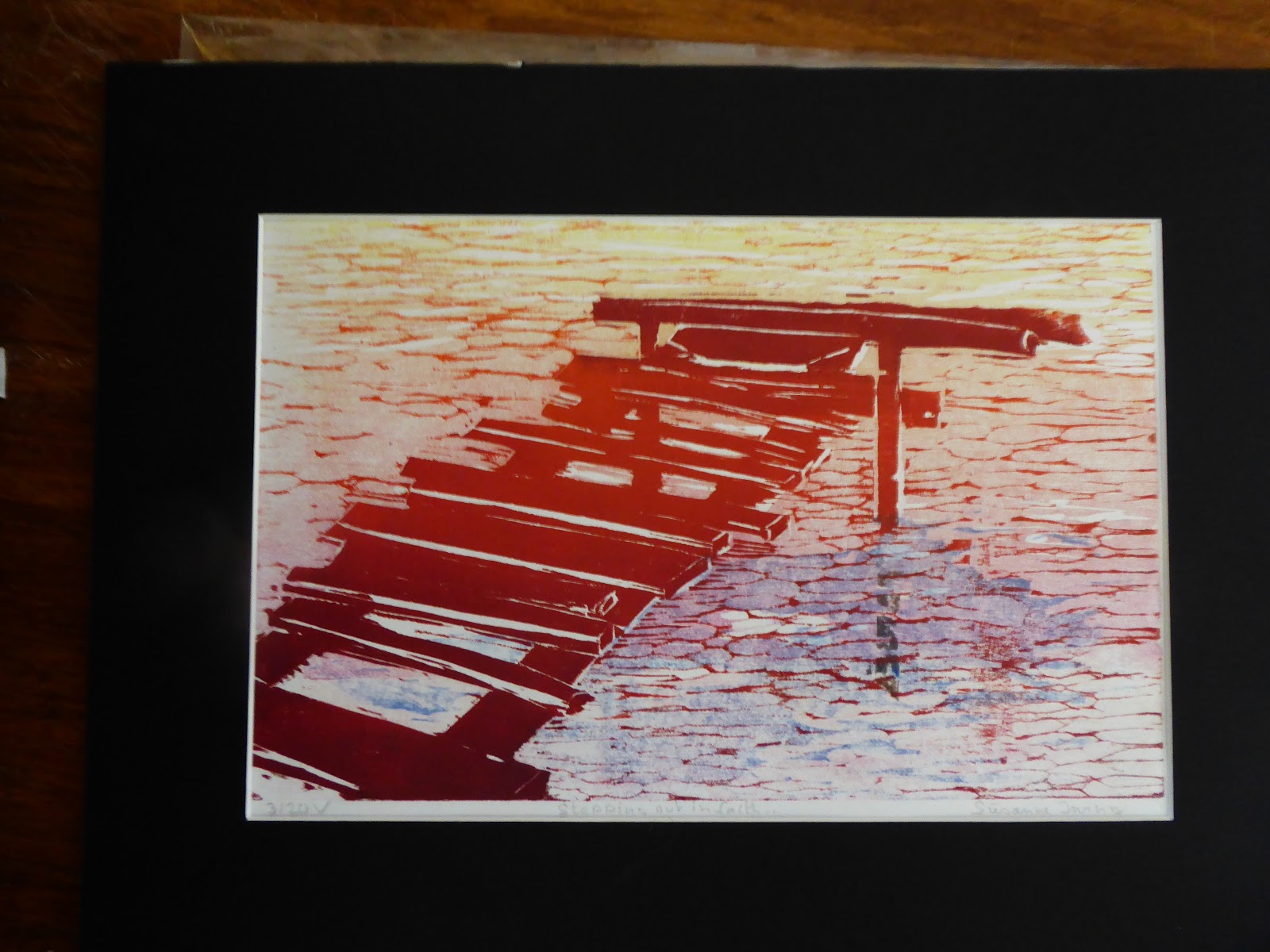
I recently tried my hand at woodcut and learned several valuable lessons:
- Make sure your tools
are sharp: Depending on the type of wood that is cut
and the size of the wood block, the cutting tools need to be
sharpened at least once a day – definitely not my favourite job,
but blunt tools are more likely to slip and create jagged edges. I
may think I am saving time if I keep going without a break, but in
the end will spend longer on a piece of work to correct my mistakes.
As a writer, I consider my mind my key tool (though a clean keyboard
and/or a sharp pencil do not go amiss either!) As a morning person,
I am more likely to create good prose when I am writing early in the day. (I must remember that next time I am writing this blogpost!).
Staying sharp as a writer also means getting up from my desk
regularly and noticing the knots and tensions in my body. -
Remain authentic: I
experimented with many different colour combinations to create my
image of the jetty. Many people on the course printed in shades of
blue , grey and browns and encouraged me to use their colour
palette. However, “their” colours did not convey my experience of
stepping out onto the wobbly jetty at sunset. The print only came
alive when I switched to a bolder colour palette. Interestingly, in
the proof sale at the end of the course, I sold three of my boldest
prints. The experience reminded me that it is impossible to please
everybody, but we are more likely to have an impact if we are true
to ourselves and to our style. -
Make space
before adding something new: There are various ways of adding
different colours to a woodblock. You can ink up a single woodblock
with different colours, but it can be difficult to get the colours
in the right place. A second method involves creating several
woodblocks, ink them up separately and then print them on top of
each other. This method only works when all the blocks are lined up
accurately, and woodblocks need to be cleared of wood sufficiently
to make space for any new information – otherwise the resulting
print will look messy and cluttered and the message gets lost. In
hindsight, the cleanest print might have been achieved if I had chosen
the reduction printing method, where a multi-colour print is created
from one woodblock. In-between each colour printing more and more of the woodblock’s surface is cut away. It means that
there is no going back to previous stages and once the cuts are
made, corrections are no longer possible. It strikes me though that
the third method most resembles how time works. We can only live each minute once. I am always
tempted to add to my to do list without asking myself how the new
tasks line up with my objectives and vision and whether there is
sufficient space in my diary. -
Take time to reflect: Creating a good
print – just like creating a good piece of prose or poetry –
takes patience and skill and cannot be rushed.
About
the author:Susanne Irving is the
co-ordinator for the Creative
Communicators in Petersfield.
She has co-written a book with her husband John about their
experiences when climbing Kilimanjaro. It is aimed at both trekkers
and those who are going through a dark time in their lives. How
to conquer a mountain: Kilimanjaro lessons is
available as a paperback and an e-book on Amazon, with all proceeds
going to charity.
Originally written by Sue Irving

