
How can we introduce variety and texture into our writing?
Try this 10-sentence writing exercise I use with students in my English teaching. This permutation of it involves describing a room (perhaps the one you’re in right now) but the method can be used whatever you’re writing.
I will give you examples for each of the instructions.
Describing a room
1. Your first sentence must be a statement about the room you want to describe. It should be a simple sentence. Simple sentences contain one subject and one verb. (Examples: The room speaks of comfort. Yellow walls brighten the room. I prefer this room to others.)
2. Your second sentence must be another statement. This time, use a compound sentence – two simple sentences joined with a connective such as and, but or so. (Examples: The room is cosy and a fire is blazing. I love the room but its decor is weary. The room is stuffy so I usually open a window.)
3. The third sentence must be a question. (Examples: Why do I feel so alone in here? Can a room’s walls hear my thoughts? When did this room last receive any TLC?)
4. This fourth sentence must be an elliptical one, meaning that it is missing an element of grammar and would normally be counted as ungrammatical. (Examples: Chipped floorboards. Tall windows. Dust everywhere.)
5. The fifth sentence must begin with an imperative (a command word which addresses the reader directly such as ‘Imagine‘, ‘Look‘, ‘Think‘ or ‘Let me …’)
6. The sixth sentence must start with a subordinating connective. Choose from ‘Because‘, ‘Although‘ or ‘If‘. (Examples: Because this room is so small, I feel its walls so close. Although I dusted yesterday, I see I missed the chest of drawers. If visitors came now, I’d be ashamed of the cobwebs.)
7. The seventh sentence must have the room saying something and therefore contain speech marks. (Example: I think I hear this room saying, ‘Leave me be. You are an imposition.’)
8. The eighth sentence must be another question. It can either be a question the narrator is asking, or one the room itself is asking.
9. The ninth sentence should contain a simile: a comparison using ‘as though/if’ or ‘like’. (Examples: One wall is painted startling red, like the red of a new postbox. The fire is lively, as though ready for action. The lamp on the piano has a gentle, respectful light, like a blessing.)
10. The tenth and final sentence should refer to the future in some way. (Examples: Soon, these walls will hear a baby’s cry. I wonder if I should close the door of this room tight-shut and never open it again. One day, I will answer the room’s question, but for now it will have to stay unsatisfied.)
Now, I will do the exercise myself. Beneath are the results, exactly as they appeared on the screen first-time round.
This living room is poorly-lit. I would switch the main light on but I don’t want the room to know I’m writing about it. Do you think I’m mad, worrying about the room’s feelings? Maybe. Think about it, though – perhaps we don’t pay enough attention to what our rooms have in mind. Although it might seem illogical, I only have to look around to feel, once again, that the room’s walls are leaning in, straining to hear. ‘She’s tap-tap-tapping on that keyboard again,’ they are saying, ‘and she thinks we are neutral and disinterested, but little does she know.’ I wonder: should I move into the next room if this one is such a voyeur? I shiver, as though someone has walked not just over but through my grave, my bones and what is left of my skin. Soon, I will snatch up the keyboard and transfer to my kitchen table where the walls seem less vindictive, less sensitive, less like whisperers.
Here’s the room I was writing about.
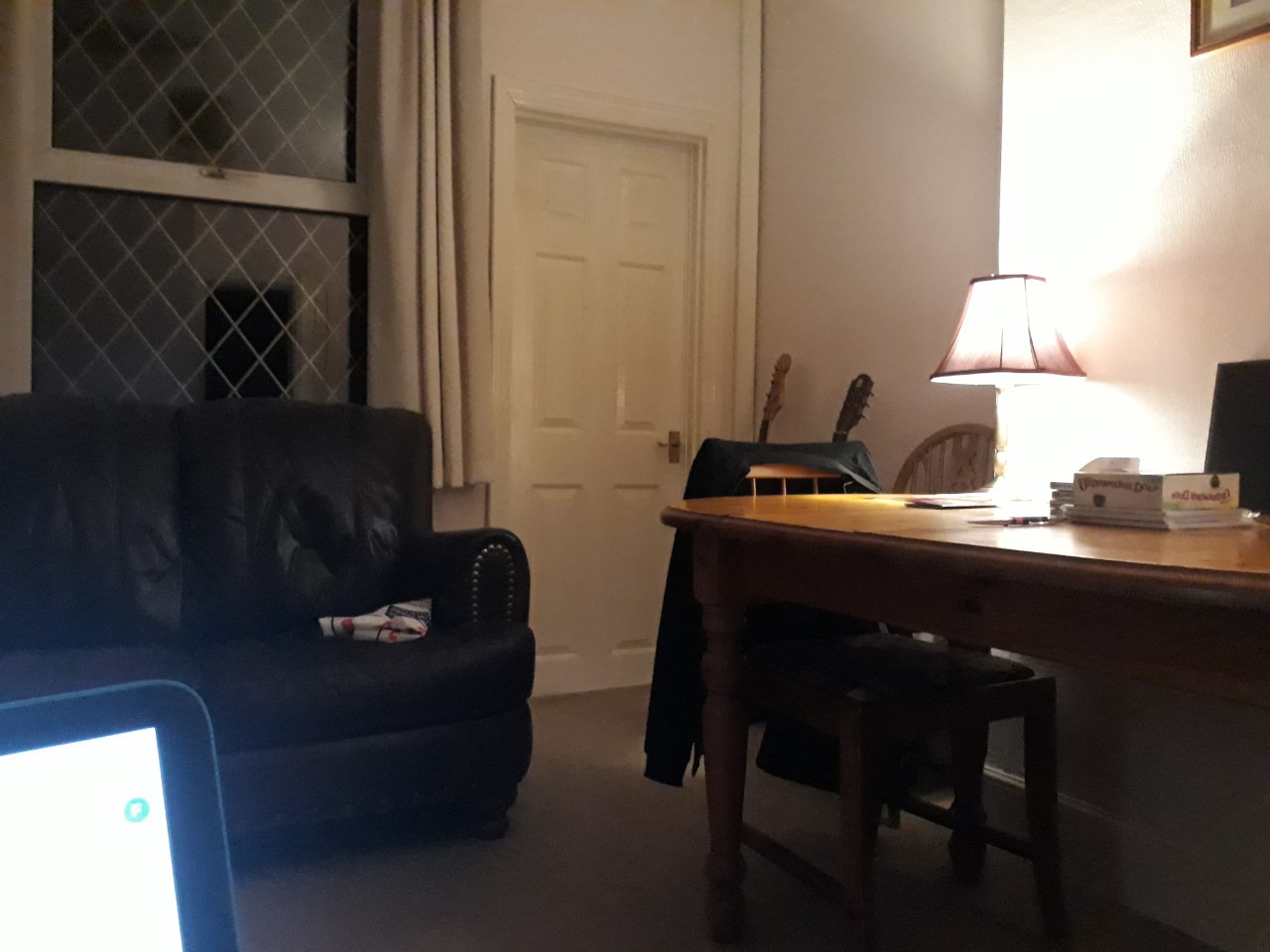 |
| Yes, it looks innocuous. But so did Lady Macbeth. |
Have a go yourself at the 10-sentence descriptive challenge. Why not post the results in the comments? I’d love to read them.

Fran Hill is a writer and teacher living in Warwickshire. You can find out about her and her work by visiting her website right here Her new book to be published by SPCK in early 2020 is called ‘Miss, What Does Incomprehensible Mean?’ and will be a memoir of a year in a teacher’s life, written in diary format. If all goes to plan, it will be funny.

