
month’s post on grammar tips seemed to strike a chord with many (thank you
for your kind comments), I thought I’d bring John back this month for some more tips. It’s very reassuring to know I’m not the only grammar nerd ????
In view of Philologus’ excellent and fascinating
post on Monday, though, I’m a little hesitant to offer more. However, on
the understanding that grammar guidelines are there to help rather than hinder
the reader, here are some more offerings, which I hope are useful.
Semicolons
Semicolons seem to be a bit of a Marmite thing. Personally,
I’m quite fond of the oft-overlooked semicolon – it can be very handy at times.
There are two main uses for semicolons. First, to avoid the
comma splice, which is considered to be grammatically incorrect. For example:
It was raining, so John went
indoors, John didn’t like the rain.
We could, perfectly correctly, separate this into two
sentences:
It was raining, so John went
indoors. John didn’t like the rain.
However, the writer might want to show that the two phrases
are closely linked; the full stop separates them too much. The semicolon is
perfect for this:
It was raining, so John went
indoors; John didn’t like the rain.

Second, semicolons convey a sublist. In a straightforward list, we
separate the items with a comma:
John went to the shops and bought
dark, milk and white chocolate.
But if John were to buy some things in addition to the
chocolate, then we’d use semicolons to make that clear:
John went to the shops and bought
bread; milk; dark, milk and white chocolate; and cheese.
And this leads very conveniently into another hot grammar
topic…
The serial (or Oxford) comma
The serial comma is another Marmite issue. Many of us were
taught at school never to put a comma before ‘and’. Well, Oxford disagrees, as
do many others.
The serial comma (sometimes called the Oxford comma because
the Oxford style guide likes it) is the rule that you insert a comma before
‘and [final item in a list]’. So:
John enjoyed roast chicken, roast
potatoes, stuffing, and vegetables for his dinner.
To use the serial comma is correct. Also, not to use the
serial comma here is correct:
John enjoyed roast chicken, roast
potatoes, stuffing and vegetables for his dinner.
Basically, you can choose whether you wish to use it or not.
But there are caveats:
Be consistent. If you decide you’re a fan of the serial
comma, be sure to use it consistently in a piece of writing. Don’t decide you
like it in one paragraph but go off it in the next – that will confuse your
reader.
If you decide not to use it in general, that’s fine, but
there are times when it’s helpful for clarity. I’m sure we’ve all seen this
example, or something similar:
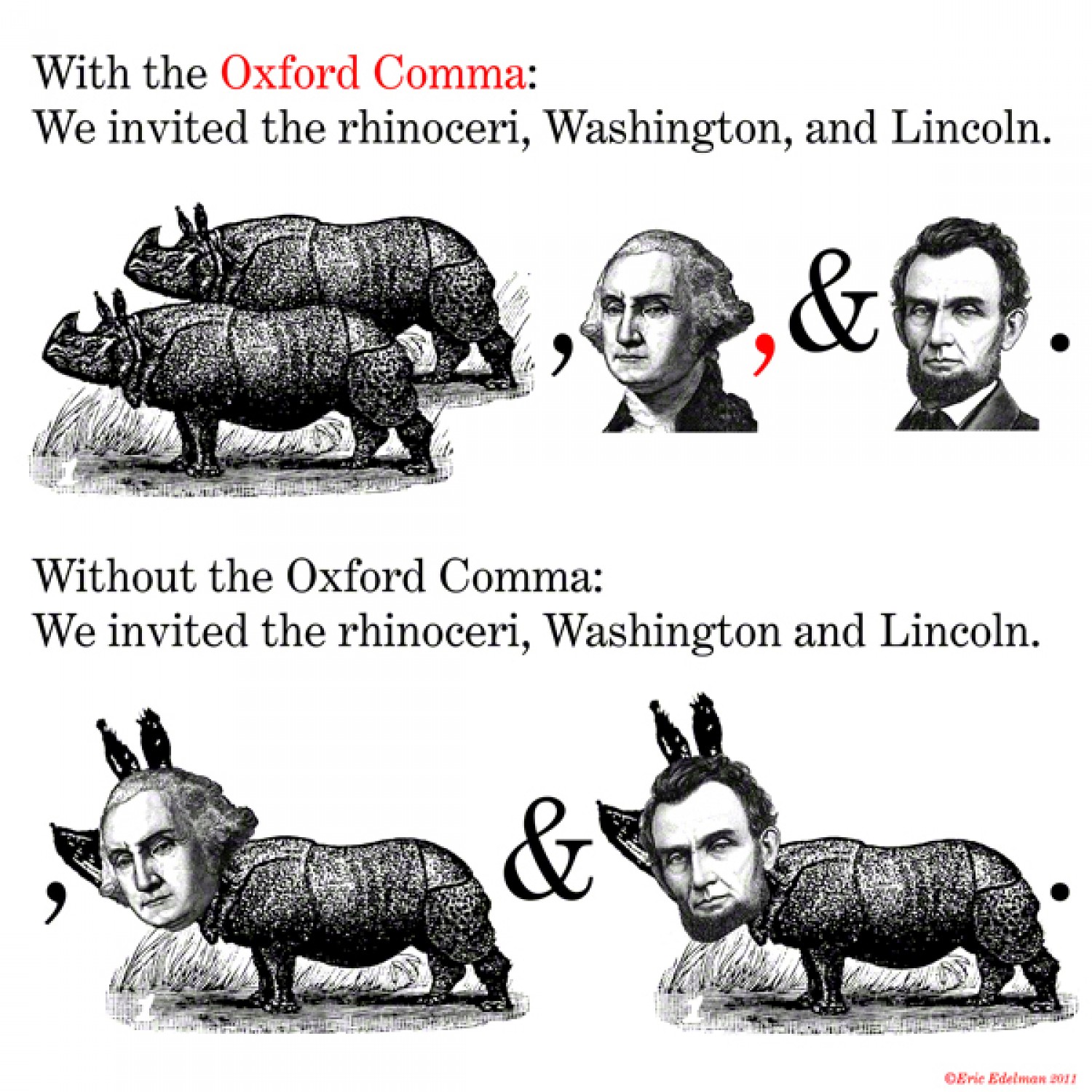
can add more confusion:
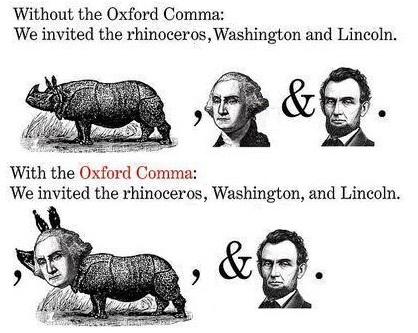
At the end of the day, of course, we need to assume some common sense on the part of our reader. Suffice it to say that the serial comma is a matter of preference – just make sure you don’t end up confusing your reader!

Copeland is a freelance writer, speaker, copy editor and proofreader – and
loves anything to do with words. She is the author of Losing the Fig Leaf
and Less than Ordinary? She is also responsible for the day-to-day
running of Instant Apostle publishers. When she has the luxury of some free
time, she can invariably be found with a book in one hand and some chocolate in
the other.

