|
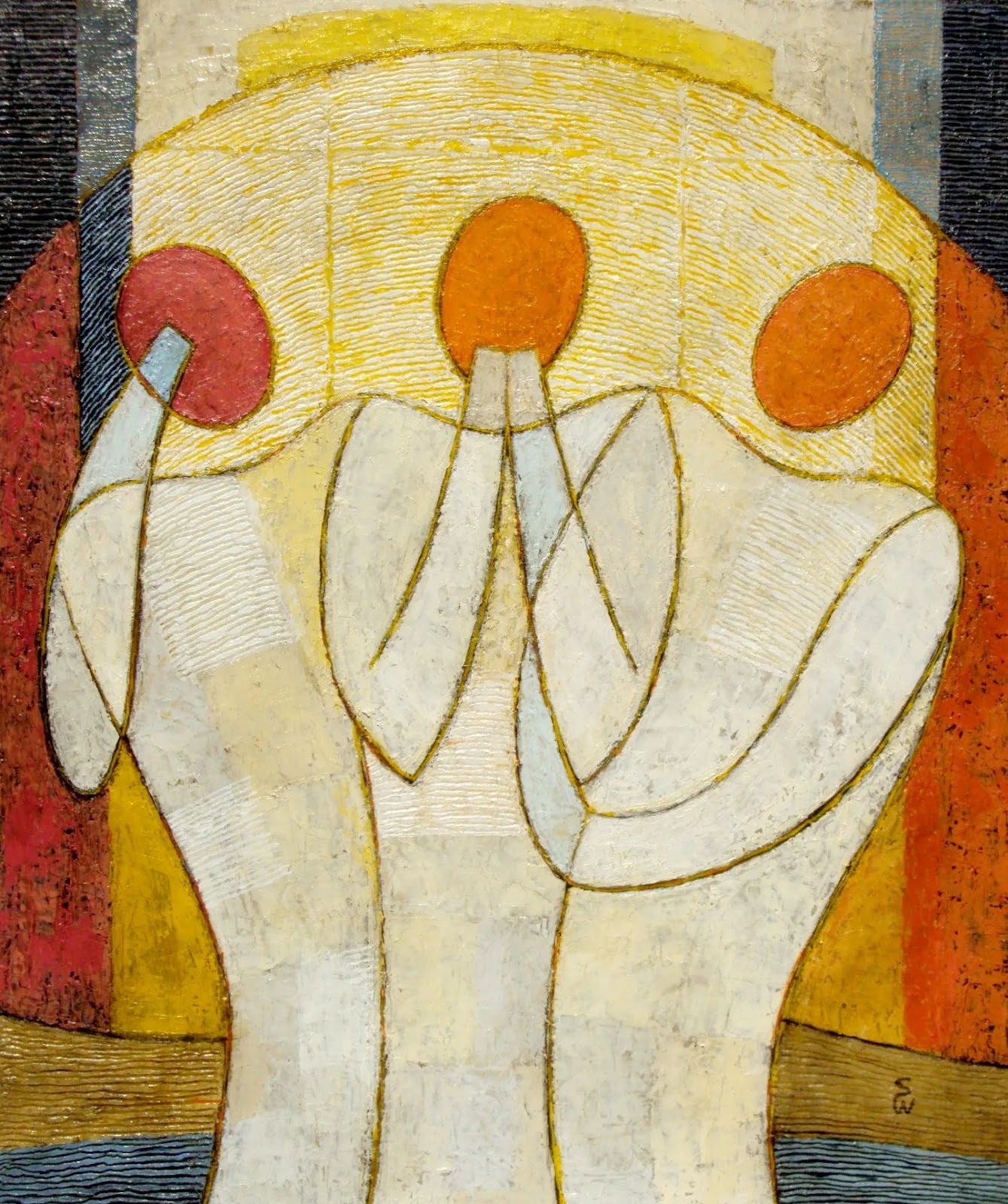
Photo Credit: Soichi Watanabe
Having had a
break over Christmas and the new year, my mind felt as though it was ready
for a stretch. For no particular reason, I found myself pondering the number
three. What is it about three, and about the way things so often group
themselves in threes? Is three a magic number? In writing terms, perhaps it is.
“He was tall,
dark and handsome” has more impact than “He was tall and dark”. The number
three is the smallest odd prime number and the smallest number that can create
a pattern.
You can’t
plait two strands, but you can plait three.
Two’s
company, and three’s a crowd.
You need
three legs to hold up a piece of furniture, though only two to hold up a
person.
You need
three elements to measure space: height, width and depth.
When
gardening, plants make a more effective statement when they are grouped in
threes.
There is a
particular emphasis in messages that come in threes. Caesar declared, “Veni,
vidi, vici” — “I came, I saw, I conquered”. He didn’t simply come and see.
Shakespeare’s Mark Antony addressed his speech to “Friends, Romans,
countrymen”. Stories and songs seem to know this rule of threes instinctively. There are
three blind mice and three little pigs.
Macbeth has
three witches, Dumas has three musketeers, and even Goldilocks has three bears
to contend with.
More
prosaically, Lionel Richie sang of “Once, Twice, Three Times a Lady”,
demonstrating that he too understood the power of love — thrice.
Greek
mythology gave us three Furies and three Graces, while the theological virtues
of Faith, Hope and Charity draw us towards balance. We speak of mind, body and
spirit, intuitively recognising a completeness in the triad.
“I promise to
love, honour and obey” may have fallen out of favour in the modern world, but
it remains a trinitarian promise, witnessed by that most important triptych of
all: the divine Trinity, the Three in One. What mystery and promise are held
within that unique and equilateral triangle of Father, Son and Holy Spirit?
The
combination of pattern and brevity in triples makes content easier to remember,
which is why the rule of three delivers such impact in oration, advertising and
persuasion. Nike’s enduring slogan, “Just do it”, distils motivation, action
and resolve into three unforgettable words.
On oath, you
promise to tell the truth, the whole truth and nothing but the truth,
emphasising honesty through repetition and completeness.
Even our
symbols reflect this instinct. The remembrance poppy is made up of three
elements: the blood-red of the battlefields, the green leaf signifying new
growth, and the black centre reflecting the sadness of mourning.
The rule of
thirds underpins many compelling images. Artists and photographers are
encouraged to divide a frame using two horizontal and two vertical lines,
placing key elements along those lines or where they intersect. The modern
colour model is RGB — red, green and blue — which can be combined in varying
proportions to create a multitude of shades.
As a writer,
the rule of three is a quietly powerful tool. At the very least, I can add a
pinch of imagination, a flavour of spice, and a hint of intrigue, in the hope
that my words will encourage people to read them and conclude that they are
useful, helpful and interesting.
Devon-based
Andrea Corrie BEM is a writer, editor, speaker, retreat leader and water safety
advocate. andrea.corrie@outlook.com
Blog at: https://andreacorriesblog.wordpress.com/
Living
in the Mourning Light (2020) and Into the Mourning Light (2014) by Andrea
Corrie available at https://www.amazon.co.uk/Living-Mourning-Light-Andrea-Corrie/dp/1916271804
|