Verbs.
They are adorable. I love them to bits. Not quite as much as I love chocolate, Prosecco and Flog It, but almost.
Ask any of my students, ‘What does she bang on about most when she’s teaching you creative writing?’
They’re used to it now: highlighting the verbs in their sentences and deciding on new ones in the search for originality. And more striking expression. And higher marks.
Three things about verbs, then, that have helped their creative writing, and mine, and may help yours.
Thing One. Sentences rely on verbs.
Each English sentence we write relies on its verb(s) for completeness. Here’s an example.
The woman wrote the blog post.
Without the verb ‘wrote’, you have a woman and you have a blog post. But you don’t have the vital question answered: what about them? We are curious beings. We want to know. What happened?
The woman started the blog post.
The woman finished the blog post.
Okay, thanks. That tells us something. But it’s pretty boring so far. These verbs were predictable. Anything more interesting that hints at a story?
The woman resented the blog post.
The woman cried over the blog post.
The woman deleted the blog post.
The woman yelled at the blog post.
The woman mocked her blog post.
The woman lobbed her blog post onto the screen as though glad to be rid of it.
Getting more interesting, perhaps.
In each of those sentences, we have the woman and we have the blog post. They don’t change. It’s the dynamic between them that creates intrigue. The verb is what does that.
An alien and Earth.
A detective and a murderer.
A wizard boy and a sworn enemy.
What? What? What happens between them????
Thing Two. The precise verb.
The following sentences go some way towards telling us about a character’s actions. That’s the verb’s job: to make actions clear.
He got out of bed and dressed in his work clothes. Going into the kitchen, he put the kettle on. He sat on a chair and drank some coffee then went into work.
But, because these verbs are fairly standard, it makes them imprecise for creative writing that is meant to engage a reader. We’re not sure what mood this character is in. What attitude does he have towards the start of his day? What kind of day might he have as a result?
We can make a huge difference to this portrayal of the character with the verbs alone. None of the other words need to change:
He swore himself out of bed and flung on his work clothes. Slouching into the kitchen, he flicked the kettle on. He slumped on a chair and slurped some coffee, then grumbled into work.
You could argue that the description is verb-heavy now, but hopefully you can see the point.
Let’s try again, and make him sound a bit keener about his job! Perhaps it’s his first day, and he’s anxious to make an impression:
He leapt out of bed and selected his work clothes. Singing into the kitchen, he tapped the kettle on. He fidgeted in a chair, hot-sipping some coffee, then bombed it into work.
Hurrah! He’s cheered up!
Thing Three. Using verbs to set a scene.
‘Have your scene DOING something,’ is what I tell my students. ‘Replace those adjectives with verbs to make your writing go tra-la-la.’
‘Writing doesn’t go tra-la-la, Miss.’
‘It absolutely CAN. That’s my point!’
Here are some sentences about a hot day, using adjectives.
The sun was hot. The sun was glaring. The sun was scorching. The sun was burning. The sun was baking.
The following sentences introduce the same idea, but the use of a verb says something much more precise and original. Each one specifies better the type of heat and its effect.
The sun punished me. The sun rode on my back. The sun caressed the back of my neck. The sun tortured me. The sun kiss-kissed my shoulders. The sun tricked me. The sun stalked me. The sun favoured me with its rays. The sun bombarded me with its heat.
Likewise, here are some sentences about a room, using adjectives.
The room was stifling. The room was claustrophobic. The room was stuffy.
Let’s try with some verbs. Obviously, there are subtle differences between the following sentences, and in which context you’d use them. But as soon as you have the room ‘doing’ something – we call it personification – the sense of tension increases.
The room closed in around me. The room stole all my air. The room’s walls inched towards me. The room throttled me. The room threatened me. I knew the room was preparing to edge me out.
Even better, have your setting speak. Settings love to have their say.
The room’s walls whispered. ‘There is no space here for such as you. We will squeeze you out.’
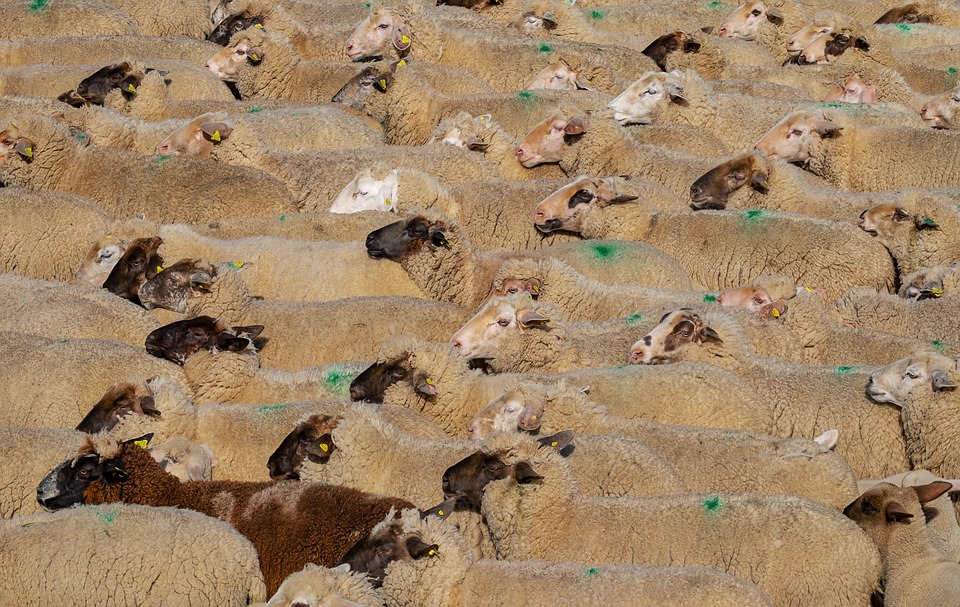 |
| This picture of sheep probably comes as a surprise, but it’s what came up when I looked for a photograph to illustrate ‘claustrophia’. I now see the life of a sheep differently. |
Fran Hill is a writer and English teacher from Warwickshire. You can read more about Fran and her work here, where you can also buy her book ‘Being Miss’, a comic tale about a day in a teacher’s life.