
I’ve just reread the first three Harry Potter books. I had forgotten how good they are, though there’s a confrontation scene just before the denouement in no. 3, The Prisoner of Azkaban, that consists of involved arguments about who betrayed who. It’s far too long drawn out, especially with Ron Weasly having to endure it with a broken leg. This is possibly an omen of things to come in the series.
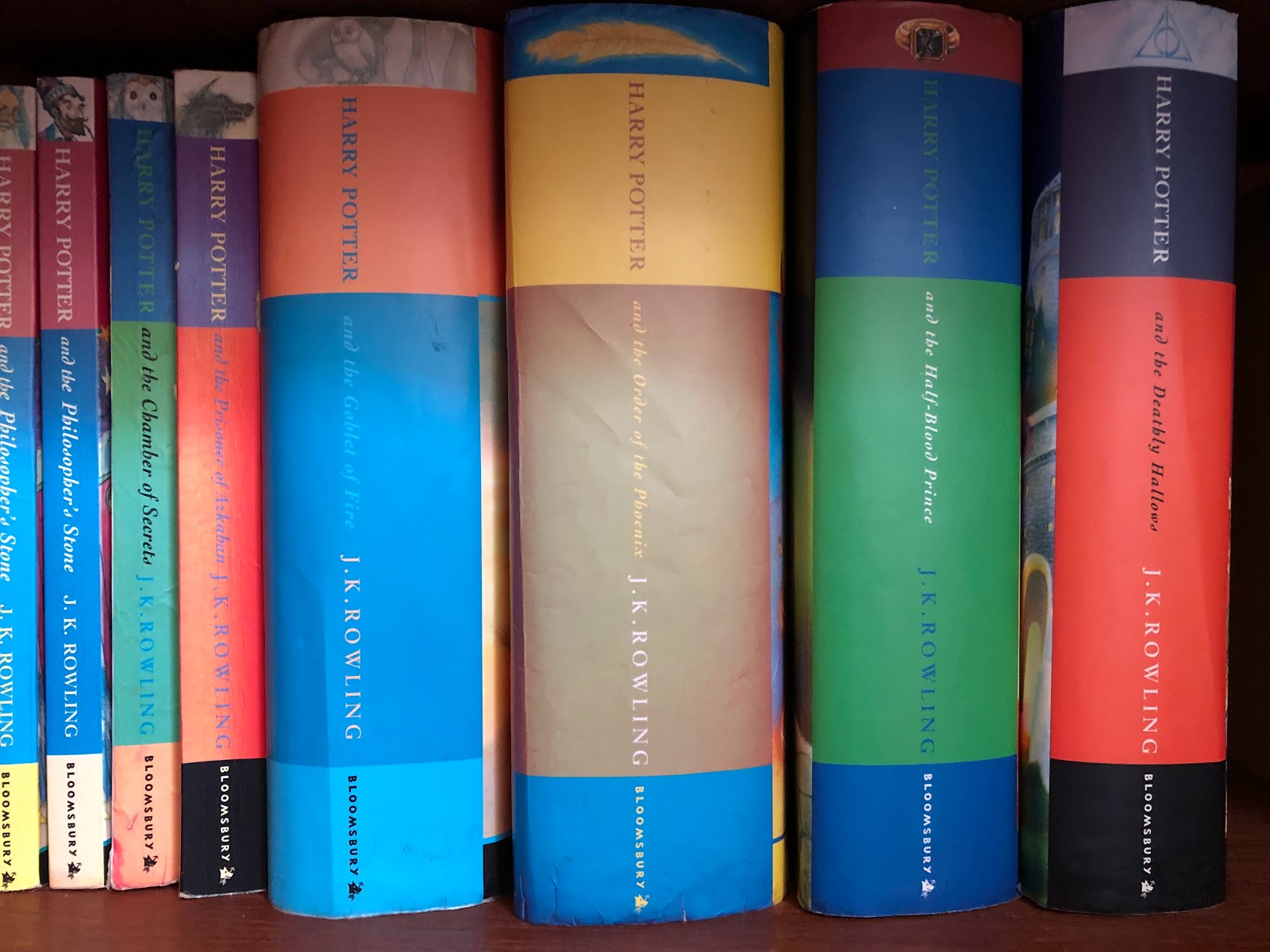
Am I going to reread any more? I don’t know. If you look at the Potter series on the shelf it’s immediately noticeable that the fourth in the series (as well as its successors) is twice as fat as any of the first three. A check on the word count confirms this: over 600 pages in The Goblet of Fire — over 750 in Order of the Phoenix — compared with only just over 300 in Azkaban. I can’t remember the last four books very well, but have a dim memory that they involve incredibly complicated and long winded unravelling at the end, however exciting the main parts are. I also remember that Goblet of Fire starts with a Quidditch tournament, and after three books I have had enough Quidditch to last me a lifetime.
Rowling says that the huge increase in size at volume 4 was planned: the issues explored were to become more serious and complex as Harry got older. But I can’t help wondering whether there might have been another factor. At what point did Rowling realize that it would be OK to make the last four books much bigger? Was it perhaps when the books suddenly became best sellers and the film rights were bought?
To generalize a bit, publishers are, as we know, dealers in very unpredictable futures. They invest all the money up front with no guarantee of more than breaking even. They have to be downright mean and stingy at this stage. The first print run of Philosopher’s Stone was 500 copies. However, once they scent success everything changes. The author’s mere name becomes a valuable commodity. Anything he or she writes will sell. As there’s little danger of failure, there’s no need to spend money on an editor wrestling the author down to an economical word limit. It makes sense to let them write as much as they like. The bigger the book, the more they can charge.
I remember this phenomenon back in the 1980s with Iris Murdoch’s novels, as she approached the end of her career. The novels got bigger and more labyrinthine — always with waterways and mysterious mage-like figures — and less and less of a good read. Whereas her very first novel, Under the Net (1954) remains short, sharp, and funny.
Most of us are not in the Iris Murdoch or J. K. Rowling class, but even on the more humdrum level of publishing, things operate in a similar way. If there’s acclaim for a book, and the print run sells well, the publisher will naturally consider another similar product to be a safer bet than taking a risk with a new author. And if the next one goes well, they’ve got the start of a line of profitable products. All they have to is make sure that the author keeps on turning out lookalikes. As long as these sell decently, and can maybe even be turned into a boxed set, the publisher’s happy. The quality of the product is of secondary importance.
So there’s a potential danger for the writer. The more success — the more the publisher beams on them — the more stories they have got to contrive. That fine fearless rapture with which their first book captured something new and special can easily be replaced by a conveyor belt production of increasingly less inspired and readable products. Yes, cash flow for the impoverished author (and even more for the publisher) — but at what cost to their creative soul? And to the reading public?
I suppose, given the structure of secondary education, Rowling was stuck with seven volumes. But we can’t know whether she would have made the books as big as they are if they’d been less of a guaranteed success. Perhaps there would have been more editing, more cutting back, less complexity, and less Quidditch. In her case, the final number was a given. For ordinary mortals, I’d say that a trilogy might be the limit, or at least a modest assumption. But we should also consider the possibility that we have only a single great work inside us, and be content with that. Once you’ve grabbed the snitch, there’s no point in scoring more goals with the quaffle, and you risk a bruising encounter with a bludger.

