
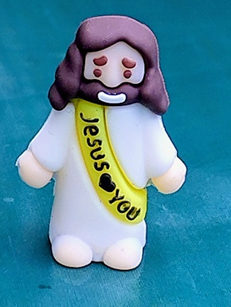
Picture credit: www.onehundredpercent-nofakeshere-justsquintabit.com
What do you think of this picture I bought online? The real deal,
right? It’s not signed or anything, like they always bang on about on the Antiques
Roadshow, but I really, really believe it’s a rare, bona fide photograph of
Jesus. Possibly the only one in existence. I got it off a reliable website, so that clinched it for me. It’s real,
and I don’t want to hear any arguments.
In recent years, fake is a word we’ve seen used more
and more. Fake news is so prevalent that a whole industry has sprung up
to ‘fact check’ the news and issue corrections. Perhaps you can think of a couple
of world leaders who frequently dismiss tricky questions from journalists by labelling
the issue under discussion as ‘fake news’. Deep-fake photographs
appear online that could fool anyone, and social media is awash with lies and unreliable
AI-generated content. This makes me think… how much fake information have
I consumed this week without even noticing?
Earlier this year, The Bible Society, a highly respected organisation
(at least within Christian circles), released a report about a ‘quiet revival,’
among the Gen Z age group in which they claim, “gen Z leads an exciting
turnaround in church attendance, as the decades-long decline in churchgoing in
England and Wales is over.” The report got widely celebrated at this year’s
leading Christian conferences and festivals, but Humanists UK immediately challenged
the findings, asserting the conclusions were based on a selective use of data. The
Bible Society’s not a dodgy setup peddling counterfeit goods, so would they do
such a thing? What’s the truth?
If you heard about the report, what did you think? Did you immediately
accept it as ‘truth’? If you saw the response from Humanists UK, did that make
you think again? Christian-based social media sites applauded the report, but
in an era of short-attention scrolling, many followers probably read little beyond the headline before hitting the ‘like’ button. Equally, on the
same sites, I saw people instantly reject the critics’ response with comments
such as ‘well they would say that, wouldn’t they?’. One person’s truth is another’s
fake news.
It can take courage to go against the flow, so I was interested to see a
well-known figure from the evangelical community do just that. It was even more
notable because he’s a regular keynote speaker at the very events that promoted
and celebrated the amazing news. He didn’t trash the report or reject it out of
hand, but his contribution to the debate was to contain his excitement, ask
questions and offer his own observations from his extensive knowledge of the UK
church scene.
In my previous occupation, academics and ‘think-tanks’ regularly
approached me with requests to work with them on an ‘exciting’ research project
or to provide them with privileged access to data for them to analyse. These
included universities and political or faith-based organisations of all persuasions.
With universities purporting to be independent, my first question was always to establish who was footing the bill. I needed to know whether they had a funder or
sponsor to please, and often, they did. Regardless of the researcher’s
credentials, I knew they could interpret the data any way they wanted, and there
would be an unspoken pressure for their findings to align with whatever their
funder or organisation already stood for. He who pays the piper calls the
tune, you might say. When the research gave them what they wanted, buffet
receptions would get laid on and press launches rolled out, but if the findings
didn’t align with their hopes, everything would go quiet and my requests to see
a copy of the findings would be met with silence or vague excuses.
Just for clarity, I’m not saying I don’t believe The Bible Society’s
report about revival; I am just highlighting that one side says this,
whilst the other says that, and I’m wary of just accepting what I read as
truth because it aligns with my hopes or because it got a big cheer at a
conference. Of course, as a Christian, I want it to be the truth because it’s a
joyful prospect, but I also think it’s okay to step back and ask questions.
So, to end… a couple of questions. First, are you seeing a revival where
you live? Second, what do you do to protect yourself from the scourge of fake
news?

