
 |
|
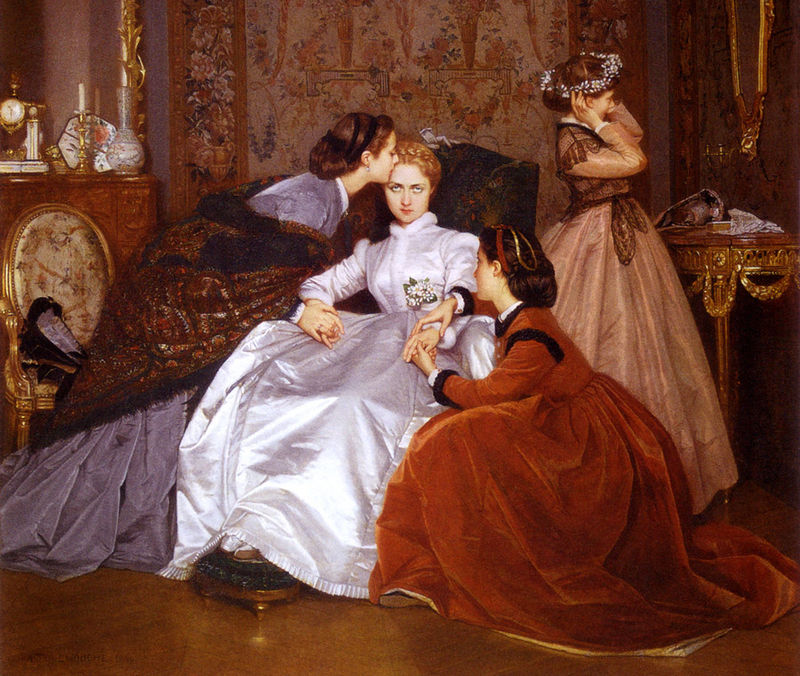
Not Little Women but The Reluctant Bride by
Auguste Toulmouche, artrenewal.org, |
I recently saw Greta Gerwig’s much praised film
of Little Women, and loved it. Gerwig chooses to tell Louisa M. Alcott’s
story not in a linear way but by presenting two parallel storylines, beginning
with Jo March trying to establish her writing career in New York City in 1869,
and then cutting away to the life of Jo and her three sisters – Meg, Beth and
Amy – in 1861. A
blue lens filter represents the sisters’ present, and a gold filter their past. This approach is a fresh take on a
classic novel which has been adapted multiple times, and the film has been
generally well received by fans of the book.
Jo March is an iconic character in her
unconventionality and passionate desire to succeed as a writer. She is a fictional writer (Alcott’s alter ego) who has inspired generations
of young women – not least young women who desire to write.
unconventionality and passionate desire to succeed as a writer. She is a fictional writer (Alcott’s alter ego) who has inspired generations
of young women – not least young women who desire to write.
Adaptations of favourite books can disappoint. Sometimes the depth, profundity and sparkle
of the book is missing. Other books are
simply too complex to be adapted well.
Also, the reverse can be true – some adaptations are better than their
source material.
of the book is missing. Other books are
simply too complex to be adapted well.
Also, the reverse can be true – some adaptations are better than their
source material.
So what makes for a successful adaptation
of a beloved story? I’m not a
screenwriter, and have never written a script for a play or film, but I know
what I enjoy in an adaptation. I’m not
always interested in textual purity: although I would like the characters to
speak many of the lines their creator wrote for them, slavish fidelity to the
text matters less to me than an intelligent and sympathetic interpretation of
the characters. After all, Shakespeare’s
plays have stood up to multiple re-tellings and re-imaginings, often in
different cultures, because his themes are so universal.
Here then are some of my favourite
treatments of beloved books (and I can now add the 2019 Little Women to the list):
treatments of beloved books (and I can now add the 2019 Little Women to the list):
·
The 1995 BBC TV adaptations of
both Pride and Prejudice and Persuasion
The 1995 BBC TV adaptations of
both Pride and Prejudice and Persuasion
·
Ang Lee’s 1996 film of Sense and Sensibility
Ang Lee’s 1996 film of Sense and Sensibility
·
The 2006 BBC adaptation of Jane Eyre
The 2006 BBC adaptation of Jane Eyre
·
Peter Jackson’s Lord of the Rings film trilogy,
2001-2003
Peter Jackson’s Lord of the Rings film trilogy,
2001-2003
·
The Harry Potter films (at
least from Alfonzo Cuaron’s 2004 Prisoner
of Azkaban onwards)
The Harry Potter films (at
least from Alfonzo Cuaron’s 2004 Prisoner
of Azkaban onwards)
Why did I enjoy these, even when the
scriptwriter(s) often took liberties with the original text? Peter Jackson sometimes substituted baroque cinematic excess for J.R.R.
Tolkien’s emotional restraint. And Jane Austen certainly never wrote any scene – as Andrew Davies did for the 1995 version of Pride and Prejudice – in which Mr Darcy goes swimming and then emerges dripping from the lake with his linen shirt clinging to his manly torso …
I consider all of the above to be
successful adaptations not only because they were well cast and well acted, but
because they caught the spirit, atmosphere and themes of the original story. Those three elements are crucial for an adaptation to win a reader over. It’s quite special when the scriptwriter
succeeds in conveying to film, TV screen or stage the spirit and essence
of a character you love.
What adaptations of books have you enjoyed? Are there any which you preferred to the
original book?
original book?
P.S.
I’m aware that we are all Christian writers. So here is a reminder that Little Women (including both volumes,
the second part is called Good Wives)
has a very strong Christian element (some would say preachy … but it WAS
written in 1868 … and besides, the book has plenty of humour and humanity.)
I’m aware that we are all Christian writers. So here is a reminder that Little Women (including both volumes,
the second part is called Good Wives)
has a very strong Christian element (some would say preachy … but it WAS
written in 1868 … and besides, the book has plenty of humour and humanity.)
I have been writing stories since I was a child, although most of them remain unfinished. I also write poetry, often after some sort of crisis. I am a Reader in the Anglican church and my day job is working for the United Reformed Church.
By Philippa Linton

