
Last month, Helen Murray wrote about how she enjoys collecting pine
cones. This resonated with me, as a couple of days previously I had parked under a huge horse-chestnut tree and opened my car door to find the ground
littered with conkers. Mahogany shells gleamed at me from spiny
green cases as they nestled – half-buried – beneath yellowing autumn leaves.
cones. This resonated with me, as a couple of days previously I had parked under a huge horse-chestnut tree and opened my car door to find the ground
littered with conkers. Mahogany shells gleamed at me from spiny
green cases as they nestled – half-buried – beneath yellowing autumn leaves.
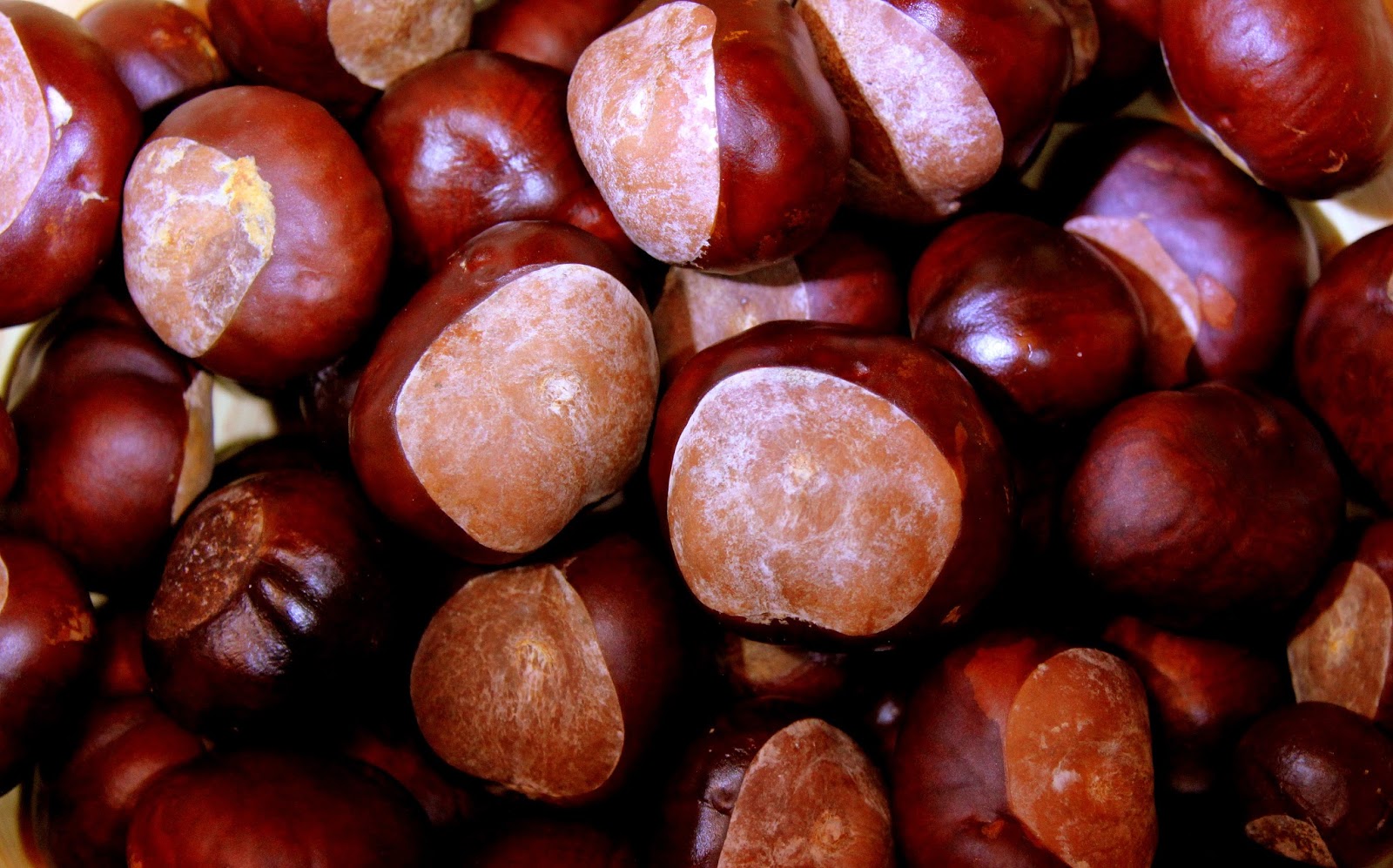
There’s something irresistibly appealing about freshly fallen conkers:
I love the richness of their colouring and the silkiness of their shells. They
remind me of misty autumn mornings melting into mellow sunshine, and how – when
my children were small – kicking up leaves in the park in the hope of finding
autumnal treasure was a great way to pass a couple of hours.
I love the richness of their colouring and the silkiness of their shells. They
remind me of misty autumn mornings melting into mellow sunshine, and how – when
my children were small – kicking up leaves in the park in the hope of finding
autumnal treasure was a great way to pass a couple of hours.
I gave in to temptation, even though my children are all grown-up now.
I gathered a couple of dozen conkers, and put them in the side-pocket of my car
door, fully intending to display them in a glass bowl when I got home.
I gathered a couple of dozen conkers, and put them in the side-pocket of my car
door, fully intending to display them in a glass bowl when I got home.
So, guess where they are now? Yep, that’s right: five weeks later,
they’re still in the door of my car. I promise myself most days that when I get
home, I’ll do something with them, but there’s always something else to think
about. And having been festering in my car for more than a month, they’re
starting to look a little the worse for wear. Their luscious colours have faded
to a dull, sludge-like brown. The shells that felt so satisfyingly smooth
initially have shrivelled and wrinkled, and a couple of them are tinged with a
white bloom. My plans for an autumnal display will have to wait till next year.
Here’s the thing about conkers: they’re lovely to look at – and to
touch – when they first fall from the tree, but they’re not intended simply for
interior decoration purposes. A conker that sits in a bowl on my kitchen table
will look good for a short while, but sooner or later will fade, shrink and
become useless. Conkers are meant to rest undisturbed on the ground so that
they can rot and be absorbed into the earth for a while before – eventually –
sprouting into a new tree and producing fruit themselves.
Shortly before his arrest and crucifixion, Jesus reminded his disciples
that a seed can only produce other seeds if it first falls to the ground and
dies (John 12: 24). It’s one of those statements we prefer to gloss over: we
like the idea of being fruitful, but the stuff that comes prior to that sounds
a tad unpleasant. Maybe we need to remember that – in God’s economy – the real
growth comes not when we are looking our best, but when we allow ourselves to
be buried and broken.

Fiona
Lloyd
works part-time as a music teacher, and serves on the worship leading team at
her local church. Fiona self-published a violin tutor book in 2013 and blogs at
www.fjlloyd.wordpress.com. You can find her
on Twitter at @FionaJLloyd. Fiona is vice-chair of ACW and is married with
three grown-up children.
Originally written by Fiona Lloyd

