
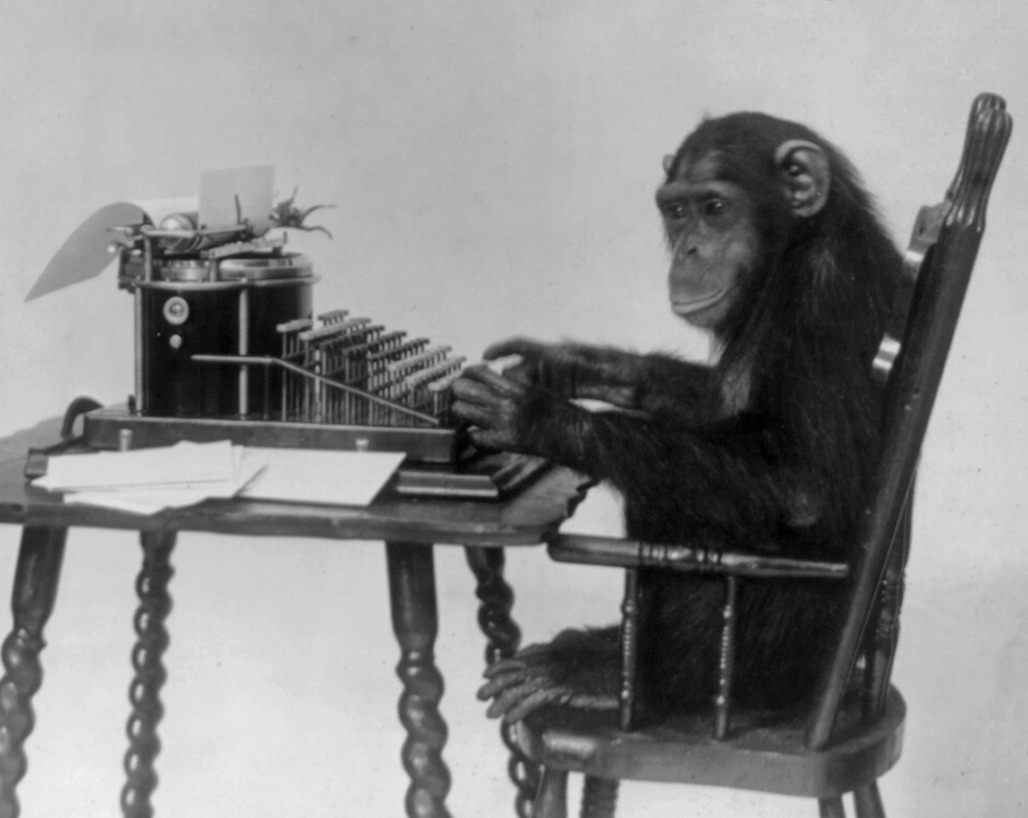
I’ve never been a fan of the infinite monkey theorem, you know
the one, where the story goes, if you left a bunch of monkeys alone with some
typewriters and paper for an unlimited amount of time, eventually they would
write the Complete Works of Shakespeare. I tend to be more of the school of
thought that says, no, I think you would just end up with a lot of monkey poo
and screwed up paper, not to mention the logistical nightmare that would go
into feeding and resupplying the monkeys. But of course, such thought
experiments are not meant to be bogged down by common sense.
The point for me
is that words have infinite potential. Almost every day, sometimes several
times, I either write or speak a sentence that has never been written or
uttered before (at least by me).Today that might be, “The halo is a hazelnut,” (don’t ask) and it strikes me that, much like
musical notes have infinite potential to create new things, so do words. We
are, in a sense, composers. And so is God. In fact I think he gets pretty
excited about it.
“Behold, I am doing a new thing;
now it springs forth, do you not perceive it?” Isaiah 43: 19 (partial, ESV)
now it springs forth, do you not perceive it?” Isaiah 43: 19 (partial, ESV)
I think it is pretty obvious
that the Creator loves variety. There are, for instance, around 75,000 species
of wasp.
that the Creator loves variety. There are, for instance, around 75,000 species
of wasp.
Doing things over and over
again in new and surprising ways is one of the things we do that mirrors God,
that makes us co-creators with him, and for me, what makes the arts so thrilling.
We are making new things! And we are all doing it our own way, in our own time,
with our own words and our unique lives and imaginations. Unlike our monkey
friends, left to bang away randomly at our typewriters, we have the gift of
language.
Some of us will write
dazzling plays, like Shakespeare did. Some will write poems that are never
critically acclaimed, but which are an enormous blessing to those in difficult
places. Some of us will bring joy to small children with our rhyming stories. We
might make people think, learn, cry, laugh, maybe even come to a faith in the
goodness of a God they had never considered before. We might create characters
that endear themselves to people’s hearts for generations to come.
Whatever it is we write,
whatever genre or method or language we use, we are doing something wonderful
that God created us to do, and if we are doing it with him, we will find it all
the more rewarding, and I believe, so will our readers.
whatever genre or method or language we use, we are doing something wonderful
that God created us to do, and if we are doing it with him, we will find it all
the more rewarding, and I believe, so will our readers.
[picture from Wikipedia –
listed copyright free – and yes, I know this is a chimpanzee, which is an ape,
not a monkey (ook!). But we’re on a budget here.]
listed copyright free – and yes, I know this is a chimpanzee, which is an ape,
not a monkey (ook!). But we’re on a budget here.]
Keren
Dibbens-Wyatt is a disabled writer
and artist with a passion for poetry, mysticism, story and colour. Her writing
features regularly on spiritual blogs and in literary journals. Her full-length
publications include Garden of God’s Heart and Whale Song: Choosing Life with
Jonah. She lives in South East England and is mainly housebound by her illness.
Originally written by Keren Dibbens-Wyatt

