
A few days ago my
husband and I started the monumental task of clearing out our attic, the first
time since moving into our current house in 1988, with two very young children,
who are now thirty-six and thirty-four and left home eons ago. We came across:
- orders of service from Westminster Abbey for
the five years my son was in the Westminster Abbey choir; - son’s and daughter’s exercise books from
primary school; - daughter’s folders from secondary school, annotated
with names of bands because by then we were much ‘cooler’; - ‘Shoot’ and ‘Match’ football magazines;
- five folders of teacher training ‘evidence’,
every page in a separate plastic wallet.
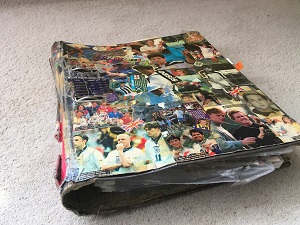

Every item evoked intense
and personal memories. I wanted to keep the
lot – except the teacher training ‘evidence’.
I could’ve made the excuse that I want to write a novel set in the 1990s
and featuring football fans, but I didn’t need all of this stuff. I have written a few notes and taken a few
photos.
Most of what we’ve
cleared so far has either gone for recycling or been taken to the tip. We looked at it, remembered it, then said
goodbye to it. Luke writes in Chapter 3: 17:
His winnowing fork is in his hand to clear his threshing floor and to gather
the wheat into his barn, but he will burn up the chaff with unquenchable fire.
We have to be
ruthless with our attic. Similarly, with
writing. Often we have to
- Delete thousands of words at a time, scenes
we’ve spent hours honing. (I actually store
passages I’ve removed in a ‘dump’ file on my computer.) - Take out characters who no longer serve
their purpose in the story structure. - Accept that some pieces we’ve written are never
going to find a place. - Discreetly get rid of writing we’re no longer
proud of. I’ve shredded whole novels,
dating back from when I wrote in pencil on file paper.
We move on, as
people and as writers. And we won’t be
able to see God and what He wants us to do unless we clear away the chaff
first.
Rosemary Johnson
has had many short stories published, in print and online, amongst other
places, Cafe Lit, Scribble, The Copperfield Review, Fiction on the Web and 101
Words. She has also contributed to
Together magazine and Christian Writer.
She has also written a historical novel, set in the Solidarity years in
Poland. In real life, she is a retired
IT lecturer, living in Suffolk with her husband and cat. Her cat supports her writing by sitting on
her keyboard and deleting large portions of text.

