
Sometimes I hanker after a quill such as Shakespeare must have used: that rhythmic dip-shake-scratch-scratch dip-shake-scratch-scratch that gave one time to think in between phrases and clauses.
Yes, I realise about the blots and the unevenness and the general ink-onvenience of it all. But it doesn’t stop me wondering whether those weren’t the good old days for writers.
Have new technologies been of as much benefit as we think?
I’m a teacher now, but before I trained in my early 40s, I was a medical secretary in the NHS. So, I learned to touch-type when I studied for the Diploma of the Association of Medical Secretaries. I don’t think this qualification exists any more, perhaps because it takes so long to say and produces unwanted spittle.
My typing classes in the late 1970s at Warwickshire College involved learning on manual typewriters in the first year of our two-year course. Here’s a picture of one in case you’re a young ‘un who’s never heard of such a thing or thought it was a phenomenon of Ancient Greece or a Neanderthal invention.
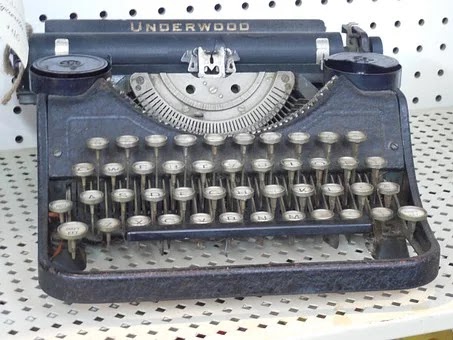
I got pretty fast on a manual typewriter. I’ve never been the fittest person overall but at least my finger muscles were worth boasting about at parties.
However, when we secretarial students came back from the summer for Year 2, we found that two strange items had been delivered to the typing classroom: electric typewriters. They looked a bit like this.
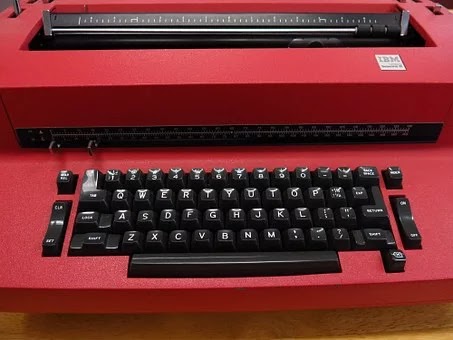
It was the closest we’d ever come to being visited by aliens.
We erupted into excited twittering.
‘Calm down, girls,’ said Miss TypingTutor, a small, pursed-lipped woman with her glasses on a chain around her neck which we often wished she would pull much tighter. She wagged a finger at her fussing class. ‘There will have to be a rota,’ she said. ‘And anyone who touches the new typewriters out of turn will be given extra typing exercises and a poisoned biscuit at break.’
Once a week, then, I was privileged to move to the right of the room where the electric typewriters had been located and to enjoy the envious gazes of the others. They’d hurtle at their clattering keys like crazed beings with bent fingers while I tip-tapped with gentle hands and – wonder of wonders – didn’t have to press the return handle to start a new line.
I began to reach speeds of over 90 words per minute which I maintained when I started work and electric typewriters became common. In 1982, in fact, I won a typing speed competition. The prize was a free computer course on Wordstar, an early word processing software package. Do you remember Wordstar? If you do, you also remember, as I do, woolly mammoths and dodos.
Much has changed. These days, I have a silver Hewlett Packard laptop as my writing tool. Its flat keyboard and mouse pad mean I can more or less type as fast as I can think, as I’m sure some of you can too. But is this always a good thing?
One disadvantage is RSI – repetitive strain injury. In me, it manifests as puffy, swollen knuckles caused by tendonitis and, if I don’t take breaks to stretch my fingers because I’m tossing rapid thoughts into my keyboard for hours at a time, I am always sorry. However much I like to lose myself in what I’m writing, I could easily lose the ability to type altogether if I don’t go easy.
To avoid this, I’m experimenting with a plug-in keyboard and mouse, but have also been revisiting an ancient country craft, akin to dry stone walling, called using pen and paper. The pens are ballpoints rather than quills, and don’t have the same whiff of romance. Also, the process slows me down to a crawl in terms of output. But it exercises different parts of my right hand, the one which suffers the most.
I find that this tortoise-rather-than-hare output represents not my splurged and random thoughts which later need seventeen edits, but more considered, crafted ideas.
I’m writing more poetry, too, something that comes more naturally to me from a pen and more pedestrian thought.
So, technology, for me, hasn’t all been good.
Thinking about it, though, maybe the writers and scribes of old were similarly susceptible to RSI, what with all that dip-shake-scratch-scratch-blot-blotting. For them, no photocopiers or printers, so if you wanted two copies, you wrote two copies. Perhaps they wrote through the night, by the light of a candle. Dip-shake-scratch-scratch-blot-blot. Yawn. Stretch the fingers. Dip-shake-scratch-scratch-blot-blot.
Whatever else has changed over the years, tendons and ligaments and joints, with all their vulnerabilities, presumably haven’t.
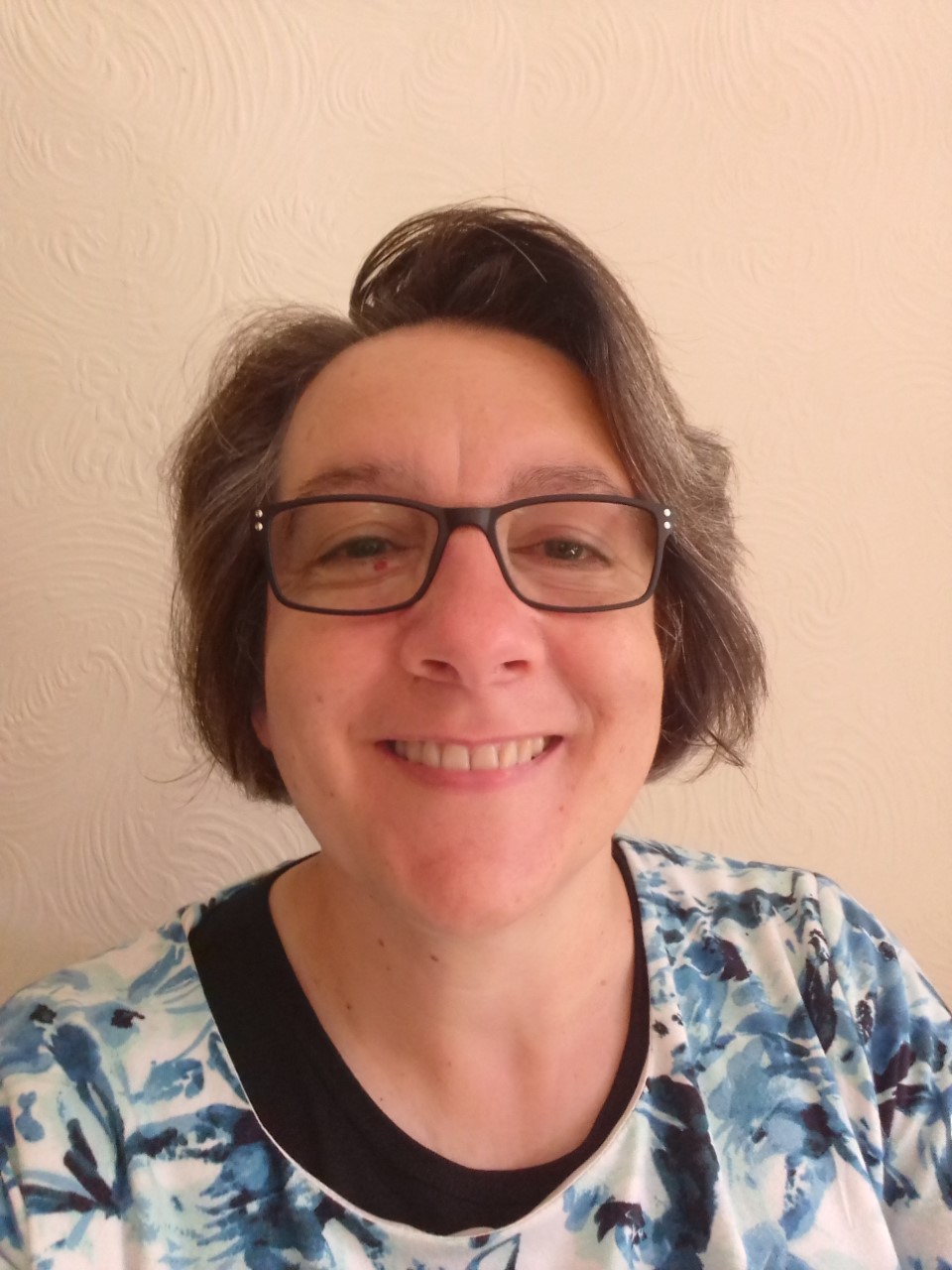
Fran is a writer, blogger and English teacher based in the Midlands. Her new book ‘Miss, What Does Incomprehensible Mean?’ is being published by SPCK Publishing in May 2020. You can learn more about Fran and her work by going to her website here

