
I don’t know whether it’s a coincidence or whether it says
something about the type of church we are, but both our previous and
current ministers claim James as their favourite book of the Bible.
With it’s clear instructions on what it means to live a Christian
life, I can see the appeal. There’s principles there, and
priorities, we ‘simply’ have to apply them to our lives.
Yet my heart sinks if someone suggests a sermon series on James. And
when it comes round in my Bible reading I know it’s going to be a
struggle. Because James is straightforward and I need a tussle. I
want to be challenged or inspired by a Bible passage, engaged with
all my heart, all my mind, all my soul.
And importantly, I want my imagination to be involved. Stories speak
much more powerfully to me than textbooks; fiction gets through to me
in a way that non-fiction very rarely does. When I read a good story,
when I relate to the characters and feel the emotions, then I am open
to learning and understanding without feeling taught or told what to
do. I hate being told what to do.
I don’t think I’m alone in this. How many of us perk up during a
sermon when the preacher tells a story or breaks into personal
anecdote. Something with human interest, something we can relate to.
Probably the thing we’ll remember afterwards, no matter how good
the exegesis.
Nathan uses this same story-telling tactic with David in 2 Samuel. He
tells him about a man who rather than using his own plentiful supply
of wine, takes from his poor neighbour. Not until David is gripped by
the injustice of the story does Nathan turn round and say, ‘You are
that man.’ David is trapped, because he has already felt the power
of righteous anger. Now he knows he needs to turn it on himself.
The historian RG Collingwood said,
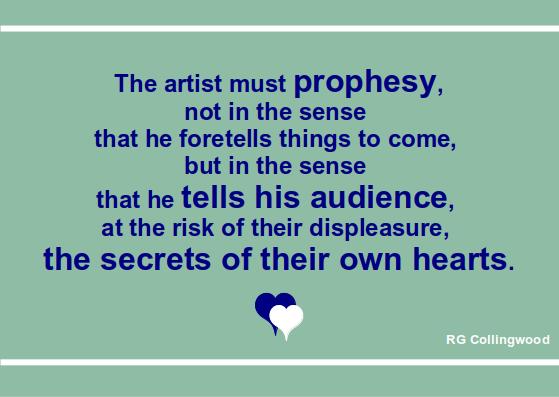 |
| The artist must prophesy, not in the sense that he foretells things to come, but in the sense that he tells his audience, at the risk of their displeasure, the secrets of their own hearts. |
Do we consider our writing a form of prophecy?
A good story is so much more than ‘just a story’. It can be a
vital way of communicating our faith with people who wouldn’t
listen to a straightforward account. Or to people like me, who hate
being told.


