
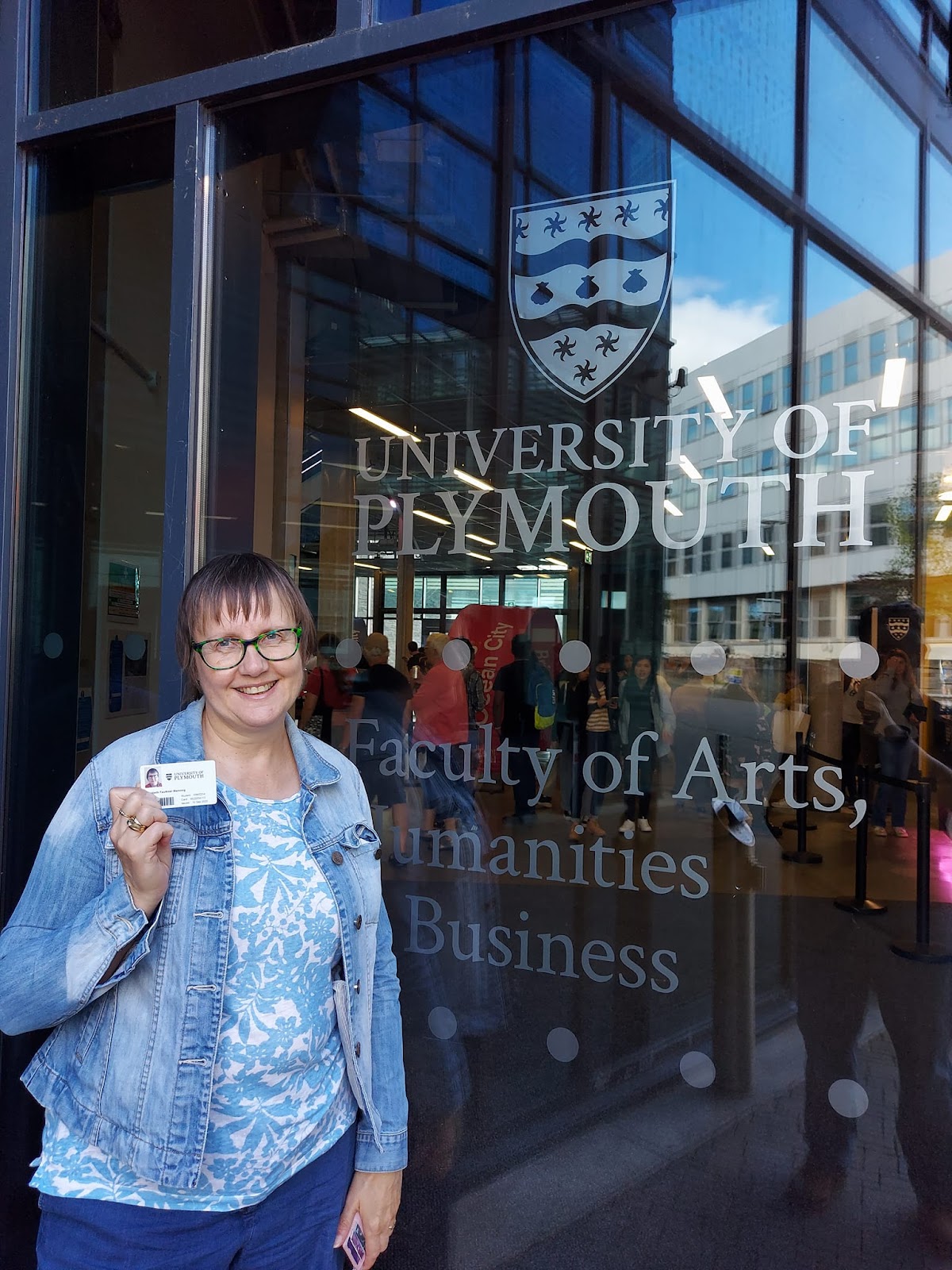
I wondered if you’re thinking about a doing a course of
formal study or if you’re just curious, you might like to know what a Creative
Writing MA entails.
I’ve just finished mine at the University of Plymouth. I
took the yearlong fulltime option but it’s also available as a part time 2 year
course. The hardest thing for me wasn’t the amount of work but switching
between different writing modes. I found it easiest to dedicate specific days
in the week to each.
One reason I chose Plymouth was because it offered a range
of genres across the modules. If you’re not sure what genre you want to pursue
or you’d just like to explore others, then I’d recommend this style curriculum.
We had four modules (2 per semester):
1.
Poetry and Creative Non Fiction
2.
Fiction
3.
Script Writing
4.
The Business of Writing
Each 3 hour seminar included some theory discussion, often a
writing exercise, and then workshopping our weekly assignments. There were also
set texts to read in preparation.
Theory included things like how to write trauma, the structure
of stories, or cognitive linguistics. Exercises could be using an online random
image generator to find an object to write about: mine was a walnut where I
wrote about Julian of Norwich, perspective, and brain anatomy. Another was to
brainstorm lists of ‘decent characters’, what made them successful, their
typical thoughts, actions and beliefs, where they lived, what they had (objects,
people, prospects).
Weekly assignments usually led on from these. For example,
the opening scenes of our ‘decent character’s’ story and a summary of how, as a
novelist, we would destroy them. Or an entire scene with no dialogue whatsoever,
with a storyboard to illustrate.
The most time was spent workshopping. Our assignments had to
be uploaded online within a few days so everyone had time to read and respond
to them. Sometimes, I found, if inspiration hit quickly, my train commute home
came in useful for getting my assignment out of the way, or at least well on
its way. Being disciplined, and used to deadlines at work, also helped.
I’d been questioned at my interview about how I coped with
feedback. Again, experience of supervision, peer support, and teaching students
myself, meant this wasn’t new for me. But tutors also set clear guidelines for
feedback that kept it encouraging and appropriate:
1. Reflect on what’s been written.
2. Pick out 2 positive things.
3. Pick one thing that needs feeding (needs more, made
bigger, more of).
And I was blessed to be part of an enthusiastic and
motivating group of fellow students.
Each module ended with an assignment which counted towards
our final grade, usually a set length creative piece (part of a novel, poem
collection, short script) and a critical evaluation of it. The latter was what I was most nervous about;
I doubted whether I had the level of academic skills. But, again, lecturers
were happy to give extra tutoring to those of us who felt rusty or unsure. Once
I’d got the hang of it, I even started to enjoy it, especially when I was able
to call on previous expertise like occupational therapy models. And that’s the
joy of the academic side of a Masters: taking theory from a wide range of
disciplines and weaving them together into something unique.
For our fourth module, our assignment was a short creative
piece (just three poems in my case) to back up a formal dissertation proposal,
so that we could ‘hit the ground running’ in the summer term.
Our dissertation, apart from a brief abstract, was entirely
creative. We met one to one with our designated tutor six times and then we
were on our own. Submission by 31st August and wait for the results.
I took the mad but stimulating decision to do an internship at the same time to
write and record a series of radio programmes. I’m glad it was short.
So, that’s the bones of my MA. Next month, I’ll tell you what
I gained from it and whether it was worth it.
Liz Manning lives in Cornwall and has recently finished a
Creative Writing MA at Plymouth University. Her dissertation was a visual
poetry collection, (a mixture of words and art) which explored the idea of
reclaiming and reshaping difficult times through faith and making. She’s currently
trying to figure out what happens next but it will include writing.
She blogs regularly at https://thestufflifeismadeofblog.wordpress.com/ and has a new website in
development at lizmanning.me

