
 |
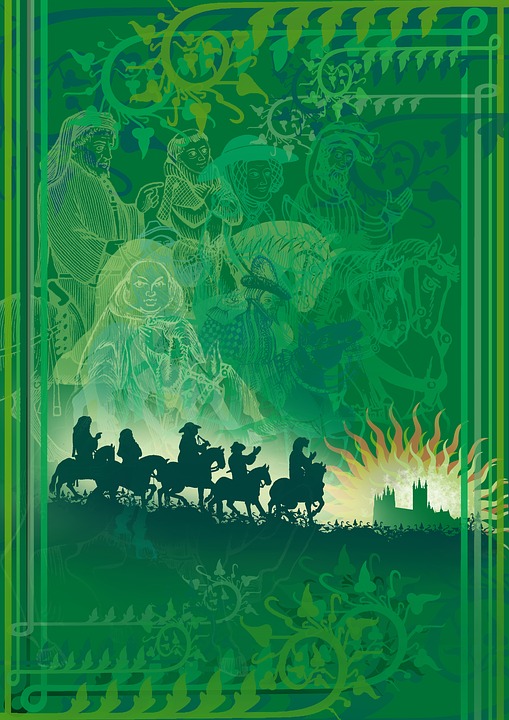
| Canterbury Tales … a fellowship of pilgrims |
Yesterday I went to see the new film about Tolkien’s early
life, starring Nicholas Hoult as the young Tolkien and the elvishly beautiful Lily
Collins as his wife Edith. As a Tolkien
geek, I liked it. How many mainstream
films have their schoolboy protagonist confidently reciting from memory the Prologue to the
Canterbury Tales in Middle English? Whether
the teenage Tolkien actually did this is not the point: the film-makers use
poetic license to show that he was an extremely clever boy with a deep, heartfelt
passion for language. The film shows the
many influences on Tolkien’s imagination: the Norse legends, the Finnish Kalevala, Arthurian myths and –
inevitably – Wagner’s Ring Cycle. (I’m
not sure that Tolkien actually liked Wagner, but I did like the scene where he attempts to treat Edith to a performance of the Ring
Cycle at Birmingham’s Town Hall, only for the young lovers to be turned away for being too poor and not posh enough). These rich
literary waters fed the springs of Tolkien’s extraordinary creativity.
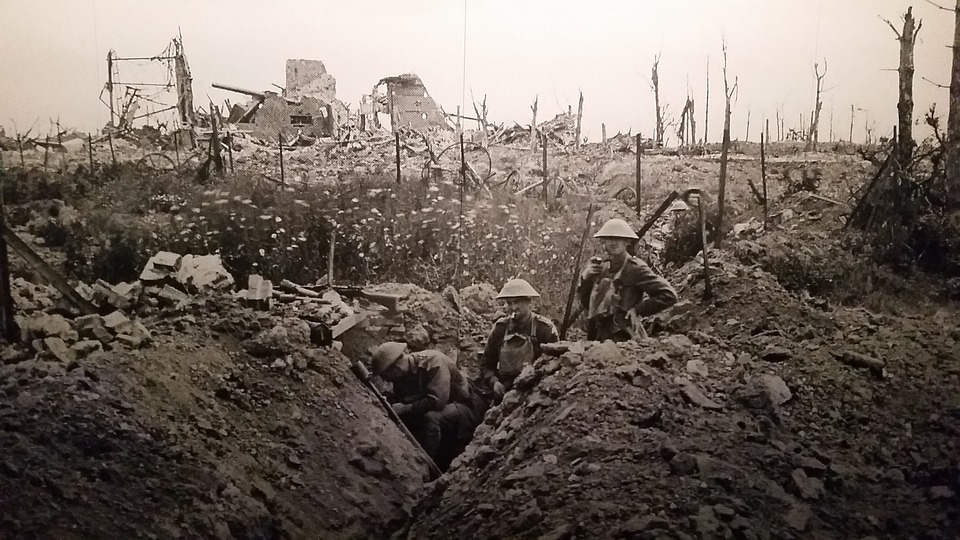 |
| Intimations of Mordor … trench warfare, WW1 |
But the young John Ronald and his brother Hilary also
suffered much sorrow, first losing their father and then their beloved mother (Tolkien
was only twelve when she died). The film includes scenes of unearthly horror: Tolkien and three of his close friends, who had formed a close
fellowship called the T.C.B.S., served as
soldiers in the First World War, and while John Ronald and his friend
Christopher Wiseman survived the carnage, their other two friends – Geoffrey Bache
Smith and Robert Gilson – did not. In
fact, Tolkien lost practically all his friends in that terrible war. War’s dark reality casts a long shadow over his
great literary creation and a deep undercurrent of melancholy, a sense of
mourning for Eden lost, pervades his work.
 |
| Creating a bridge back to Eden |
Tolkien and C.S. Lewis extolled the power of fairy stories,
legends and myths as conduits of beauty, truth and transformation which point to
a deeper truth, a deeper magic at work in the universe … the ultimate source of
world-making and creativity, the ultimate Song-maker, the Creator. We are made in the image of God and when we
create and explore and discover – as writers and poets and artists and
musicians, and also as architects and scientists and much more besides – we reflect,
in our own unique way, his vast, unending creativity and imagination.
Of course this truth is not limited to people who read
fantasy. A literary world doesn’t have
to be an imaginary one for me to find it rewarding and mind-expanding. As a child, I was thrilled as I journeyed with Bilbo
into the heart of the Misty Mountains … but the mystical power of Frances
Hodgson Burnett’s The Secret Garden,
the bittersweet heartbreak of Mary Norton’s The
Borrowers and the perils of pioneering life depicted in Laura Ingalls
Wilder’s Little House on the Prairie were
just as formative. Different kinds of
books, in practically all genres, open up our minds and hearts in different
ways.
What helps to feed the source of our God-given imagination?
What inspires us? Which
writers influence us?
writers influence us?
And how can we find our own unique voice as writers and
artists?
artists?
We may not become world-famous authors whose best-selling books
inspire an Oscar-winning movie franchise. But we can, with God’s help, tap into the deep wells of our own creativity,
and produce stories that shine a little more of his
light and love into the world.
inspire an Oscar-winning movie franchise. But we can, with God’s help, tap into the deep wells of our own creativity,
and produce stories that shine a little more of his
light and love into the world.
By Philippa Linton

