
 |
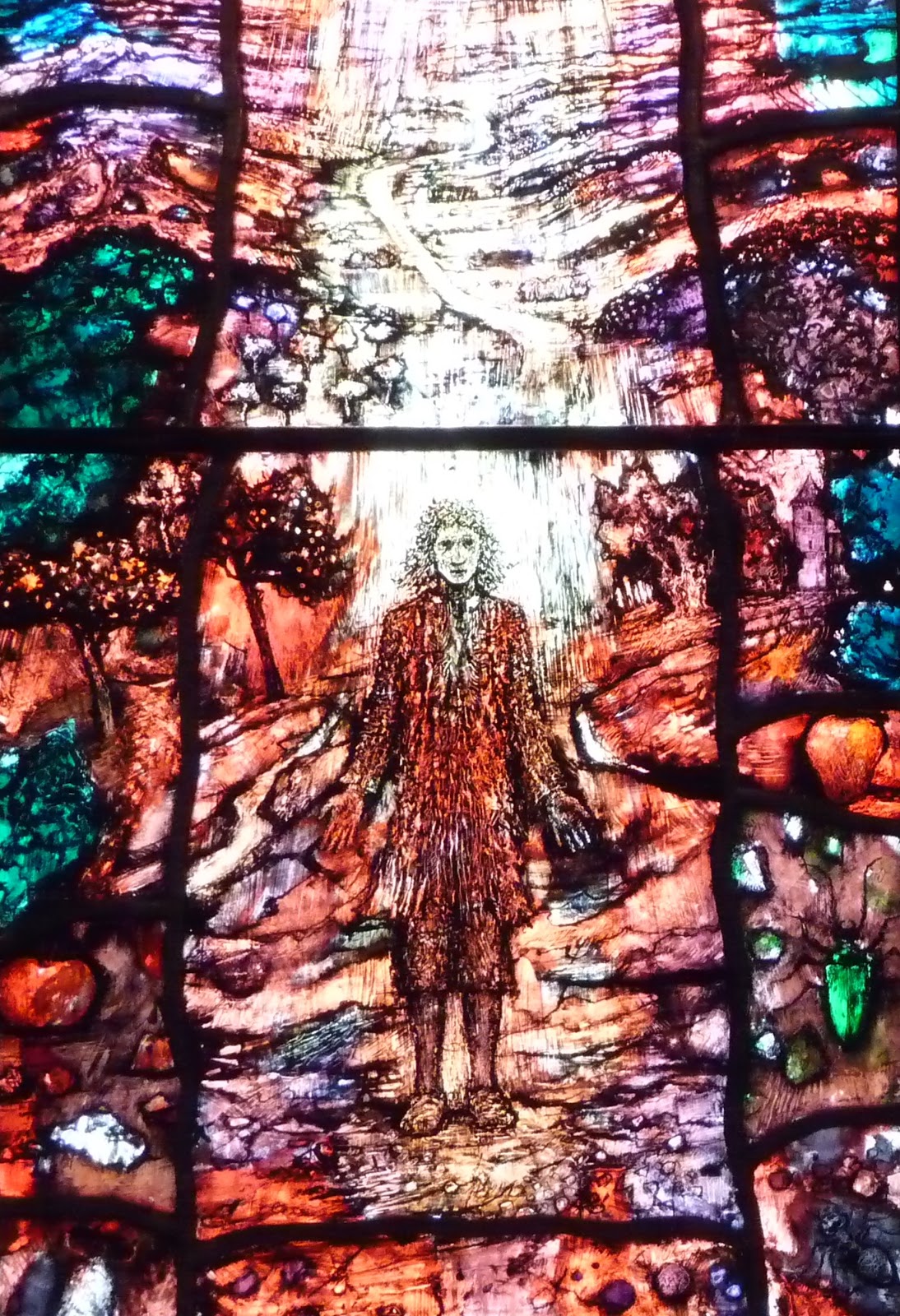
| Traherne windows by Tom Denny, Hereford Cathedral |
occasionally, I dip into the ‘Confessions of St Augustine’, which is his
personal blog written in the fourth century. I’m not really getting into
theology or doctrine here, but I want to reflect on something he says about
happiness.
Happiness is
not often talked about in the Christian life – it’s as if it isn’t deep enough
or spiritual enough to be really taken seriously. Either that, or happiness is
associated with a kind of self-indulgent naughtiness careless of common sense
or duty.
As with
Augustine, the writings of Thomas Traherne give a very profound view of
happiness as part of the Christian experience. Traherne, born in Hereford in
the seventeenth century, wrote on the flyleaf of his work, ‘Why is this soe
long detaind in a dark Manuscript, that if printed would be a Light to the
World and a Universal Blessing?’ Ever felt like that? His words would have to
wait four centuries to be published. Some of them were found on a bookstall
barrow, many have turned up in manuscript form in private libraries, and one
section was found burning on a bonfire in the 1960s and was fortunately
rescued.
So what is
happiness and where can it be found? I don’t mean the desperately forced
jollity of game shows and holiday camps, but the inner glow of life-enhancing
wellbeing that lifts our hearts. Does it just exist for the lucky and the
strong? It seems crucial to explore its nature in a world where so many around
us are stressed-out, anxious and despondent to an alarming degree.
Augustine
made some observations about happiness. Firstly, that everyone wants it. No one
would say they didn’t! A happy life, he goes on, is to joy in the truth. An
interesting statement in our post-truth, unhappy world.
How does he
argue this? Because everyone desires to joy in the truth. He says that he has
met many prone to deceive others, none that wish to be deceived. And yet many
deliberately do not choose the truth, and so forego happiness. Why? Because
‘they love truth when she enlightens, they hate her when she reproves.’ ‘…they
love her, when she discovers herself to them, and hate her, when she discovers
them.’ So the mind of man wishes nothing to be hidden from it, but wishes
itself to be hidden.
I think this
hits on something in our own experience with God. We don’t like being exposed
to truth or God’s discerning Spirit, we like to keep the power balance in our
favour. And yet happiness is found when we accept God’s love looks clear-eyed
into our souls.
Traherne was
adamant that we were created for happiness, and that happiness was allied to
active holiness, virtue and humility.
is. It is the Zeal wherewith we render unto Things their sacred value…
idea of passionately according things – and people – their sacred value. Think
how life-affirming it would be if we all lived such holiness towards our work,
our creative writing, our planet, our relationships.
Traherne saw
blessing in God’s creation and a life lived in harmony with God’s infinite and
eternal love. Ultimately, it is the generous love of God that bestows happiness
on his creation:
Greatest Happieness… I intirely Lov Him, that He is Infinite Lov to every Soul!
find the happiness of knowing and rejoicing in God’s love, truth and holiness
in a world where so often we find ourselves, as Traherne puts it, ‘Swerving
from this Glorious and Happy Life’.

