

What are your bad habits as a writer? Do you have your own set of overused words? I do: ‘all’, ‘suddenly, ‘eventually’, ‘then’’,
‘now’ and ‘lots’. I’ve known
this for a long time.
‘All’ seems to creep in ALL by
itself. We have close friends in Texas who
include ‘Y’all’ in almost every sentence they utter but I’m not Texan and in my
writing, ‘all’ has no real purpose. I
probably use this word frequently when I speak and I may be setting down on the
computer the words I would say. (But who
knows? We cannot play back our speech.)
‘Suddenly’ and ‘then’, I find
myself using as link words, often to join two paragraphs, even when an event
isn’t in the least sudden, as in ‘Then, suddenly, over a period of months, she
realised she was falling in love with him.’
Aargh! ‘Eventually’ also. ‘Eventually, the bus arrived and …’ into the
next scene at home. I find myself asking
why ‘eventually’? Why was it necessary to
the story for the character to wait for the bus, except to lead the reader into
the next scene? And now… don’t get me
started on ‘now’. The Bible makes good
use of ‘now’, as a word to move between paragraphs (see Matthew Chapter 1 verse
18 and Luke Chapter 8 verse 40) in the New Revised Standard Version. And I find myself starting sentences
with ‘And’, ‘But’ and ‘Then’ – as did those who translated the Scriptures into
modern English.
I find it is helpful – sometimes –
to cut these overused words as I go along.
However, if I am writing to a tight word count – flash, for instance – it’s
a good idea deliberately to leave them ALL… here we go again… in the
first draft, knowing that, when I edit it down to fit what is required in the
submission or competition, there are some words which are just ripe for the
pruning. Afterwards, rarely, do I feel that
their absence.
My father’s overused phrase was ‘Funnily
enough’, something which was picked up by his co-author whose own favourite was
‘And so we find…’ They wrote geography
textbooks designed to get schoolchildren through O and A level – not humorous
at all.
There are electronic ways to rid
oneself of one’s overused words. In Word
(on a Windows device), use the keyboard command Control F and enter each
overused word:
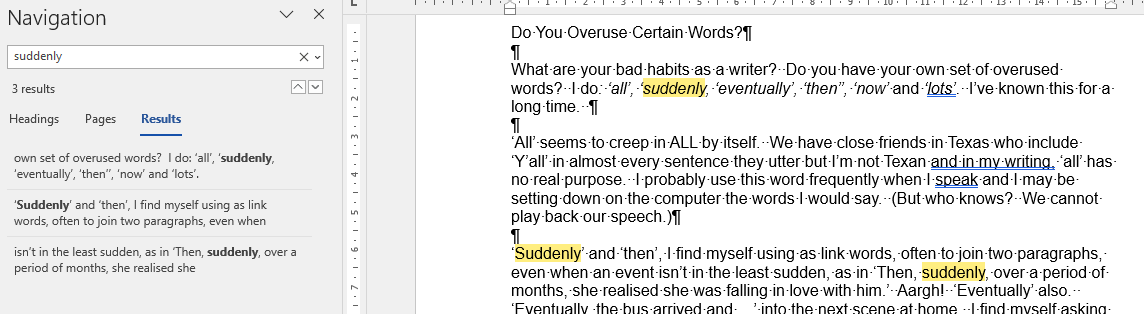
You can see how often you have
used it and in what context, then edit as necessary.
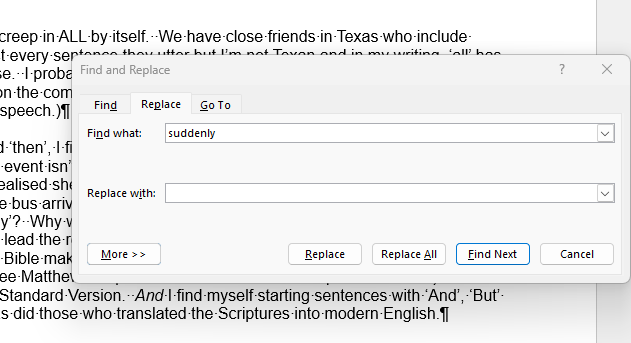
you definitely want to get rid of your particular bugbears, use the keyboard
command Control H. Type the
overused word in the Find what box and leave the Replace with box
empty. Then click on Replace All,
to get rid of all instances every instance of that word or phrase.
(For Apple machines and others,
the concept will be the same but the tools and commands slightly different.)
Which are your overused
words? How do you cope with them?

