
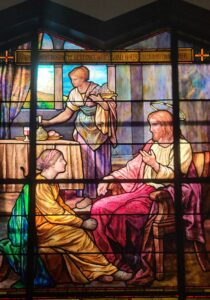
Image of Window in church in Sleepy Hollow, New York
In our bathroom, there are three decorative blocks with words printed on them: Relax, Restore, Rejuvenate. I imagine they are intended to be a mantra for bathtime, and a long soak in the bath can certainly be relaxing, reviving and rejuvenating. But these words, along with Rest, Restore and Revitalise may equally be applied to attending a retreat.
I have been a guest on three retreats (so far) presented by author and ACW member Amy Boucher Pye who provides excellent, thought-provoking programmes which leave attendees with new understanding and knowledge. Today, I am linking the content of one of her retreats to my perspective as a bereaved parent; which I have been since 2005 following the sudden loss of my 19-year-old son, James.
The relevant theme revolved around the friendship between Martha, Mary, Lazarus and Jesus. Their friendship is rich with layers of love, faith and intimacy, which Amy encouraged us to explore in key moments. “Are you a Martha or a Mary?” is a common question based on this story. It focuses on the fact that Martha is busy with, and stressed by, practical tasks, while Mary sits at Jesus’ feet, listening to his teachings. This reflects the balance between active service and passive, contemplative stillness.
In grief, it is common to surround yourself with distractions, to the point of overwhelm, to avoid confronting the pain of grief itself. But there are times when it is infinitely preferable to ‘be a Mary’ and sit with your sorrow – something that becomes easier to do as time passes.
Mary’s actions remind us that allowing ourselves to feel and be present with grief is also a way to heal. While this approach can be more painful in the moment, it opens the door to processing sorrow, perhaps finding comfort in spiritual presence, and potentially experiencing moments of grace.
When Lazarus dies, Martha and Mary express their grief in distinct ways—Martha engages Jesus with questions about faith, while Mary sheds her tears. Jesus met both Martha and Mary where they were, showing compassion for their unique needs. His tears at Lazarus’ tomb demonstrate his deep humanity and love for his friends. The shortest verse in the Bible, “Jesus wept,” captures the powerful emotions of loss and hope entwined.
Both sisters express an ‘if only’ view – in their words, “Lord, if you had been here, our brother would not have died”. How easy it is for us to play the ‘if only’ game – and how fruitless it turns out to be. Unfortunately, we cannot rewrite the page, however hard we try.
Martha and Mary were not alone in their grief; they were surrounded by a community of mourners who came to console them. This speaks to the importance of community in helping people through the grieving process. For the grieving, the presence of friends, family, or a faith community can provide comfort and a reminder that we are not isolated in our pain.
In grieving a loss, both approaches—Martha’s busyness and Mary’s quiet reflection—are valid and appropriate at different times. Sometimes, busyness is a lifeline to get through the day, and at other times, quiet reflection brings the release needed to begin processing the loss.
Following Lazarus’ resurrection, at a meal in his honour, Mary anointed Jesus’ feet with expensive nard, wiping them with her hair. Here, Mary shifts from quiet contemplation to active service, moving from sitting at Jesus’ feet to doing something physical and practical. Her actions remind us that, in grief, both stillness and action hold meaning—whether in honouring the present, preparing for the inevitable, or living with the aftermath.
I am grateful for the guidance of an expert retreat leader such as Amy to interpret the Lazarus story in such depth, which has broadened my understanding of grief. Drawing parallels between these ancient narratives and modern emotions adds a layer of meaning to how I process loss, for myself and for others whom I support in grief.
At the conclusion of the weekend with Amy, I believe we all agreed that we are part Martha, part Mary throughout life. It is just the balance that shifts.
Devon-based Andrea Corrie BEM is a writer, editor, speaker, retreat leader and water safety advocate.
Blog at: https://andreacorriesblog.wordpress.com/
Living in the Mourning Light (2020) and Into the Mourning Light (2014) by Andrea Corrie available at https://www.amazon.co.uk/Living-Mourning-Light-Andrea-Corrie/dp/1916271804

