
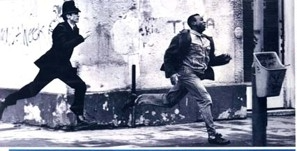
The picture above of a white police officer running behind a black man appeared as a recruitment advert for the Met Police in the late 1980s. It generated a lot of interest and opinions, which I guess was the point. Essentially, it invites us to complete the story.
Our minds are powerful storytelling machines. Whoever we are, whether we are writers of fact or fiction, or not writers at all, our minds are constantly telling us stories. Humans can take a snapshot of information and instantly fill in the blanks. From the picture above, here’s just some of many potential scenarios:
- They are both running from an angry and dangerous mob.
- They are both running towards something unseen to render help.
- The black man is a plainclothes detective.
- The black man is a criminal.
- A typical scene of racist police harassment.
- Fake news, an early example of AI.
- They are both hungry, and the chip shop is about to close.
The picture is staged so there’s no ‘correct’ answer, but whatever you first thought, where did your preferred story come from? Your own life experiences? The news you hear about what’s going on in your area? Did you revert to prejudice or stereotypes to complete the scene? If you think you’re above such things, I’m sorry to burst your bubble, but we all do exactly that, consciously or otherwise. Our brains make sense of the world by sorting all our incoming data through a complex layer of filters that have been forming within us since birth. When information is missing, we complete the story in our own way.
I’ve written a short story featuring a drifter woken in the night by an electric storm after a heatwave (written before recent events!). It ends with them collecting driftwood on the beach before fading away like ‘rain on hot cobbles,’ which is the title of the piece. That’s a quick overview of a story which, in its entirety, contains less than five hundred words.
Short stories demand economy, but not only to hit a word count. It’s also knowing what you really want your reader to take away. As the writer, I know all about my fictional drifter. In my head, I know their gender, appearance, age, and what they’re wearing. I know the town and the name of the cobbled street, none of which I included because it would only distract from a tale about being dislodged from our comfort zone and moving on. I might have my preferred image of the drifter, but I must leave the reader to see what they see. They are not ‘wrong’ if they see things differently. Your picture might differ from mine, radically perhaps, but the second I release my words to you, I no longer own them.
Whatever you are currently writing, what detail have you included that’s a distraction from the meaning behind the piece? Why is it important for your future reader to see things as you do? What could you allow the reader to decide for themselves?
Picture Credit: Metropolitan Police Archives

