
 |
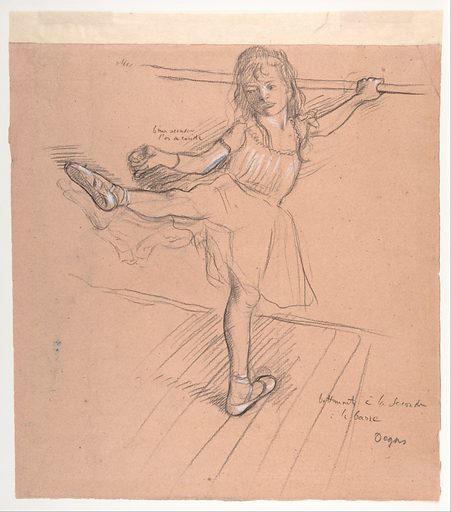
Degas: Little Girl Practicing at the Bar free public domain image |
Sometimes the most powerful and affecting art is the simplest: a
Picasso line drawing, a preparatory sketch by Degas or da Vinci. A
simple line can suggest so much, and the space around it allows the
observer to use their imagination and fill in the gaps.
I
have a print of an unfinished painting by Albrecht Durer above my
desk. There’s something about the emptiness in the painting that
intrigues. What did Durer plan to put in that space? What would I put
there? So much to reflect on, more than if the landscape had been
completed.
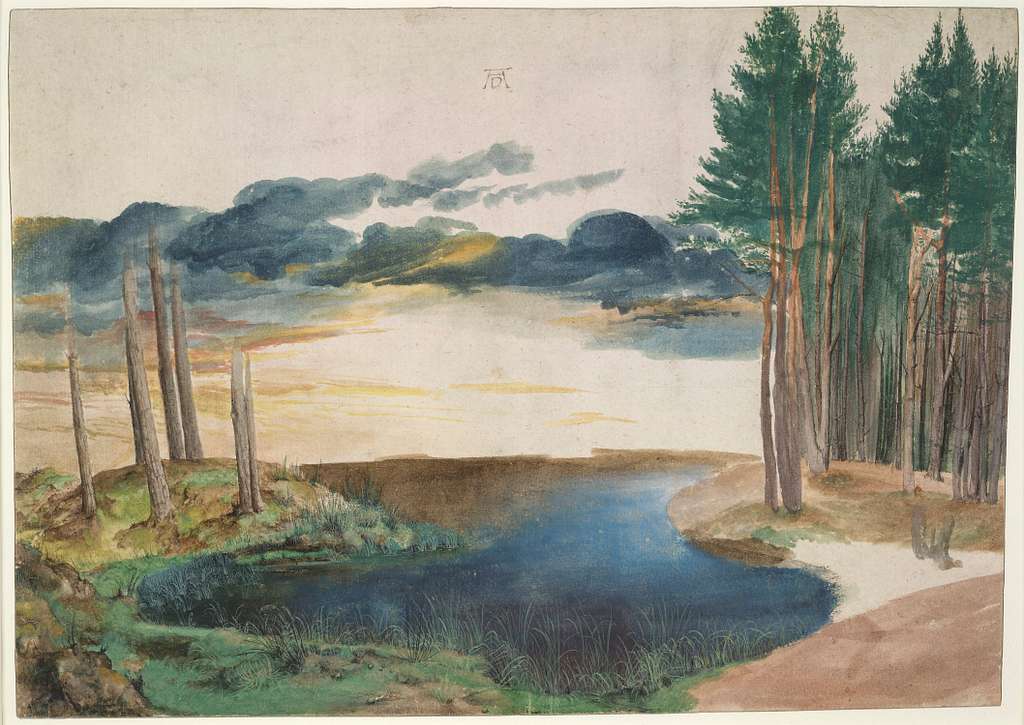 |
Albrecht Dürer – Der Weiher im Walde (ca. 1497) – PICRYL – Public Domain Media |
If I drew a few lines on a page, they wouldn’t be powerful or
evocative. An unfinished picture of mine would look abandoned, not
intriguing. It’s not the simplicity that makes a piece of art powerful. It’s
simple lines drawn by someone who knows what they’re doing. Who has
placed those lines precisely and with a lot of care.
In
writing, less is often more. It’s better to suggest an emotion
rather than state it, to allow the readers’ imaginations to fill
the gaps. But it takes skill to suggest, it’s easier to tell.
Writing more can often be quicker than writing less. Fully describing
the scene that’s in your head is more straightforward than giving
just enough to lead the reader where you want them to go.
There’s
so much depth in Jesus’s 1 or 2 verse parables; books have been
written unpacking what they mean. But which speaks more powerfully to
us; the 200 page book or the 2 verse parable? Jesus knew that we
learn more when we are forced to consider his words and work out for
ourselves what it means to follow them. When we use prayer together
with our imaginations, our experience and our friends to puzzle out
how to live as a Christian today.
The
16th century writer Francis Bacon said, ‘reading makes a
broad man, but writing makes an exact man.’
Before
we write, whether it be a sermon, an article or a novel, we need to
research. Read around the subject, go down rabbit-holes to issues
that will never find their way into our writing. Broaden our minds.
And then when we’ve planned and thought and read as much as we can,
we write, making our writing as precise and as simple as we can.
I
can’t remember who said this to me, but it stuck. ‘Why use an
unusual word when a common one says the same thing? It’s just
showing off. Why fill your writing with adverbs when a well-chosen
verb can communicate the same message in shorter, less flowery
prose?’
We
need to hone our writing skills so that we are precise and our lines
look as effortless as a Picasso drawing. Then we can allow readers to
bask in the space and let their imaginations fly.


