
 |
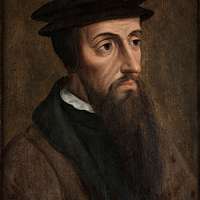
| Jean Calvin 1509-1564 |
I heard these words in passing, as we History Honours students huddled together in a corridor at university, attired in hired gowns over best dresses/suits and clutching the mortar boards which we would be entitled to wear in a few minutes’ time, after graduation. Just one of us had a job offer, the louse from my Reformation in Europe course, who, immediately before finals, had dumped his girlfriend of two years and was now going out with her best friend. He had a management job with a shoe company. Of the rest, a large proportion were about to start PGCE courses. After spending most of my final year studying the Reformation in intense detail and writing a thesis about its impact in the Midlands, I was about to begin a secretarial qualification (a ‘postgraduate’ secretarial qualification, as if this made it any better). This was how I began my circuitous career path towards teaching computing, because – really and truly – no employer needed a historian.
I didn’t use my history until I started researching my historical novel, Wodka, or Tea with Milk, which is set during the Solidarnosc years in 1980-81 in Poland. And even then, I was using, not facts, but historical methodology: trust primary sources before secondary sources; find the bias of the author of your source and then interpret it through his/her bias; the dreaded validity (Does this information emanate from a trustworthy source?) and reliability (Is this information repeated elsewhere?)
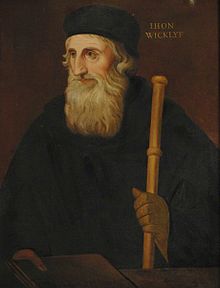 |
| John Wycliffe 1328-1384 |
Imagine then my excitement, a few weeks ago, when I was asked to review two books on Reformers, from the A Long Line of Godly Men series, for Together magazine. (All ACW members receive Together in electronic format, from a link in the eNews). Oh, Dear Reader, I even had a choice of Reformers and, after much deliberation, I opted for John Wycliffe, the very first person to question the medieval Catholic establishment, and that firebrand in Geneva, Jean Calvin. So, as I read these books, did everything I learned at university years ago come back to me? Er… no. Although the historical background was still familiar, I realised that my university courses had done little more than skim the surface, and what I was finding out about these great Christian visionaries was all new to me.
Reading these two books has made me think about the role of history in school and university curricula. Education is not just about preparing learners for employment, but about teaching life skills. History is important because, through history, we learn about who we are. This is very important. Well researched historical novels can support this understanding. A badly researched and one-sided historical novel, however, can do a lot of damage.

