
I’m going to make a bold claim that will, no doubt, slither into the sands of obscurity, but “Halfway to Cambridge” is a saying first coined by John S. Stevens on Friday 1st September at 10.36 in a dusty layby on the A43. And it is all mine, hands off, it’s copyrighted, and has a triple-patent-lock filed in an obscure building secluded somewhere underground.
Other phrases and lyrics with place names are arguably more famous: Johnny Cash’s ‘I’m going to Jackson’, or Paul Simon’s ‘I’m going to Graceland, Graceland, Memphis Tennessee’ or Kennedy’s “Ich bin ein Berliner“ are contenders.
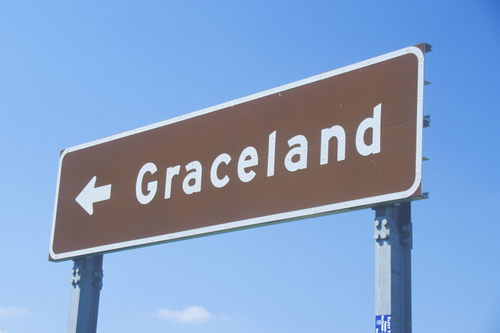
Never mind, we’re not put off by obscurity, are we?
Here are the facts – which, as facts often are, rather irrelevant.
I was en route to Ridley Hall, Cambridge, to attend the British Christian Writer‘s Conference when my mobile pinged. I needed a quick break anyway, so pulled into a dusty layby to read the text. It was from a friend who had left secondary school with no qualifications and yet, later in life, had just passed a rigorous set of exams and assessments to become an accredited and professional Counsellor. To quote him: ‘Today I reached my greatest personal achievement’.
I haven’t asked him if tears were shed but I wouldn’t be surprised. Tears of joy and relief, rolling back all those troubles of yesteryear, and greeting a new future, an open door to walk through, all legitimate reasons to let the tears fall.
In my reply I said: ‘Am halfway to Cambridge. Congratulations! Will call you…’.
But the phrase ‘Halfway to Cambridge’, even as I was typing them, took on layers of meaning I hadn’t anticipated, mostly amusing, like noticing someone had drunk maybe one too many Proseccos at a wedding reception or a gentle observation of human frailty; perhaps an alternative to ‘mad as a bunch of frogs’, but also as state of mind, grappling with a new or fresh idea.
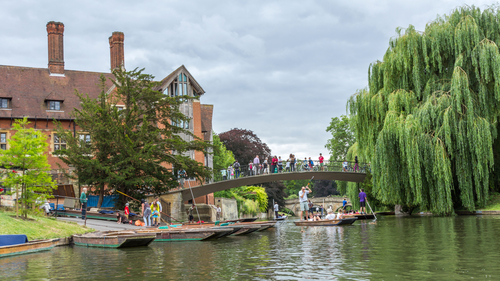
An hour or so later I was parking the car at Ridley Hall ready to enjoy Friday’s Retreat led by Ian Adams. Thence to be bathed in Cambridge’s wonderful architecture including Christ’s College where I was staying overnight. There was also a Cambridge gin & tonic with a few others thrown in at the riverside pub, Granta, in the late afternoon, and breakfast the following morning at the Copper Kettle, and numerous amusing, friendly, and informative conversations with fellow writers during the two days.
Obscurity?
To me, at any rate, there seemed to be a sub-theme to the two days, tucked away, if not quite out of sight. Ian Adams based much of the Retreat on the life and times of Julian of Norwich, the Anchoress, famous for writing The Revelations of Divine Love, an account of a series of mystical visions she had, called ‘shewings’, in 1373.
The point being that her writings lay more or less undiscovered, in obscurity, for 300 years and now, almost 700 years later, sell prodigiously in several languages around the world.
The sub-theme, then, is actually a question, or a series of questions. Why am I writing? What are my true motivations? Are my motivations from God, to God, through God to others? If so, then perhaps anxieties bound up with notions of ‘success’ can be allayed and find their true proportion, but no longer be like a tail wagging the dog?
Obscurity is not the aim, but we begin to see it in its true light. It turns out that obscurity is an illusion. After all, if the eyes of heaven are on our writing, nothing’s ever obscure or truly lost.
I am still pondering, still letting the questions sink in and have their full effect. I’m definitely Halfway to Cambridge.

