

Here in the snow, as I currently am, it is hard to
imagine how it was for Jesus, fasting in the heat of the Negev Desert, where he
was tempted by Satan.
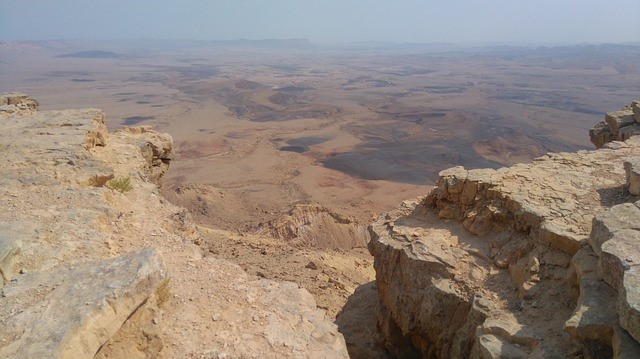
The Negev is mile upon mile of ginger-hilled nothingness.
There are deep canyons with dried up riverbeds – wadis – where, in winter, flash
floods may snuff out all forms of life, including human, without warning. In
summer, the intense heat is crushing and life-sustaining water hard to find.
To this day, hikers frequently get themselves into perilous
situations.
Although we remember Lent at this time of year, but no
one can say when Jesus was actually fasting in the desert –midbar in
Hebrew. All we know is that, ahead of Satan’s tempting, he was hungry and that
angels ministered to him.
What was Jesus doing during those forty days and forty
nights of fasting.? Why was he there?
John the Baptist had just confirmed him as, “the Lamb
of God who takes away the sin of the World,” (Jn1:29). A Voice from heaven had just said, ““You are
my Son, whom I love,” (Mk1:11).
It seems to me that Jesus was there to process what he
had heard. He wanted to talk– medaber in Hebrew – to God. Where better
to medaber than in the midbar? The consonants of the two words m-d-b-r are
identical. Since Hebrew is written without vowels, they are written the same:
מדבר
We can only imagine what they talked about. I would
suggest that God talked to Jesus about his mission, should he choose to accept
it.
Perhaps they talked about how his ministry would
begin. Jesus would emerge from this time out of time at a wedding celebration
in the Galilean village of Cana. Here, he would assume the role expected of the
bridegroom by providing the wine. Only, unlike other bridegrooms, he miraculously
transformed it from water intended for purification. In doing so, he laid claim
to those who followed him as his bride.
God would have talked, too, about how Jesus’ ministry
would end. On the cross, his death would echo the sacrifice of the Passover
Lamb, whose blood was daubed on the Hebrew slaves’ doorposts in Egypt. It would
save them to life. The Passover sacrifice would be combined with atonement
sacrifices made on the Great Day of Awe – Yom Kippur. Jesus’ sacrifice
would take away our sins and free us to eternal life.
As we know, Jesus did accept God’s mission. It had always
been his destiny, since the Angel Gabriel first hailed his mother Mary as highly-favoured
and declared to her that the Lord was with her, (Lk1:28); since Simeon, held him
as an infant in the Temple and recognized him as the Messiah, prophesying that, “this child is destined to
cause the falling and rising of many in Israel, and to be a
sign that will be spoken against,” (2:34); since Isaiah and other prophets of
the Old Testament wrote down what they had heard from God about the Messiah.
We, too, can find out our mission by taking time out
of time in the midbar, (not necessarily an actual desert, but a place of peace
where we can connect), a place where we can medaber with God.
In my next post – 3rd April – I will
explore ways we can do that.

Bobbie Ann Cole, Christian
writer, speaker and writing teacher is currently writing The Messiah’s Mother, Mary’s PainfulJourney to Disciple.
Check out her writing courses for Christian writers
and her popular free groups at http://bobbieanncole.com.

