
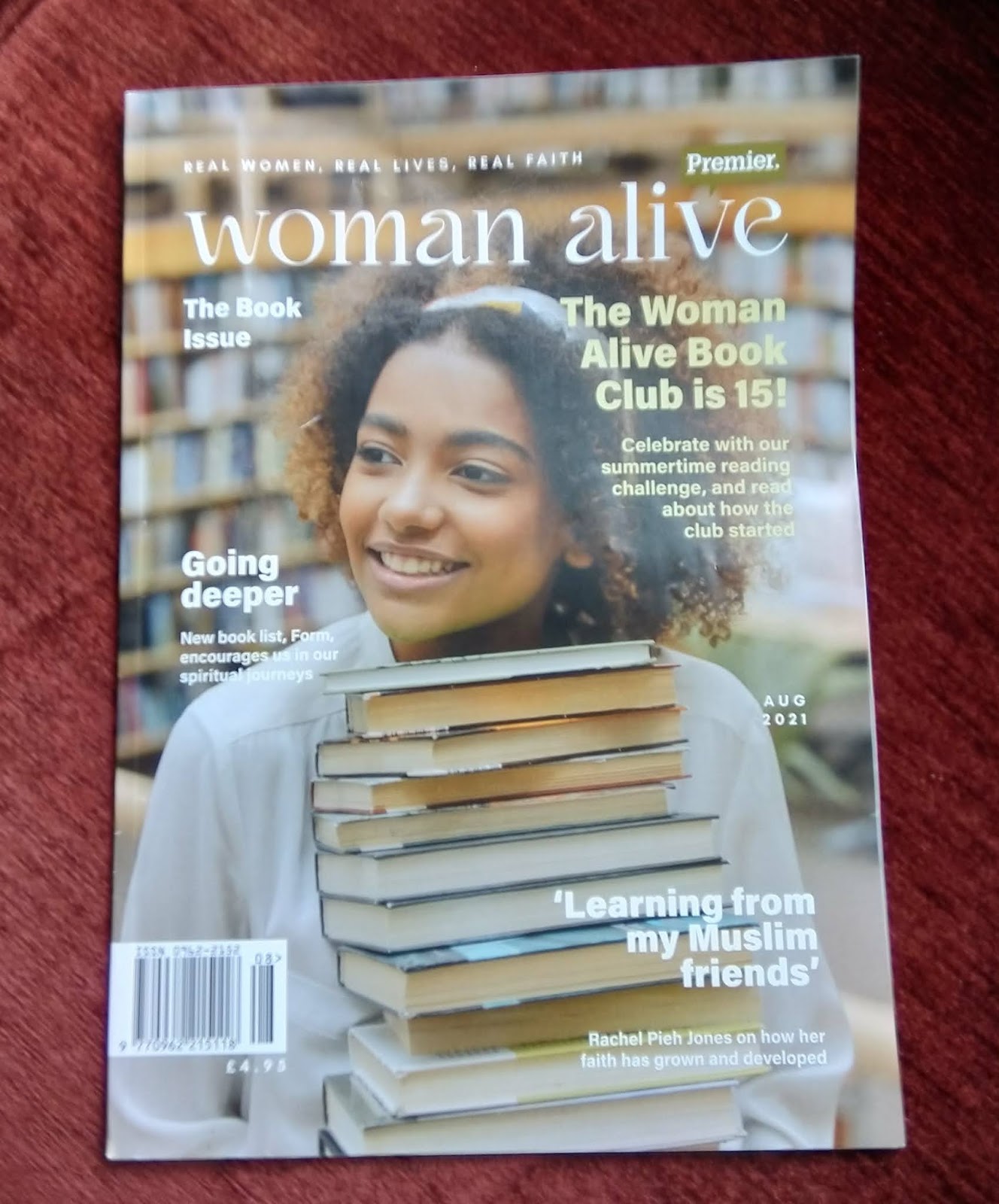
My brother kindly pays for a subscription to Woman Alive magazine
as my annual Christmas present. This month, it’s had a books theme and one
article particularly held my attention.
Emma Randall is an illustrator. She didn’t follow her
mentors’ expert yet conventional advice for her career but has found success after
taking a year out and following God’s direction. She gives five tips for budding
illustrators which, reading them, resonated and I think they very much apply to
writers too:
1.
Ask God: What do You want me to do with the
talent You have given me?
I think this has to be the key to our success
as writers.
It would be so easy to assume the only real
success for a writer is publication and sales. But God has a different definition
to the world and isn’t held by such a narrow rationale. That’s not to rule it
out, as so many of our members prove, but we need to look beyond this one idea.
So what does His success look like for you?
Is it a blog post that speaks to one or more people, letting them know they are
not alone? Is it faithfully collating and editing the church newsletter? Is it
using your specialist knowledge to share technical discoveries? Is performing
your own poetry that puts experiences into words that others can’t express? Is
it writing sermons for your local church or liturgies for your national one?
Most importantly, have you stopped to ask
God this question?
2.
Work hard at it: Be diligent and
disciplined
Recent posts on this blog have talked about
seasons of writing and times when it’s OK to stop writing. I find it difficult
to know when I’m in a fallow period, when I need to allow other things to take priority
over writing, and when I just need to be more disciplined! If you have any tips
in how to distinguish between these, please share them in the Comments.
I think that’s where having a deadline, a
regular responsibility, helps. For me, that means the Five Minute Friday community
and this blog, working in other writing as my confidence grows around these habitual
commitments.
3.
Always be yourself: Be inspired by others
but don’t be a clone
I find this such a hard one.
Even here in ACW. I am surrounded by such
talented people, many of them so much further along the writing journey than I
am. I wish I was in the middle of writing a sequel to a comedic heartfelt novel
like Ruth Leigh. I wish I was a multi talented author of detective fiction and
children’s books like Wendy Jones. Or had published a truthful funny account of
my job like Fran Hill. Or had the courage to submit my work to BBC Sounds like Deborah
Jenkins. Or. Or. I wish. I wish.
I need to accept that God has made only one
of each of these people and only one me. Only I write what He has shaped from
my life. Time to look up instead of out.
4.
Don’t take criticism of your work
personally: Learn from it.
Actually, I think I live in a very kind
world and possibly have the opposite problem. Family, friends, the Five Minute Friday
Community, my local ACW group all concentrate on being encouraging. Of course,
the best criticism is constructive not destructive. But we all need a bit of reigning
in, pruning back, redirecting to grow vigorously.
But putting writing out into the public
sphere in any way feels a bit like parading naked! Our stories, poems,
anecdotes, all carefully crafted and nurtured, are our babies. Just as when our
children leave for the first time for nursery, school, or university, we are
trepidacious for how the world will treat them. Our words, like our offspring, are
a part of us. Reactions and criticisms can wound.
I know I need to step back and remember my
blog posts and poems are not my children. How do you deal with criticism? Is it
easier when you ask for it than when it is unlooked for? And how do you craft
your responses to someone else’s work?
5.
Keep going: Know your worth in God as an
artist.
Maybe this is the most important of Emma
Randall’s tips.
God has given us this talent for a reason.
He puts us in places where we can grow and develop it to His glory. Let’s not bury
it in the ground like the third servant in the Parable of the Talents, especially
out of fear. The owner in that story must have had confidence in his servants in
order to give them those talents to invest – you can hear the frustrated
disappointment in his reaction to the third after celebrating the success of the
previous two.
How much more confidence must God have in us
to given us this talent of writing?
He gave us this urge to express ourselves in
word, surely in order for us to use it? He trusts us and wants us to reach our
full potential, which is surely another way of saying live our lives in all
their fullness?
Liz Manning fits writing around being an Occupational
Therapist, BB captain, wife, and mum to two adults. Or perhaps it’s the other
way round. She blogs regularly at https://thestufflifeismadeofblog.wordpress.com/,
has one WIP and more ideas in the pipeline.

