Some years ago, a close friend of mine, who knew she was
dying, held a ‘celebration of life’ service.
It was a beautiful, poignant service, and the church was
full of family and friends. As we filed out, we passed a lone piper, the music from
her bagpipes ringing out across the Scottish hills.
The piper was called Doreen. I’d met her briefly the
previous day, when she collected me from the train station. I chatted further
with her at the Ceilidh that night. She drove me to the station the following
day, we said goodbye, and that was that. Or it would have been, if not for
Facebook.
One of us friend-requested the other, and so we stayed in
vague touch.
Recently, we’ve been chatting more. Doreen, from – and
currently in – America, but splitting her time between there and the UK, was
interested when I told her about the ‘Clap for Carers’ we do over here. She worked
out the time difference, and declared that at her equivalent of 8pm UK time on
Thursdays, she would play her bagpipes in solidarity with us.
So followed a discussion about bagpipes.
Doreen sent me a picture of the music she’s currently
working on.
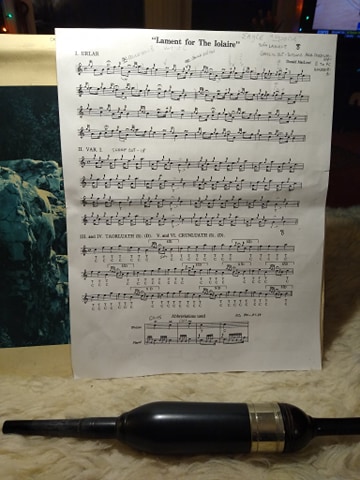
It is a long time since I’ve really read any sheet music.
What were those little notes above the main notes called?! I wracked my brains,
and asked Doreen if they are called trills?
Her answer? Those are Grace Notes.
My response: What are Grace Notes?
I quote her answer here:
‘The little notes on the pipe music are the “grace
notes” and it takes ages in the beginning to learn them properly and then
to be able to play them very fast on the themal note. But they
are what give pipe music its soul really, for without grace notes it’s just notes
without much feel.’
(I don’t have space to properly unpack all that here, but
feel free to do so yourself.)
Grace notes are notes added to accentuate and embellish the
other notes.
‘…they are what give pipe music its soul really, for
without grace notes it’s just notes without much feel.’
As Christian writers, do we have a grace note equivalent?
Perhaps ‘Grace Words’. Words from the heart of God. Words which embellish the
writing we can produce on our own.
Doreen pointed out that it takes a long time to learn the
grace notes properly but, without them, the music has no soul.
Perhaps it takes time to learn Grace Words, too. Time in
which we learn to tune into the very heart of God, so that it is His voice
which echoes through and beyond our writing.
The music Doreen referred to is, she told me, the ‘piobaireachd’,
and is the equivalent of classical music for the pipes.
It’s very old music, and is not played by most pipers.
Piobaireachd – and therefore the Grace Notes within it – is
old.
Grace Words are old, too. God’s words, resounding since before
the creation of the world.
Time and again in the Bible, and through other Christian
writers, we see people catching hold of God’s echoes and framing them into Grace
Words.
Piobaireachd is not played by all pipers.
Grace Words are not written by all writers.
The majority of writers in the global book market are not
writing with God in mind (note: I say this as observation, not fact).
But we, as Christian writers, are. We write with God in
mind. We have the opportunity to write Grace Words into our manuscripts.
But only if we take time.
Time to learn to recognise words God whispers in our hearts.
Time to learn how to write them.
And then be able to play them fast on the themal note.
The themal note is the main note, the note which Grace Notes
embellish.
As we learn Grace Words,
as they embellish the ‘themal note’ of the writing we
produce on our own,
as they are absorbed into our natural language,
we will write from God’s heart more and more.