In a previous post, I mentioned an affection for the writings of P G Wodehouse, one of the funniest writers of the 20th century.
Wodehouse’s full name was Pelham Grenville Wodehouse which gives me even more reason to like him. He added ‘Sir’ to his name in 1975 or, at least, the Queen did.
Wikipedia tells me that Wodehouse published ‘more than ninety books, forty plays, two hundred short stories and other writings between 1902 and 1974’.
I might be going off him now because that’s just boasting.
But, pick any paragraph, any page, any chapter. Like the word ‘Blackpool’ in a stick of rock, comedic techniques run all the way through Wodehouse’s writing. They’re the same techniques used by joke writers, stand-up comedians and any other kind of humorist. And we can use them too if we’re trying to be funny.
I’ll use one of his Jeeves and Wooster stories to illustrate. At the beginning of this story*, Bertie Wooster, a young gentleman-of-leisure, gets ready for the day, aided by his valet, Jeeves. Jeeves informs Bertie that he knows Bertie’s hapless friend, Bingo, is keen to speak to him. Bertie then goes for a walk in the spring sunshine, and runs into Bingo. Bingo persuades Bertie into a cheap local cafe much to Bertie’s disgust. What he doesn’t realise at first is that Bingo is hopelessly in love with the waitress and is hoping Bertie will approve …
So, to the techniques.
1. Reversal of expectations and norms
One reason that Wodehouse’s Jeeves and Wooster stories are so popular is the subversion of character stereotypes. Although Jeeves is the valet, he is streets ahead of his ‘master’, Bertie, in every way. He is Wodehouse’s equivalent of Shakespeare’s stock character ‘The Wise Fool’ who sees things his superiors don’t. Bertie grudgingly accepts Jeeves’ superiority, most of the time.
For example, in this chapter, as Bertie gets ready for his day, he asks Jeeves about some shirts. He tells us:
‘Talking of shirts,’ I said, ‘have those mauve ones I ordered arrived yet?’
‘Yes, sir. I sent them back.’
‘Sent them back?’
‘Yes, sir. they would not have become you.’
Well, I must say I’d thought fairly highly of those shirtings, but I bowed to superior knowledge.
Bertie’s immediate, unquestioning submission to Jeeves’ unilateral decision is a clear breach of class norms but is what makes us laugh.
In some of the stories, Bertie’s pride is hurt and he tries to re-assert his authority over Jeeves. Needless to say, he fails. Wodehouse can’t have him succeed. The stories rely on this reversal.
2. Understatement
Understatement involves using implication and suggestion, trusting the reader to infer the true meaning. That’s why it has to be done well.
For instance, that morning, when Jeeves informs Bertie that his friend, Bingo, wants to see Bertie urgently, Bertie tells us this:
I wasn’t what you might call in a fever of impatience …
We learn so much about Bingo’s character and about Bertie’s attitude from this wry comment. And it’s the exaggerated ‘fever’ metaphor that provides the entertainment. It wouldn’t be half so funny had Bertie said, ‘I wasn’t what you might call impatient.’
3. Comic use of sound effects
Sound effects such as alliteration (repetition of consonant sounds) aren’t merely for poets. Advertisers use them all the time. Pick up a Penguin. Have a break, have a Kit-Kat. We love word-play even as adults and, combined with sound-play, the results can be comical.
Wodehouse draws on sound effects as Bertie explains to us who Bingo is.
He’s the nephew of old Mortimer Little, who retired from business recently with a goodish pile. (You’ve probably heard of Little’s Liniment – It Limbers Up The Legs.) Bingo biffs about London on a pretty comfortable allowance given him by his uncle …
There’s so much here. Not only does the playful alliteration make Little’s Liniment seem like a comical product, in contrast to the serious ointment it was no doubt marketed as, but the use of the bracketing trivialises it further. It’s tossed aside as though it doesn’t matter.
This is social satire, poking gentle fun at class and wealth, and it’s reinforced by the alliterative description of Bingo biffing about London. It makes him sound as though he’s doing nothing of worth, which of course he isn’t! Wodehouse is satirising the leisurely lives of gentlemen, living off relations made rich on the sales of an ointment.
Perhaps he’s also poking fun at those customers who bought it.
4. Bathos (anticlimax)
Bathos – a form of anticlimax – only works well when there is a clear build-up and then a big DROP!
During the morning, Bertie decides to go for a walk. He allows the lovely spring weather to uplift him. He describes it thus:
… the sky’s a light blue, with cotton-wool clouds, and there’s a bit of breeze blowing from the west. Kind of uplifted feeling. Romantic, if you know what I mean … on this particular morning it seemed to me that what I really wanted was some charming girl to buzz up and ask me to save her from assassins or something …
But, Bingo then pitches up. Bertie says,
I merely ran into Bingo Little, looking perfectly foul in a crimson satin tie decorated with horseshoes.
The anticlimax usually relies on this stark contrast between hope and reality. Wodehouse achieves it here by gradually layering up Bertie’s expectations of the day and his transformation into a romantic hero. Foolish Bingo’s arrival in a ghastly tie couldn’t be more different from Bertie’s fantastical imaginations about how the day might turn out.
5. Outrageous exaggerations
It sounds obvious, but comic exaggeration works best when it’s exaggerated. It has to be outrageous, unreasonable and ridiculous.
Bertie and Bingo, having met up unexpectedly (at least on Bertie’s part) are now in the cafe of Bingo’s choice. Bear in mind that these two normally eat in more refined establishments.
Bertie’s first descriptions of the cafe are as a ‘blighted tea-and-bun shop’ and a ‘God-forsaken eatery’ so things don’t look promising. He’s confused about why Bingo has even chosen it.
The waitress appears, and we have Bertie’s description of Bingo’s reaction to her.
The man was goggling. His entire map was suffused with a rich blush. He looked like the Soul’s Awakening done in pink.
Can you see how Wodehouse builds this up? Each sentence is more outrageous than the previous. He caps off the description with a cultural reference recognisable to his readership: ‘The Soul’s Awakening’ is a famous religious painting and comparing Bingo to this is a genius touch. Readers love cultural references they recognise. It makes them feel that the writer trusts them to ‘get’ the association.
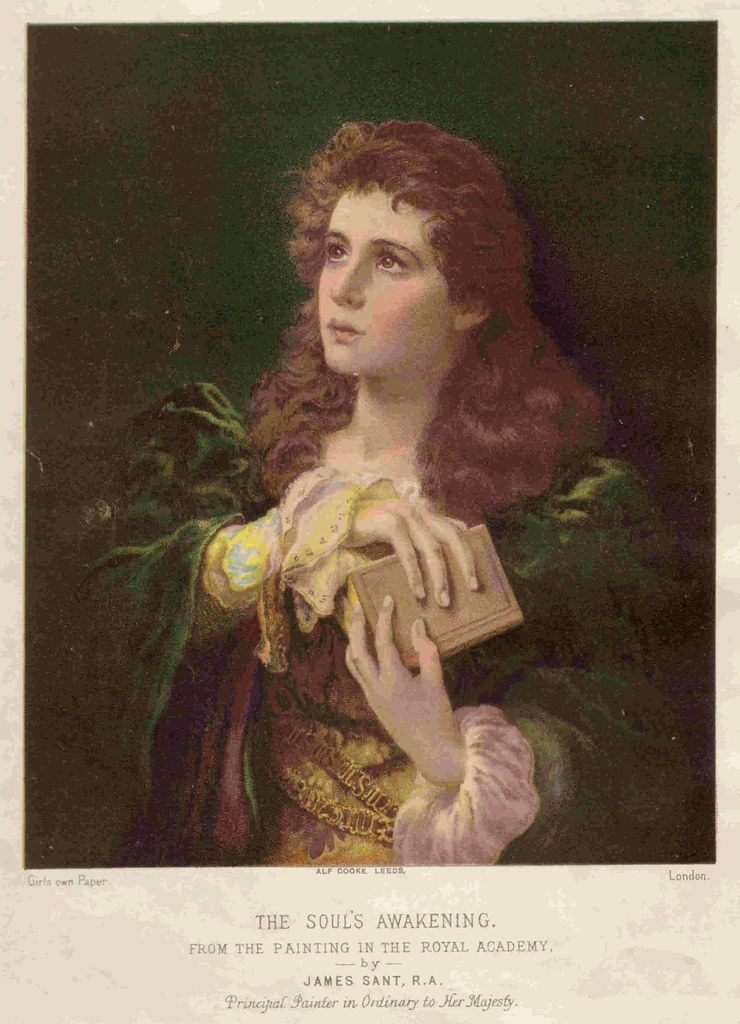 |
| This is the mentioned painting |
Then, the waitress comments on Bingo’s tie, which has already been described to us by Bertie and which we realise is a gift from her. ‘It suits you beautiful,’ she says. (Note the grammatical joke, with which Wodehouse places her firmly in her working-class place.)
This is Bertie’s opinion on the tie.
Personally, if anyone had told me that a tie like that suited me, I should have risen and struck them on the mazzard, regardless of their age and sex ….
Google tells me that ‘mazzard’ was slang for ‘head’ but who cares? It sounds wonderful, whatever part of the body it is and contributes towards Bertie’s exaggerated and horrified reaction to the tie.
When they order food, Bertie’s exaggerations go even further.
A roll and butter and a small coffee seemed the only things on the list that hadn’t been specially prepared by the nastier-minded members of the Borgia family for people they had a particular grudge against ….
The mention of the infamous, criminal Borgias isn’t enough for Wodehouse. It has to be the ‘nastier-minded members’ and ‘people they had a particular grudge against’ for the comic exaggeration to do its best work.
In this article on a P G Wodehouse-dedicated website Stephen Fry discusses more of Wodehouse’s methods and explains how Wodehouse has influenced his own writing. He talks about a key technique Wodehouse uses in the Jeeves and Wooster stories: having Bertie narrate them in first-person so that we have his inner commentary and observation on the events.
Let me know in the comments if you’re a Wodehouse fan, and why.
* Chapter 1 – ‘Jeeves Exerts the Old Cerebellum’ – from ‘The Inimitable Jeeves’

Fran Hill is a writer and English teacher based in Warwickshire. Her new book is being released on 21 May. It’s called ‘Miss, What Does Incomprehensible Mean?’ and is a funny but life-affirming memoir in diary form of one year in a teacher’s life. You can find out more about Fran and her work by going to her website here