
 |
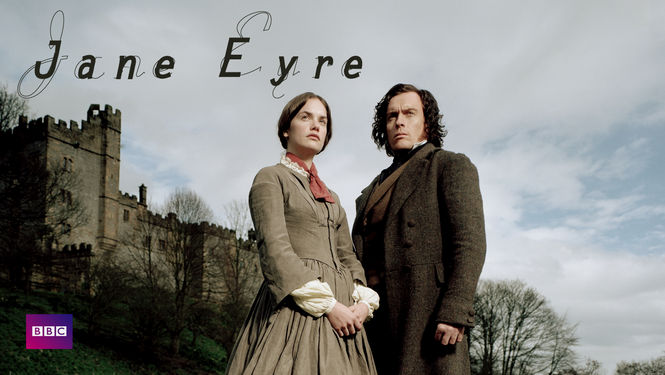
| The BBC’s 2006 adaptation of ‘Jane Eyre’ |
Some years ago I saw Charlotte Brontë’s original manuscript
of Jane Eyre at the British Library.
of Jane Eyre at the British Library.
Cliché alert: a thrill went up my spine
when I saw Charlotte’s exquisite copperplate handwriting. Her writing was disciplined and neat but also quietly
explosive and energetic – all those curly d’s and curling y’s – as if Jane’s story was flowing steadily
out of Charlotte’s mind and she had to get it down on paper as fast as she
could. The page was open at the point where Jane first encounters Rochester,
when she is walking to town and inadvertently startles him as he is riding on horseback.
He passed, and I went on; a few steps, and I turned: a sliding sound and an exclamation of “What the deuce is to do now?” and a clattering tumble, arrested my attention. (Jane Eyre, Chapter 12)
One of literature’s great iconic
moments: the heroine meets the man who will change her life forever.
moments: the heroine meets the man who will change her life forever.
Seriously, a shiver did go up my spine:
the thrill of seeing Charlotte’s handwriting, of seeing Jane and Rochester’s first meeting on the page, was like an electric shock. There
lay an imprint of Charlotte’s authentic self, the visible proof of
her genius – the colour of the ink had faded but the sparks of Charlotte’s
vivid creative energy hovered there. Here was a magnificent novel being birthed
and brought to life. I could see the tracery
of the author’s creative process, like a tree and its branches, as her story
flowed out from her imagination and her heart.
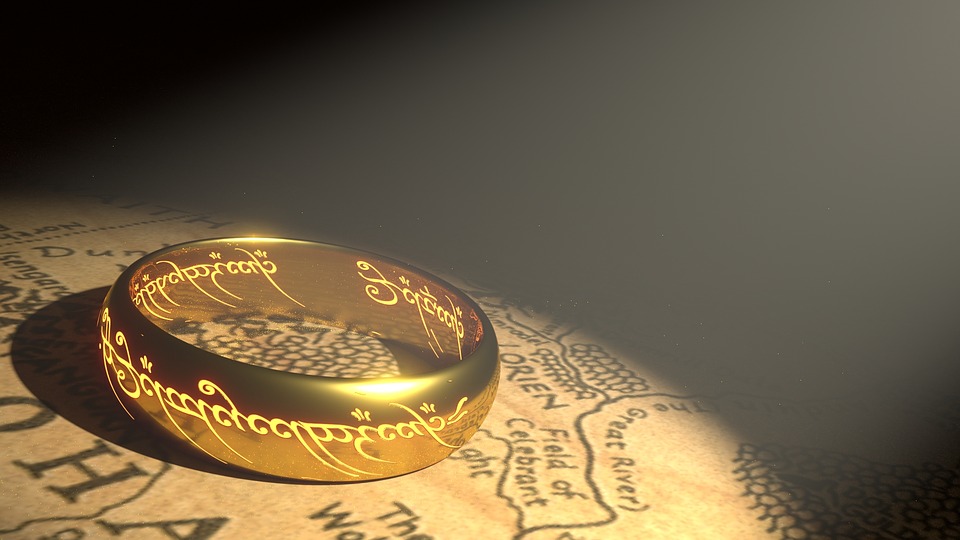 |
| The One Ring (Pixabay) |
J.R.R. Tolkien said of his own great opus, The Lord of the Rings, that it was ‘written in my life-blood … and I can
no other.’
no other.’
I guess that is
true for all great authors and artists – that their truest, deepest work, the greatest
expressions of their genius and their gifts arises deep in their heart and soul
and therefore their work is written and produced ‘in their life-blood’. I certainly felt like that on seeing
Charlotte’s writing. I could almost feel
her excitement, her passion, her utter commitment to her characters and her
story.
A great work of art takes on a
life independently of its creator, which is one of the things that fascinates
me about the artistic process. It’s a
mystery and a miracle, how that happens. Echoing Tolkien again, he took the view that
we are sub-creators, reflecting the imagination and capacity of our good
Creator when we create secondary worlds.
The same is true when we produce ground-breaking works of art that help in
some way to shape culture and the world itself.
I am no Brontë or Tolkien … I have a writing gift, but I would never compare it to the great authors
and artists who inspire me. Nonetheless,
the flame of imagination and creativity is there, and I believe God put it there. And just as a great book can inspire us to
think more deeply, live more attentively, perhaps even to love more deeply and try
to change the world around us for the better, so I can commit my small gift of writing,
this small flame, to God and ask Him to help me change the world around for me –
for the better.
By Philippa Linton

