
In Matthew 5: 37, Jesus tells us, “All you
need to say is simply ‘Yes’ or ‘No’; anything beyond this comes from the evil
one.’ (NIV).
need to say is simply ‘Yes’ or ‘No’; anything beyond this comes from the evil
one.’ (NIV).
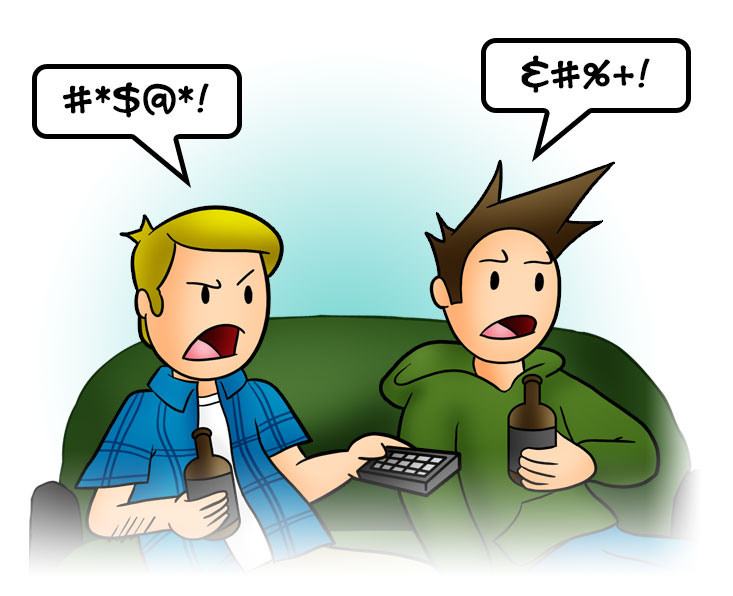 However, most of us don’t write about saints, and real
people living in the real world swear. So,
how do you compose dialogue for a character who is potty-mouthed? Marya, in my work in progress, has just
bungled her Cambridge University interview and, after a bad night, alone with a
bottle of wine, is telephoned by her sister at seven am. For several weeks, my typescript had her
telling her sister to “F- off”, but, at the last minute, before sending that
chapter to members of the ACW Email group, I changed her words to “Shut
up”. In that instance, I think “Shut
up” worked, but it’s not always possible to find words of equal meaning and
impact.
 My parents told me that the f-word was
so totally beyond the pale that I wasn’t to use it – ever. However, when I was teaching teenagers, they
used the f-word every few minutes, often in place of very, and, as a football supporter, especially when my team was in free-fall out the Premiership, I have heard a lot of language, often conjuring up sexual imagery and actually quite comical. What I do find offensive is
‘Oh my God’, often shortened to ‘OMG’. My former students used to argue that this was
okay, because they weren’t using naughty words. Then they would ask me if I was religious, another pejorative term – see
Clare Weiner’s post last week.
The challenge, in writing, is getting across the ferocity,
and dirtiness, of potty-mouthed speech, without using potty-mouthed
language. People do swear, when they’re
angry, when they’re disappointed and – particularly – when they’re
frustrated. If we’re writing about conflicts,
our characters are going to experience all these emotions and they must be
able to express them in a natural way.
Maybe…
- We should include characters’ facial expression,
the way they are holding themselves, and actions, such as shaking fists. This will not be easy, or always appropriate. - Some words – such as sexual and lavatorial words
– are less unacceptable than others, provided
they are not directed at any specific person, gender, ethnic or other group. - We should search for non-profane but evocative
words; to my mind, potty-mouthed is one of them because it conjures up many
unpleasant images and scenarios.
I don’t have a ready answer.
I would be interested to know what other writers think.
Rosemary
Johnson has had many short stories published, in print and online, amongst
other places, The Copperfield Review,
Circa and Every Day Fiction. In real
life, she is a part-time IT tutor, living in Suffolk with her husband and
cat. Her cat supports her writing by
sitting on her keyboard and deleting large portions of text.
Originally written by Rosemary Johnson

