
Earlier
this month I had the honour of being at an awards dinner with the crème de la
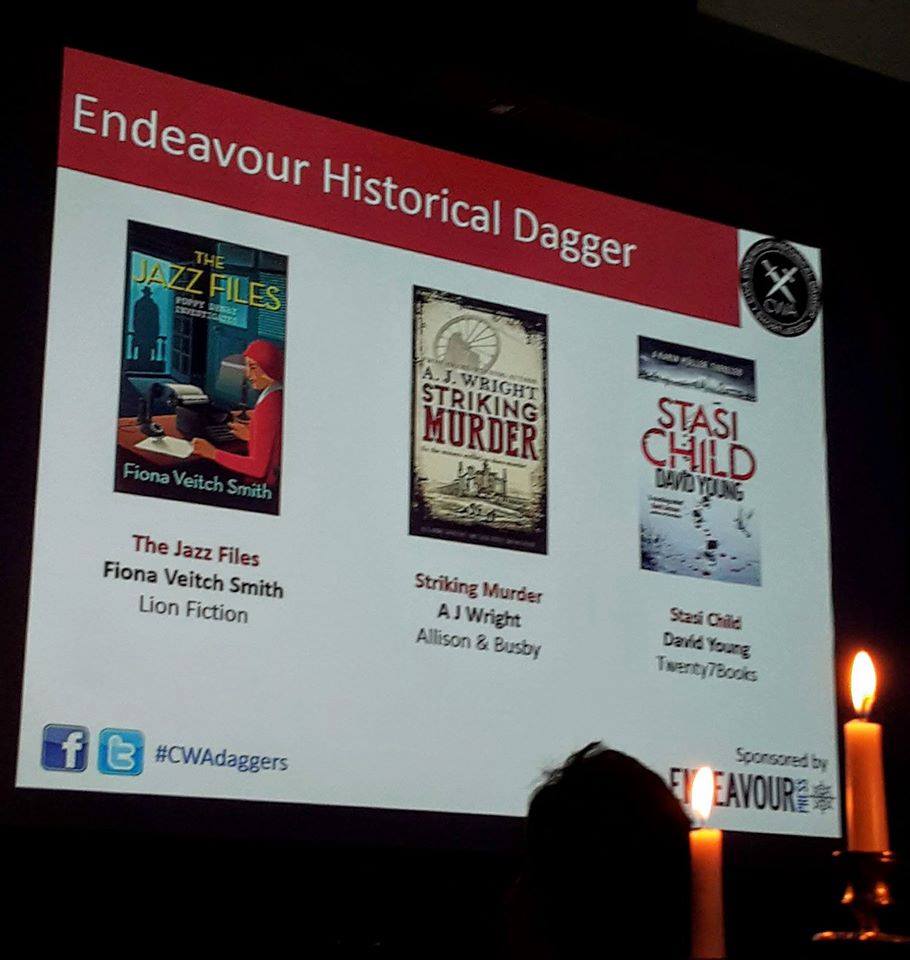
crème of British crime and mystery writers. My debut crime novel, The Jazz Files, had been nominated for the
Crime Writers’ Association Endeavour Historical Dagger – awarded for the best
historical crime or mystery novel published in theUnited Kingdom
this month I had the honour of being at an awards dinner with the crème de la
crème of British crime and mystery writers. My debut crime novel, The Jazz Files, had been nominated for the
Crime Writers’ Association Endeavour Historical Dagger – awarded for the best
historical crime or mystery novel published in the
I was
supported by friends and colleagues from my publisher Lion Hudson. We had a
fabulous evening, dressed up to the nines and served a top-notch meal, before
the business of the night got underway.
supported by friends and colleagues from my publisher Lion Hudson. We had a
fabulous evening, dressed up to the nines and served a top-notch meal, before
the business of the night got underway.
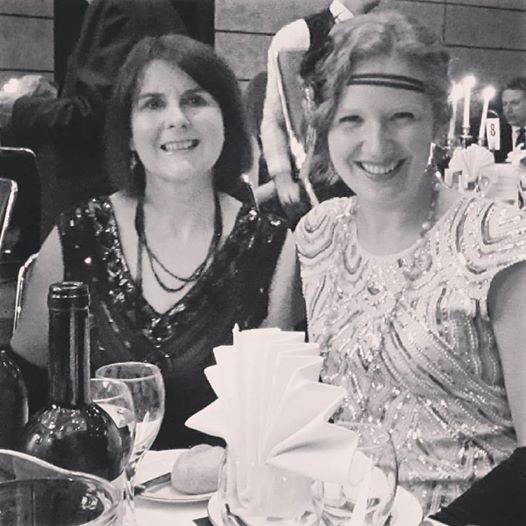 |
| Me (left) and my editor Jessica Tinker at the awards. |
The main
speaker of the evening was James Runcie, the author of the Grantchester Mysteries, about a vicar who
is an amateur sleuth. It is now a TV series. James pointed out that as a genre
crime offers an opportunity to morally examine humanity – at their best and
worst. Religion, as we know, also deals with the stuff of moral transgression
and the resultant need for the world to be put to rights. My publisher, Andrew
Hodder-Williams, suggested that perhaps that was why the crime genre was such a
good fit for Lion Fiction, an imprint of the Christian
publishing house, Lion Hudson.
Since the
days of GK Chesterton and Father Brown, clerical mysteries have been
a thriving sub-genre of the crime scene. From a Christian writer’s perspective,
the character’s job gives the author an excuse to bring a bit of faith into the
stories. However, it also offers plot opportunities as the clergy encounter the
best and worst of humanity on a daily basis, and are often privy to people’s
secrets, sins and lies.
Runcie
commented: “I hope to have written a loving portrayal of a man who moves between
the world of the spirit and the all too mortal world of the flesh, bicycling
from Grantchester toCambridge
unloveable, forgive the sinner, and to lead a decent, good life.”
commented: “I hope to have written a loving portrayal of a man who moves between
the world of the spirit and the all too mortal world of the flesh, bicycling
from Grantchester to
unloveable, forgive the sinner, and to lead a decent, good life.”
The
Christian imperative, encapsulated so beautifully here by Runcie, is not just
the preserve of the professional clergy. So what about books where the main
character is just an ‘ordinary’ Christian? That is a harder ‘sell’ to
publishers and the secular book-buying public. In modern literature, as in
modern life as a whole, people of faith are generally viewed with
suspicion. Lion Fiction is trying to
change that. Elizabeth Flynn’s DI Costello for instance is a police
officer who happens to be a Christian. In Paul Trembling’s debut Local Poet, the main character is not a
Christian but he encounters people who are, and who positively model Christian
compassion and forgiveness. But there is not a ‘professional’ Christian in
sight.
In my
novels in the Poppy Denby Investigates series the
protagonist, an investigative journalist, is the daughter of Methodist
ministers – so that I suppose could be considered an ‘excuse’ – however, she
grapples with the faith in which she was raised. Hence, she is someone outside
of the traditional church establishment and perhaps, because of it, is more
relatable to non-Christian readers.
What all of
the books above have in common is that they deal with issues of justice and the
notion that the world cannot be set to rights while injustice goes unchecked.
And, unlike crime novels without a spiritual dimension, there is a sense that
God is the ultimate arbiter of that justice. Like Nathan exposing David’s
murder of Bathsheba’s husband in the Bible, the heroes of our books have a
strong sense of what is right and wrong and that justice needs to be served. We
need to be aware though that not all our readers share our faith and a
heavy-handed ‘preach’ that God is the ultimate judge would not be appropriate.
Oh, before
I forget, I should probably tell you that The Jazz Files did not win. It was
pipped at the post by a wonderful crime thriller by David Young set in 1975,East Berlin , called Stasi Child. Was
justice served? I’ll leave that for you to decide ;)
I forget, I should probably tell you that The Jazz Files did not win. It was
pipped at the post by a wonderful crime thriller by David Young set in 1975,
justice served? I’ll leave that for you to decide ;)
Fiona
Veitch Smith is a writer and writing lecturer, based inNewcastle upon Tyne . She writes across all media, for
children and adults. Her mystery novel The Jazz Files, the first in the Poppy Denby Investigates Series
(Lion Fiction) was nominated for a CWA Historical Dagger in 2016. The second
book, The Kill Fee is out now, and the third is
due out next year. Her children’s books The Young David Series and the Young Joseph Series are published by SPCK. Her novel The Peace
Garden is self-published
under Crafty Publishing.
Veitch Smith is a writer and writing lecturer, based in
children and adults. Her mystery novel The Jazz Files, the first in the Poppy Denby Investigates Series
(Lion Fiction) was nominated for a CWA Historical Dagger in 2016. The second
book, The Kill Fee is out now, and the third is
due out next year. Her children’s books The Young David Series and the Young Joseph Series are published by SPCK. Her novel The Peace
Garden is self-published
under Crafty Publishing.
Originally written by Fiona Veitch Smith

