
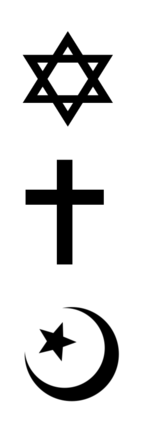
 |
| Just 3 of the faith symbols of UK communities today, (source, Wikipedia) |
BBC Radio 4’s Sunday is always a diverse programme, covering many religious topics beside Christianity. Three items specially caught my attention this week.
1. Don’t Write Jedi!
The Atheists’ Foundation of Australia is anxious about the upcoming Census. Anxious that people don’t ‘waste their vote’, they’re urging that you take courage, be honest, and tick the ‘no religion’ box, said the upbeat atheist interviewed by Sunday. Why? Well, for Australians to discover discover if they, like the UK and New Zealand, have a diverse society with a majority who simply have no religion at all. Not committed to secular humanism, or to atheism? No religion is your box. No map, no guide, and no community who think like you…
2. Citizen of a country where the ‘official’ religion is not yours …?
Meanwhile, at the ‘Living Islam’ festival (a kind of Islamic Greenbelt, held this past weekend), two women from ‘other faiths’, Sughra Ahmed, Chair of the Islamic Society of Britain, and Rabbi Laura Janner Klaussner, senior rabbi to the Movement for Reform Judaism, were to appear in a panel discussion. The subject was whether their country, the UK, should continue to have a ‘state religion’, at present the Church of England.
Sughra Ahmed, interviewed on the Sunday programme, argued that we should. She appreciates the C of E as a stable and decent force for good, which accepts the diversity of other religions in our country, while also keeping a religious side (acknowledging God) to public life. We all, she felt, might hopefully see the C of E, as our ‘state religion’, functioning a bit like a benign umbrella which protects those of other faiths. (My words not hers.)
Rabbi Laura preferred the monarch to be ‘defender of faiths’. She saw this as acknowledging that we have many faiths within our population. She backed this up by mentioning the place of Roman Catholics and Nonconformists within the Christian, but non-C of E, group. She also, possibly relating to the historical precedent of the Holocaust, expressed some apprehension about the C of E as a state religion. Our present Archbishop Welby, she said, is a good head of the Church of England, but is there any guarantee others in the future would be as tolerant? One third of his remit is, apparently, evangelism. Evangelism could be a threat to other faiths: after all, what does or could it mean? She has a point, even though we in ACW would not necessarily agree. Try imaging being an ‘other faith’; in a country which has an official religion.
So what is diversity?
Here we see two, opposing, examples of the attitudes to what is called ‘religion’. One, which would like to see ‘religion’ (however they define it) dying away, leaving nothing in its place. Nothing to disturb, challenge, care and protect, comfort or assure. Nothing which demands obligations or unites in joy and praise to the Other, the ‘divine’, God. The census box you can tick if you live in Britain, New Zealand, or Australia, and your vote will be counted in the stats (on policy making).
Or an option of retaining a diversity, or number of differing, and unique, ‘faiths’ (note not ‘religions’) within a society. These seek to live harmoniously alongside one another, in a world where life has developed in such a way that religions and countries don’t necessarily demand we all think the same thing. And the two women, specialists in their areas, suggested two alternate ways of this being worked out.
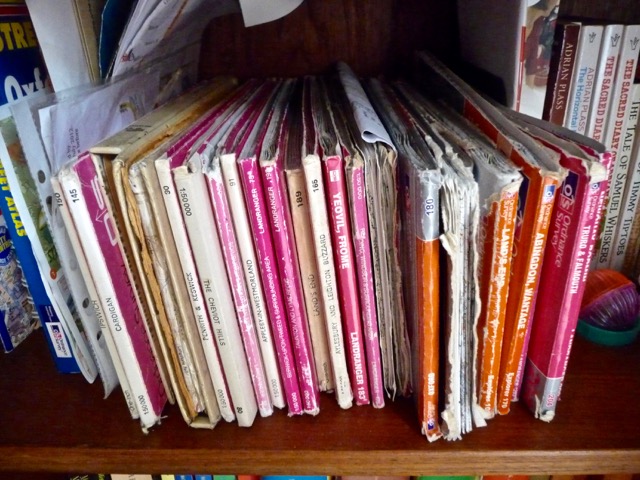 |
| Our map collection (and some books – is that a Plass? To the right?) Faith beliefs are a kind of ‘map’ … |
Life without a Map
Personally, I find that census box creepy. Quite how anyone decides that ‘no religion’ is a practical way to live as a community is mysterious. Try imagining it. What exactly would ‘no religion’ mean?
After the thousands years of human cultural development, to totally excise every cultural aspect of society which is grounded in something, someone, greater than ourselves, can only be possible by scratching out all vestiges of what we call ‘moral’ or ‘ethical’ behaviour, or indeed, ‘human rights’. As communal living patterns have been worked out, the actual sense of the law being given by God has declined. But the imprint of what we call ‘religions’ remains. Remove the basis totally, step away from ‘secular humanism’ or ‘atheism’ — which attempt to maintain ‘the most useful/easiest bits’ (of Christianity, in Western society) and there is nothing. The house built on sand, falls.
‘No religion’ perhaps describes a blind hedonism. Or putting policies in place of faith? Of making no reference at all to any wisdom from scriptures or spirituality? Or of human wisdom built up over eons of time? It is something which may work for the individual if and while they are in control of their own, individual, life.
A scary, sobering thought. Where can secular societies of ‘no religion’ find themselves in a few generations’ time?
‘Things fall apart; the centre cannot hold;
Mere anarchy is loosed upon the world …’
(from The Second Coming, by W.B. Yeats, 1919 – apposite lines, though Yeats’ religious beliefs were unorthodox, these lines well describe a breaking down of society)
Note the countries which give the no-religion option. In many non-Western places, the Church is strong. What can Christians do for a Western World heading towards an ideal of holding no basis or direction other than, presumably, each person getting a good life for themselves? Saving the planet is even a ‘religion’ of sorts, a faith placed in the worth of the planet, with its amazing eco-systems, the flora and multiple creatures including ourselves, along with the elephants, tigers, and all other endangered species. Humanists believe in humanity’s qualities, atheists possibly in energetically denying the existence of God. But no religion …?
And how best to include those of other faiths? Other than none?
3. Meanwhile, in another part of the wood…
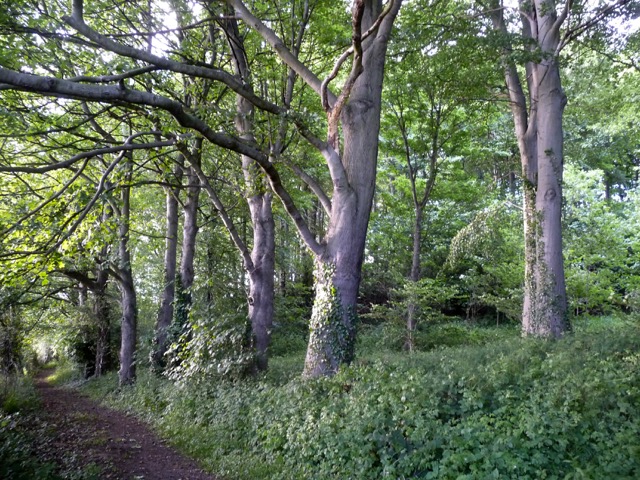 |
| Woodland, Shincliffe, Durham: how many diverse species live in these trees, this undergrowth, this leafmould? |
Up to or maybe over a million young people gathered in Krakow, Poland, for a Catholic youth rally. Some from Australia, others from Indonesia, and from Europe and South America. The young people were bubbly and enthusiastic as they sang, chatted, and waited for Mass, celebrated by Pope Francis, to begin. Faith for them was not dead, and diversity was represented in a crowd of many, many nationalities.
So, three options on ‘diversity’ …
Finally …
‘God is nice. He likes (us).’
(from Adrian Plass, The Sacred Diaries of Adrian Plass, aged 37 3/4, reproduced from Tony Collins, Taking My God for a Walk)
If only the ‘no religion’ people knew that God likes us … even while knowing our faults and our arrogance, he wishes us well… and a great deal more is on offer, through grace … they might take a chance on … a map …?
Mari Howard’s website is having a make-over. The blog will then move to the website.
Meanwhile, Her blog is at
Mari Howard’s website is having a make-over. The blog will then move to the website.
Meanwhile, Her blog is at
Originally written by Mari Howard

