
A fellow Mennonite and I have a little game in which the title of a
book plus its author make up a sentence, for instance The Courage To Be
Paul Tillich, or Jesus Asked Conrad Gempf (or indeed, David Watson You
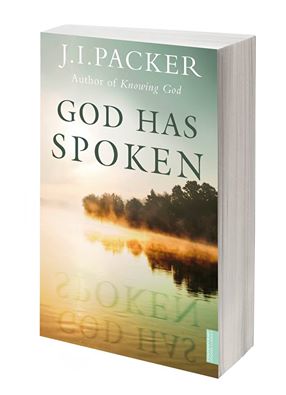
Are My God!). I’ve found a new one recently, in a reissued classic: God
has Spoken by J I Packer. Can’t wait to tell her (apologies for all these
titles being by men – can’t think of any by women at the mo, please
supply my deficiency in the comments…).
That last one
has given me pause. Has God spoken by J I Packer? I’m inclined to
answer Yes, though I haven’t read the book. Not in the sense, perhaps,
that God spoke by Isaiah, Jeremiah, Simeon or Anna, or even the five
daughters of Philip. But certainly, there will be
many people who have
read the book and heard God speaking through it. Jim Packer (or any
Christian writer) might not think of himself as a conduit for God’s
utterances, but then I have a theory that St Paul, writing letters of
encouragement or challenge to the churches he had founded, probably did
not think he was writing Scripture. Nevertheless, church leaders
collected his writings and those of others as especially holy and
authoritative, because of the unique relation they had to the life of
Jesus on earth.
Now I don’t want to suggest that Jim
Packer, or any of us, are writing new Scriptures. There’s a dire warning
at the back of the Bible for those who think they can add to it.
Nevertheless, Jesus promised his Spirit would lead us into all truth.
So while we may not be writing with the same authority as the early
church writers, we can write under the inspiration of the same power
that inspired them.
Sisters and brothers, I find this
scary. When I write daily Bible notes, I do not want my readers to take
what I write as Gospel. It is merely my reflective response to a Bible
passage, in its context and hopefully informed by two thousand years of
prior interpretation . My aim is not to give a final or binding reading,
but to inspire my readers to apply their own thought to the passage; I
want them to approach my words critically, and indeed to approach the
Bible passage critically, not in the sense of finding fault with it, but
in the sense of reflecting imaginatively on its many meanings for
different people and times.
 If the Holy Spirit ever
speaks to someone through my faltering words, I am honoured and humbled
(or, as I heard a sportsman say on TV the other day, ‘humbled and proud’
– how does that work?). That neither makes me verbally infallible, nor a
‘mere channel’, like a tin can telephone: God speaks using our God-made
talents, experience and insights. That means I should write carefully
and prayerfully, but not ‘scarefully’; my readers, in turn, have the
duty to ‘test the spirits’, and not take what I write without
questioning it boldly. That way, we may reach a common understanding;
for the gifts of the Spirit are given for the body, the community of
Christ, not for individuals to show off their talents.
Veronica Zundel is a freelance writer whose latest book is Everything
I know about God, I’ve learned from being a parent (BRF 2013). She also
writes a column for Woman Alive magazine, and Bible notes for New
Daylight. Veronica used to belong to what was, before it closed, the only non-conservative, English
speaking Mennonite church in the UK, and is currently churchless. She also blogs at
reversedstandard.com

