
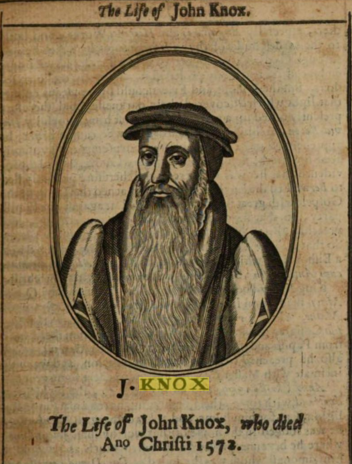
As I’ve been saying in previous blogs, C. S. Lewis in English
Literature in the Sixteenth Century
displays a wonderful balance of critical analysis and sympathetic insight. He
brings out for us the strengths of the era, so that we may profit from them,
while not hiding their dark side—a side that is unfortunately quite familiar
today.
figures of the Reformation in the British Isles (especially for Scots). Having
been brought up a Northern Ireland Presbyterian, Lewis was well placed to
understand Knox’s faith from the inside.
where he was already in exile, to the Continent. From there he wrote the Epistle
to His Afflicted Brethren in England,
‘full’, Lewis tells us, ‘of his exulting certainty that the persecutors will be
punished in this life and in the next’. Lewis comments ‘it is impossible to
suppress the uneasy remembrance (even though we dare make no judgement) that these fiery exhortations are uttered by a man
in safety to men in horrible danger’. Those are my italics: Lewis’s reactions
are more charitable than mine would have been.
outrageous pamphlet’, the English congregation at Frankfurt protested to
Calvin, no less, had ‘added much oil to the flame of persecution in England’.
Lewis again: ‘Knox is already becoming the enfant terrible of Calvinism; and in the Admonition we see both why and how.’
Amazingly, Knox thought of
himself as a culpably gentle preacher; he felt that he had sinned by not
speaking out plainly enough, not being fervent enough. And this, says Lewis,
for a reason that no one who had
ever met him would suspect: ‘My wicked nature desired the favours, the
estimation, and the prayse of men’. Lewis allows himself a degree of
good-humoured criticism when he comments ‘No equal instance of self-ignorance
is recorded until the moment at which [Dr] Johnson pronounced himself “a very
polite man”.’
reformed) and wrote an Appellation to the Nobility and Estates of Scotland, showing that all the estates
of a nation had as much responsibility for enforcing orthodox Christian belief
as the church. He tells the common people that if they shirk their duty it will
not help in the day of wrath to say ‘we were but simple subjects’. Lewis
comments: ‘Knox…undisguisedly appeals to every section of the community to use
instant violence for the establishment of a revolutionary theocracy.’ Lewis
could not have envisaged how familiar such a situation would become to us fifty years
after his death.
against the Monstruous Regiment of Women (it
was planned to be the first of three blasts), Lewis calls it ‘the most
embarrassing of all his works’ because, ‘in a certain sense nearly every
one…agreed with Knox.’ Everyone at the time believed that it was contrary to
Natural Law for women to rule men; but many political arrangements, as the
world is, are equally contrary to Natural law, because this is a fallen world,
therefore nobody should try to depose female rulers. Spenser, for example, says that
women are ‘borne to base humilitie’, but as a practical and loyal citizen, adds
‘Vnless the heauens them lift to lawfull soveraintie’. Calvin took exactly the
same view: ‘it is unlawful to unsettle governments’, he wrote. Nevertheless,
Knox went ahead and published his book. Lewis comments: ‘No book more
calculated to damage the Protestant cause could have been written—and all, as
Calvin says…because one conceited man would not think what he was doing’.
Women as nature and experience do this day declare
them…weake, fraile, impacient, feble, and foolish.
he permits not a woman to bear rule over a man; therefore’, Knox says:
Nowe let man and angell conspire against God, Let them
pronounce their lawes and say, We will suffre women to beare authoritie, who
then can depose them? Yet shall this one word of the eternal God spoken by the
mouth of a weake man, thruste them everie one into hell.
duty of the people to depose all sovereign queens and kill all who defend them.
‘And he never to the end of his days seemed quite to understand why Elizabeth
disliked this little book. He had advanced proofs from scripture; if they were
invalid, let them be answered.’
to an Anabaptist tract. The tone of the Anabaptists and the tone of Knox’s
writing are equally harsh and vindictive. Lewis comments: ‘behind every system
of sixteenth-century thought, however learnedly it is argued, lurks cruelty and
Ogpu [the infamous Soviet secret police, forerunner of the KGB].’
of the Reformation in Scotland. It contains
a little deliberate, but ferocious, humour, but a great deal of unconscious humour, as in
Knox’s descriptions of his dealings with Elizabeth I. He wrote to her telling
her not to be offended by the Monstrous Regiment at exactly the moment when
English aid was most crucial to the Scottish Protestants. Just to inculcate
humility in the Queen, he told her:
Consider deiply how for feir of your lyef ye did declyne
from God and bow till idolatrie.
John Knox’, says Lewis humorously.
Stop Press: A film on the life of John Knox has just been nominated for a bafta: http://bit.ly/23ioBzD

