
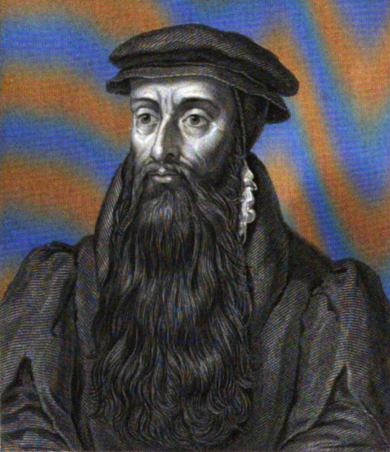
If you’ve read C. S. Lewis’s Pilgrim’s Regress, you’ll know that the Northern Irish Presbyterianism
of his childhood was rather forbidding. Now, pretty much the main founding
father of Scottish Presbyterianism was, of course, John Knox (1513–1572). When
Lewis comes to discuss John Knox in English Literature in the
Sixteenth Century, he gives Knox a very
fair hearing: showing as always his ability to set aside his own preferences
and imagine his way into the minds of writers in the past, even ones with whom
he might not entirely sympathize. Knox is so interesting that I think I shall
need two blogs for him. Let’s start, then, with a list of six little known
facts about Knox.
1. Knox is famous for writing The First Blast of the
Trumpet against the Monstruous Regiment of Women. I hope it’s not a little known fact that monstruous (yes, with a U in the middle) means ‘contrary to the
natural order’ and regiment means
‘the action of ruling over other people’: so it doesn’t mean ‘the huge army of
females’.
Trumpet against the Monstruous Regiment of Women. I hope it’s not a little known fact that monstruous (yes, with a U in the middle) means ‘contrary to the
natural order’ and regiment means
‘the action of ruling over other people’: so it doesn’t mean ‘the huge army of
females’.
2. Did you know that Knox was once a galley slave? On 31
July 1547 a French force captured the castle of St Andrew’s where Knox was
chaplain to the Protestant garrison and he and the defeated Scottish noblemen
were chained to benches in the French galleys and forced to row to France,
where they were imprisoned.
July 1547 a French force captured the castle of St Andrew’s where Knox was
chaplain to the Protestant garrison and he and the defeated Scottish noblemen
were chained to benches in the French galleys and forced to row to France,
where they were imprisoned.
3. Did you know that during Edward VI’s reign (1549–53),
Knox, then in exile in England, engaged in a controversy with Archbishop
Cranmer? Knox and others wanted Holy Communion to be received sitting: they
regarded kneeling as idolatrous. As a result the once (in)famous ‘Black Rubric’
(explaining why kneeling was OK) was added to the Second Prayer Book. Elizabeth
I left it out of her Prayer Book (1559), and debate about what theologians
called the ‘table gesture’ went on throughout the seventeenth century.
4. During Queen Mary’s reign, numerous Protestant leaders
went into exile on the Continent. When John Foxe (of Book of Martyrs fame) came to Frankfurt in 1554 to serve as preacher
for the English church he found himself unwillingly drawn into an acrimonious
controversy. One faction favoured the Book of Common Prayer, the other
advocated worship similar to that of Calvin’s Genevan church. Did you know that
the latter group, supported by Foxe,
was led by John Knox, while the
former was led by Richard Cox?
Eventually, Cox & co. forced the departure of Knox & Foxe & co.
Really Dr Seuss should have been there!
5. Did you know that Knox wrote his First Blast in Geneva? He spent two and a half very happy years
(1556–9) there, and described it as ‘the most perfect school of Christ that ever was in the
earth since the days of the apostles’.
(1556–9) there, and described it as ‘the most perfect school of Christ that ever was in the
earth since the days of the apostles’.
6. Did you know that Knox was one of the ‘six Johns’ appointed by the
Scottish Parliament in 1560 to draw up a plan for church governance called the First
Book of Discipline? The scheme was to be funded from the revenues confiscated from the old
church, but these were now in the hands of the nobles, and unfortunately they
did not want to give them up, so the new church was drastically underfunded.
Plus ça change…
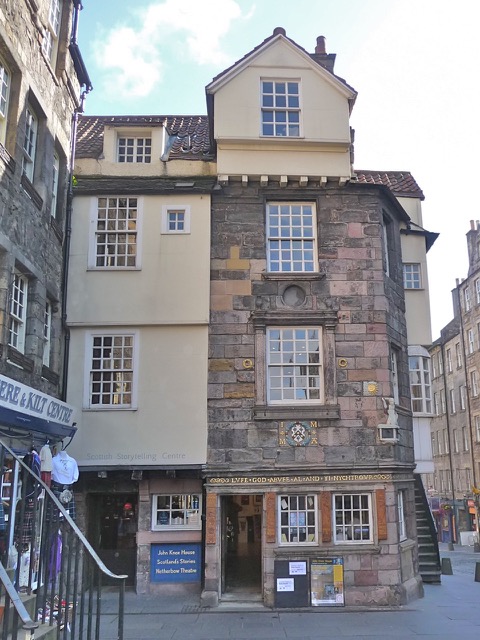
John Knox’s House, Edinburgh
Originally written by Philologus

