|
| Numinous Loth Lorien – (Bracknell Forest, in the common speech) |
The power of the how
This week, I was made aware of the importance of how we say things – tone and style, not only words – by being involved in a discussion about a blog addressing would-be writers.
Then, I heard this: We have lost the numinous… must people deride the spirituality of religion?
I quote from memory, having scribbled down in haste after hearing Radio 3’s morning programme. The speaker, last week’s mid-morning interviewee with Rob Cowen, declared herself someone who had nothing to do with ‘religion’ and expressed the view that in our society, we have passed the point of being religious.
However, she added, we do need ‘the numinous’ and pointed to Buddhism, and the Quakers, where she thought this could still be found. A fairly widely held view.
Her statements interested me. They demonstrate how the words we use and the attitudes as we speak combine to convey an attitude. Use words with enough confidence, putting into what you say your total belief that you are right, and speak for humanity as a whole, and you will carry your audience along.
A thought both humbling and terrifying.
She followed her confidence about the passé nature of ‘religion’ with a pause, then enquired, ‘… must people deride the spirituality of religion?’ The word ‘deride’ was well chosen: it carries her feeling of disappointment that spirituality, as she defines it, has been abandoned along with religion. For her, religion has no spiritual content, it’s merely a tragically misplaced belief in a God. Why can’t we have ‘spirituality’, a kind of vital force, or non-materialistic attitude, and presumably good.
Effectively Communicating ‘God’ to today’s world
Her choices of words, tone and style demonstrate how these three taken together add up to powerful and effective communication. While ‘religion’ carries many negative associations, ‘the numinous’ is mystic, unearthly, seductive. It’s neither irrelevant nor abusive. Additionally, ‘… must people deride…’ uses an unusual construction. It begins with a strong word, ‘must’, which suggests both forcefulness and necessity. The verb, ‘deride’ is both strong and unusual. Next we have ‘spirituality’, which by contrast flowingly suggests a soft, questioning, option to the harder, corner-y end word, ‘religion.’
Recently an American Christian (International Christian Writers Blogspot) blogged about Christian fiction, suggesting that this always includes characters who prayed, and attended church. There were objections: surely it’s okay for Christians to write stories without necessarily including church settings and ‘preachy’ characters?
|
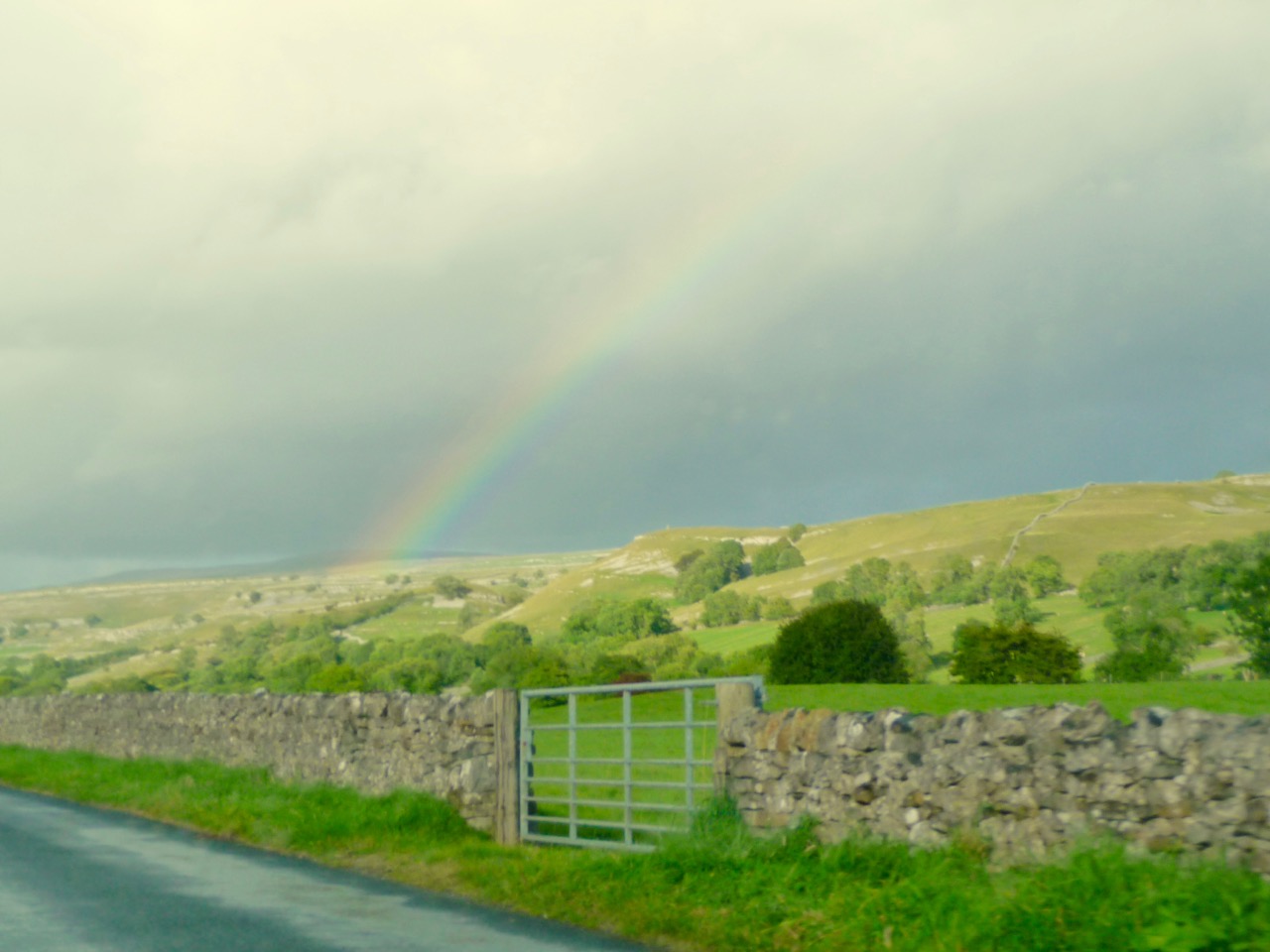
| God’s character (rainbow, entering Wharfedale for Scargill) |
God’s character isn’t defined by acts of worship or lectures on morality. But her point, that what we write should demonstrate God’s character is worth considering. If the tone, style, and choice of words together carry an atmosphere or overall effect then showing God’s character does not mean spelling out religious practice. Indeed, I dare to suggest, God’s character, his mercy and his graciousness, can shine through style and tone, whether we include Bible quotes or allow characters to use the f-word. Or do both. Whether we write crime for the secular market or cross-over fiction.
I was wrong when I condemned, as disrespectful and sneery, a different recent blog which identified ten mistakes made by new writers. I’d skim-read it and recalled other similar ‘advice to the writer’ blogs by writers and editors. I referred to a contemporary teaching style which believes in employing derision, and how it is simply abusive to tell newbie writers they are ‘Mary Sues’ who naively expect to make it big with their first attempts at untutored writing. These ‘Mary Sues’ may be people who just don’t think, not necessarily people ‘who can’t take criticism’ and flee from being edited. I’d recalled how a friend, taking a degree in Fine Art, had experienced her tutor snatching her sketch book and lobbing it across the room. Her drawing was very good: would his style of apparent unbridled rage empower her to break through to more original work? Does being trashed necessarily empower?
My mistake (besides having only skim-read) was to rant against this blog, whose style and tone attempted to use a joky, getting-alongside, slightly wry humour. It didn’t quite work, but it wasn’t the tutor throwing the work at the wall. And, I know that the ebook market does include badly edited, poorly produced books, whose stories have no ‘arc’ and which frankly make me and probably you reach for the editor’s pencil. They’re giving writers a bad name. Their how is how they’re doing this.
Finding the atmosphere, maintaining the spiritual
 |
| wearing your worship hat … |
So, demonstrating God’s character by our tone and style. Think of the way Jesus speaks to the crowds who followed him, who made demands, even the people who arrested and crucified him. Even giving Peter a telling-off, he didn’t deride. Or trash. He taught some very high moral values, but he mixed with people who didn’t have them. Dare I say it, I believe demonstrating God’s character, his mercy and his graciousness, is not dependent on using a religious setting, it isn’t shut out by characters ‘swearing and (using) strong language’. Style and tone are ‘spiritual’: in writing, the writer’s spirit – generous, mean, cynical, hopeful, sarcastic, joyful – is a discernible presence. Honour to God really does inhabit the how of style and tone, not just the vocabulary. Whatever we write, let’s write so that the reader is drawn towards God by the Holy Spirit. (Or, wear your worship hat while you write your 21st century crime mystery …)
Clare Weiner writes fiction as Mari Howard, and paints/occasionally writes poetry, under her ‘own name’. (Actually, all those names are hers …)
Her novels Baby, Baby and The Labyrinth Year, featuring the Mullins family, a mixture of Christian and secular relatives by birth, marriage, adoption, and all manner of interactions, are available from the Hodge Publishing website (paperback) or Amazon p/back or Kindle). Third in the series, Love You to the Moon is the work in progress.
Clare is booked to appear, with other writers, reading at the Hawkesbury Upton LitFest in April.