
How is your word-bank at the start of this new year? Is it brimming with new and original ways to describe and explain? Or is it stuffed with tired expressions that you are bored of thinking about and reluctant to write?
Am I the only one who is annoyed by certain expressions used endlessly? It’s not because the words themselves are irritating. Somebody somewhere thought of using them to describe things in a different way, and the effect was brilliant. But they catch on. And once this happens the word-police are everywhere, using them repeatedly and insisting everyone else does.
The other day I was describing our big new room at the back of the house to someone and how it…”Space!” she corrected me. I looked at her face carefully for any trace of irony. “Sorry?” She smiled, “Space, I believe is the expression now!” No, it isn’t! Space is a gap between things. It’s an unmarked area. It’s a nothing place. A space is vastly different to a room! But she was right of course. The word room is less used these days than the word space. Quite simply space is trendier – the latter a decent word that is considered untrendy these days, more’s the pity ;)
Another one is robust. It’s everywhere. I’ve seen it on adverts, in reports and used to describe political ideas, school policies and recipes. Recipes! I know it’s a satisfying word to say. I’m sure my daughter, who is a linguistics student, could explain why. But, not to put too fine a point on it, if I hear this word cavorted about in 2016 as many times as I did last year, well, I may have to go out into the street-space and…and, scream like a fox, a robust one.
My third irritating phrase is It is what it is, usually accompanied by a shrug or a pout of resignation. Well, no! The fatalism bound up with this particular expression is what rattles me.Things don’t have to be as they are. We can decide we don’t like being part of a system that annoys and stresses us. We can work for change from the inside, or we can leave. Above all, as Christians, we can pray. It is what it is implies that this particular reality is all we have so we need to just get on with it. But I don’t believe that to be the case. We are not at the mercy of circumstances.
Now before you write me off as a grumpy old so-and-so, it does rather fascinate me the way these words and phrases reach common usage. Is it simply that someone in a remote village in Rutland starts using some expression a little differently and, as it spreads, we all catch on? Or do you have to be someone prominent – in the media or politics – to express yourself originally and have everyone catch on and use your expression in every field of life?
I stumbled across a website explaining the origins of some of our favourite expressions. Did you know that “to butter someone up” came from an ancient Indian custom of throwing butterballs at statues of their gods to earn forgiveness and favour? Or “mad as a hatter” – which was not Lewis Carroll’s inspiration after all – comes from 17th century hat makers in France who poisoned people by using mercury for the hat felt. Common symptoms of “Mad Hatter’s Disease” included shyness, irritability and physical tremors. Then there’s the expression “bury the hatchet” which dates from the arrival of the Puritans in North America when their conflicts with the natives were officially resolved by a literal burying of their weapons. All this implies there can be a lasting link, in society, between behaviour and language.
So let’s start a little experiment. Here are some words and phrases I’ve thought of. Let’s see if we can get them to spread a bit…
1. Flimsy, as in “That’s a flimsy system of assessment!” meaning adaptable/flexible/easily understood (opposite of “robust”)
2. Pass, as in “Our pass has room for shoes, hats and coats” meaning a corridor/hall area that you only pass through (opposite of “space”)
3. D for Down, accompanied by the index fingers of both hands pointing to the ground, as in “That’s D for Down!” It won’t last/it’s going to change/this can’t continue (opposite of “It is what it is”)
Sayings for the future?
4. Throw the mouse at the screen, as in “If you don’t let her lead it, she’ll throw her mouse at the screen” originally used in the 21st century to describe people who can’t sit still during computer downloads.
5. B.H. rubbish-happy, as in “I know it’s a bit mean but I’m B.H. rubbish-happy about her dismissal!” First used in the 21st century to describe a certain smugness when the neighbours put their rubbish out, after a Bank Holiday, on the wrong day. To show pleasure in another’s misfortune.
6. A churcher, as in “What do you mean I don’t owe you anything? Is this a churcher?” Originating in the 21st century practice of many members of churches sharing their homes and food with refugees.
Can you think of some? Could we, as Christian writers, both by our words and our behaviour, shape the language of tomorrow? Are we robust enough? Aaaaargh!
Deborah Jenkins is a primary school teacher and freelance writer who has written articles, devotional notes and short stories. She has recently completed a novella, The Evenness of Things, available as an Amazon e-book and is currently working on a full length novel.. Deborah loves hats, trees and small children. After years overseas with her family, who are now grown up, she lives in south-west London with her husband, a Baptist minister, and a cat called Oliver.
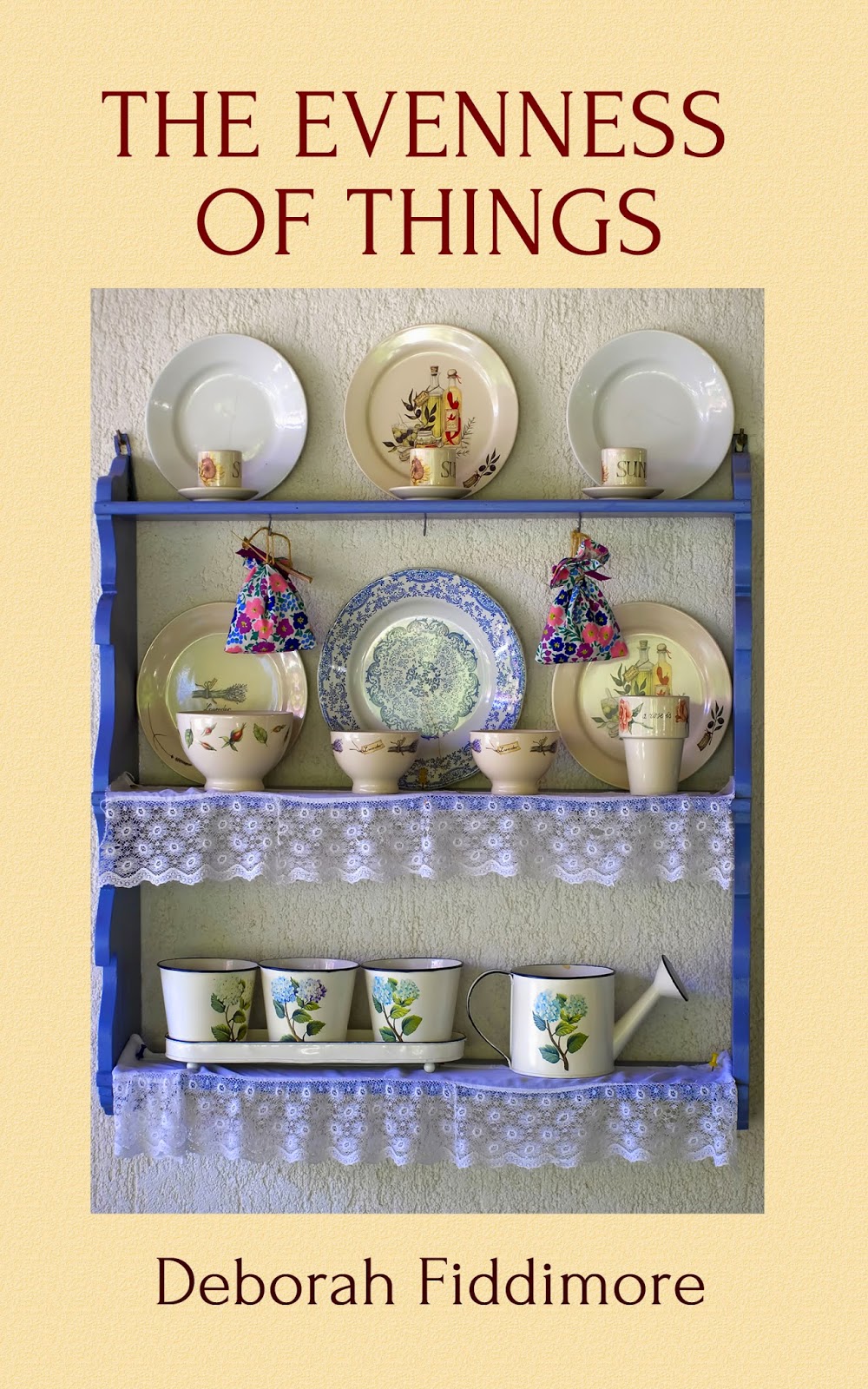
Click on the link to see the book.
.

