
I need to begin my first ACW blog post with an apology, which isn’t a great start but it has been weighing on me. At the writers’ day in Bath last year a lady asked if my short story collection was suitable for 11 year olds and I blithely assured her it was.
Well …
Perhaps I meant I would have been happy to read it as an 11 year old, and it contained nothing any 11 year old doesn’t already know. One story however features an exceptionally unpleasant character whose choice of words under stress is not pleasant. I imagine that is the one that caused the offence, and complaining phone calls to the ACW president. So, to that lady, I apologise; I should have thought my response through more carefully.
Appropriate language can be a knotty topic for a writer. Nothing kills a story more quickly than dialogue that just does not sound authentic, but we also want to be faithful witnesses as Christians.
Recently a piece of e-reader software called Clean Reader raised a few eyebrows. (See Charles Stross at www.antipope.org/charlie/blog-static/2015/03/an-exercise-in-futility.html – but, caution, contains rude words). In short, Clean Reader does a quick find-and-replace on contentious words in a downloaded book so that nothing offensive should appear to the reader. Quite apart from some very odd replacement choices – for example, a whole plethora of body parts replaced with “bottom”, which really doesn’t help – it raises questions of artistic integrity. Others may disagree, but I would say it’s like putting clothes on a Titian nude. It kind of misses the point.
There is an interesting piece on Biblical profanity at www.relevantmagazine.com/life/what-bleep-does-bible-say-about-profanity. I didn’t know that when Paul writes in Philippians 3:8 that he considers everything he has lost for the sake of Jesus to be garbage, just say “garbage” was not the first meaning of the Greek word he uses.
And it is Paul, I think, who provides the best pointer on this topic. Everything is permissible, says Paul in 1 Corinthians 10:23 – but not everything is useful.
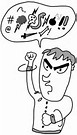
A character like my swearer has zero self knowledge or self control, and self control is one of the fruits of the Holy Spirit. If your swearing comes from lack of self control then that tells you that a lot that you need to know about a fictional character. If however you know exactly what you’re doing, then it becomes words, nothing more. An expulsion of air, squiggles of ink on paper or pixels on screen. So perhaps the thing to consider is: are you just being squeamish? Are you being gratuitous?
What is the take-home impression left by your writing?
And when someone else asks about your writing’s suitability, try to think where they’re coming from.

